
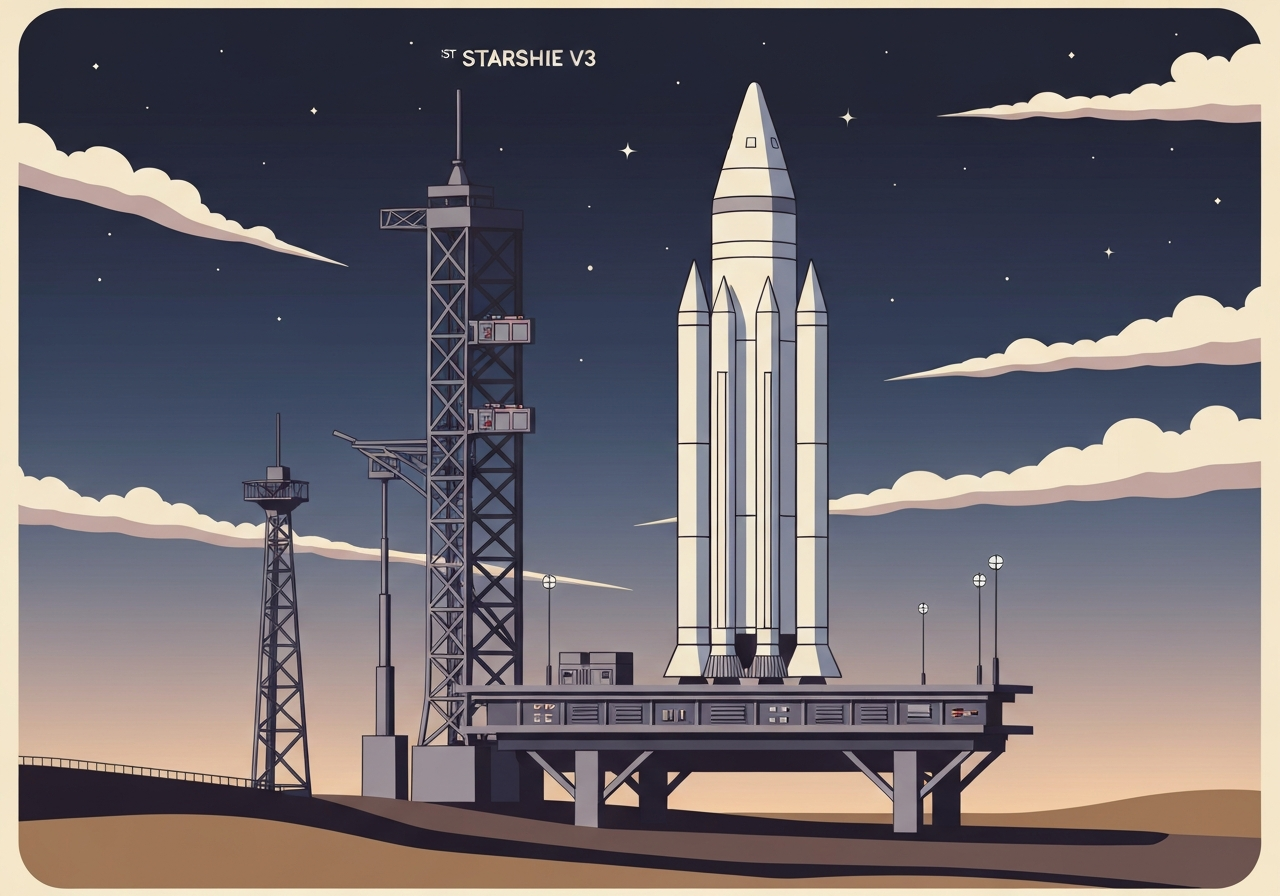
Lead: SpaceX scrubbed the May 21 launch attempt of its first Starship Version 3 (V3) megarocket at Starbase, Texas, due to a technical issue late in the countdown. The company said it expects to try again no earlier than Friday, May 22, with a planned window opening at 6:30 p.m. EDT (2230 GMT) and a webcast starting about 45 minutes earlier. Flight 12 is the 12th Starship test since 2023, the first of 2026 and the first V3 flight after a seven-month gap following the October 2025 mission. SpaceX and mission commentators emphasized this is a learning flight for new systems and a critical step toward operational and Artemis-related goals.
Key Takeaways
- Launch scrubbed: SpaceX called off the May 21 liftoff in the final minute before T‑0, citing a technical hold; a retry is targeted no earlier than May 22 at 6:30 p.m. EDT (2230 GMT) with a 90‑minute window closing at 8:00 p.m. EDT (0000 GMT).
- Webcast timing: Live coverage is scheduled to begin roughly 45 minutes before liftoff, at 5:45 p.m. EDT (2145 GMT) for the May 22 attempt.
- Vehicle and mission: Flight 12 will fly Ship 39 atop Super Heavy Booster 19 from Pad 2 at Starbase; the flight is suborbital and is expected to last about an hour with splashdowns planned at sea for both stages.
- Payload and loadout: The vehicle was being fuelled with liquid methane and liquid oxygen; SpaceX commentary referenced carrying the heaviest payload yet for Starship and noted either 20 or 22 dummy Starlink satellites in public comments (see Unconfirmed).
- Firsts and cadence: This is the debut launch of Starship V3, the 12th Starship test since 2023 and the first flight since October 2025 after a seven‑month pause.
- Pad and operations: Pad 2 hosted the first-ever V3 wet dress rehearsal and SpaceX said propellant loading on Pad 2 ran about 20% faster than Pad 1 in live commentary.
- Engines and size: The system stands about 408 feet tall; Super Heavy is powered by 33 Raptor engines on this configuration.
Background
SpaceX has iterated its Starship stack through several prototype cycles since 2020, with Flight 12 marking the introduction of the Version 3 design. V3 represents an evolutionary set of changes intended to move the system toward operational missions: higher reliability, changes to ground interfaces and integration with newly built Pad 2 at Starbase. The company reported a busy 2025 with five test launches; the program then paused in October 2025 while SpaceX assessed upgrades and integrated the new V3 hardware.
Starship is central to multiple SpaceX ambitions: fully reusable heavy lift for Starlink and commercial customers, a proposed lunar lander for NASA’s Artemis program, and human missions to Mars. The V3 upgrades are presented by SpaceX as steps to meet those requirements, but any new architecture brings fresh interface and ground‑system risks that must be validated in flight. Local stakeholders and federal regulators have tightened range and environmental procedures since earlier Starship operations, which adds procedural steps to each launch campaign.
Main Event
On May 21 SpaceX progressed through pad operations and began propellant loading for the Flight 12 attempt, conducting a wet dress rehearsal the day before and stacking Ship 39 on Booster 19 at Pad 2. Final tanking was under way; live commentary reported that upper‑level winds earlier had delayed the target time before conditions improved. At roughly T‑40 seconds the countdown entered a hold and subsequently a last‑minute scrub was announced when the team logged a technical anomaly in the final phase of the countdown.
SpaceX spokesperson and pad commentator Dan Huot told viewers the scrub related to a hardware or ground‑system response that tripped an automated hold (he referenced a water diverter as part of the hold sequence in live remarks). Huot emphasized the value of the checklist and that the team would analyze telemetry overnight to determine whether troubleshooting or a simple restart is required. SpaceX stated publicly that a second attempt is expected no earlier than May 22, keeping the original 6:30 p.m. EDT (2230 GMT) opening of the 90‑minute window.
The planned Flight 12 profile will send Ship 39 on a suborbital trajectory, with a targeted splashdown about 65 minutes after liftoff in the Indian Ocean off Western Australia; the Super Heavy booster is expected to perform a controlled splashdown in the Gulf of Mexico about seven minutes after launch. Neither stage will attempt a return to the pad this flight; recovery-to-pad and Mechazilla capture remain objectives for later flights once V3 performance is proven.
Analysis & Implications
Operationally, the scrub highlights the risk profile of introducing a new vehicle variant. Ground systems and automated safing logic are designed to prevent a marginal or unsafe launch, and a late hold typically points to sensor, plumbing or ground‑support anomalies rather than a fundamental design failure of the vehicle. SpaceX’s public posture — calling the hold a learning moment for new systems — is consistent with iterative flight test programs that emphasize data collection over immediate success.
Programmatically, a successful V3 debut matters for SpaceX’s roadmap: NASA’s Artemis architecture is contingent on a proven Starship variant to serve as a lunar lander candidate, and commercial plans for Starlink mass deployments and orbital infrastructure rely on a reliable heavy‑lift workhorse. Any further delay shrinks the margin for NASA mission certification timelines and for commercial launch cadence projections.
Economically, repeated delays can raise short‑term costs and schedule risk for customers, but a careful first flight that captures comprehensive telemetry may reduce long‑term risk. Internationally, demonstrated progress or setbacks influence competitors and partners: a clean V3 flight could accelerate agreements for payload launches, while a visible anomaly could invite additional regulatory scrutiny and schedule reviews by national agencies involved in range safety.
Comparison & Data
| Metric | Starship V3 / Flight 12 |
|---|---|
| Stack height | ~408 feet |
| Super Heavy engines | 33 Raptor engines |
| Launch window | 90 minutes (6:30–8:00 p.m. EDT / 2230–0000 GMT) |
| Flight number | Flight 12 (12th Starship test since 2023) |
| Last Starship flight | October 2025 (seven‑month gap) |
This table summarizes the core technical and schedule facts for Flight 12. V3’s designated improvements focus on ground‑station changes, faster propellant operations on Pad 2 (SpaceX said ~20% faster fueling compared with Pad 1), and other integration modifications; the table does not list all internal changes but captures the externally verifiable numbers discussed during live coverage.
Reactions & Quotes
“New rocket, new pad, we’re learning a lot about these new systems as we execute them for the first time. We are expecting to be able to make another flight attempt tomorrow.”
Dan Huot, SpaceX live commentary (company representative)
“This is historic. This is a major moment, y’all.”
Nicki Minaj (attendee at Starbase)
“It’s going to be a fly by mission of Mars… let’s get it started with a flyby.”
Chun Wang (private mission announcement, recorded message)
Context: Huot framed the scrub as a procedural hit that allows the team to diagnose data before another attempt; public figures present on site expressed excitement but did not provide technical details. A separate recorded announcement from private mission participant Chun Wang referenced a planned Mars flyby mission using Starship hardware, a programmatic detail SpaceX has not publicly scheduled for Flight 12.
Unconfirmed
- Exact payload count: live commentary referenced both 20 and 22 dummy Starlink satellites in different remarks; official mission documentation should be consulted for the definitive manifest.
- Root cause of scrub: SpaceX cited a technical issue and an automated hold but had not released a detailed anomaly report as of the last update.
- Details of the announced private Mars flyby: the surprise announcement naming a private commander and a Mars flyby has not been corroborated by a formal mission manifest from SpaceX or public regulatory filings.
Bottom Line
SpaceX’s last‑minute scrub of the first Starship V3 flight test is a setback in schedule but consistent with an iterative test program that prioritizes safety and data collection. A quick, well‑documented recovery and a successful May 22 attempt would reestablish momentum for the program while preserving the rigorous telemetry that informs later operational steps.
Observers should watch the post‑scrub updates for a technical readout from SpaceX on the hold trigger and for an official mission manifest clarifying the payload count and any passenger or secondary mission announcements. The V3 debut is consequential for NASA, commercial customers and SpaceX’s timeline for reusable heavy lift — success will lower technical and programmatic risk; further anomalies would lengthen the path to routine operations.
Sources
- Space.com live updates (news coverage — original live update feed)
- SpaceX Mission and Live Webcast page (official webcast and mission page)