
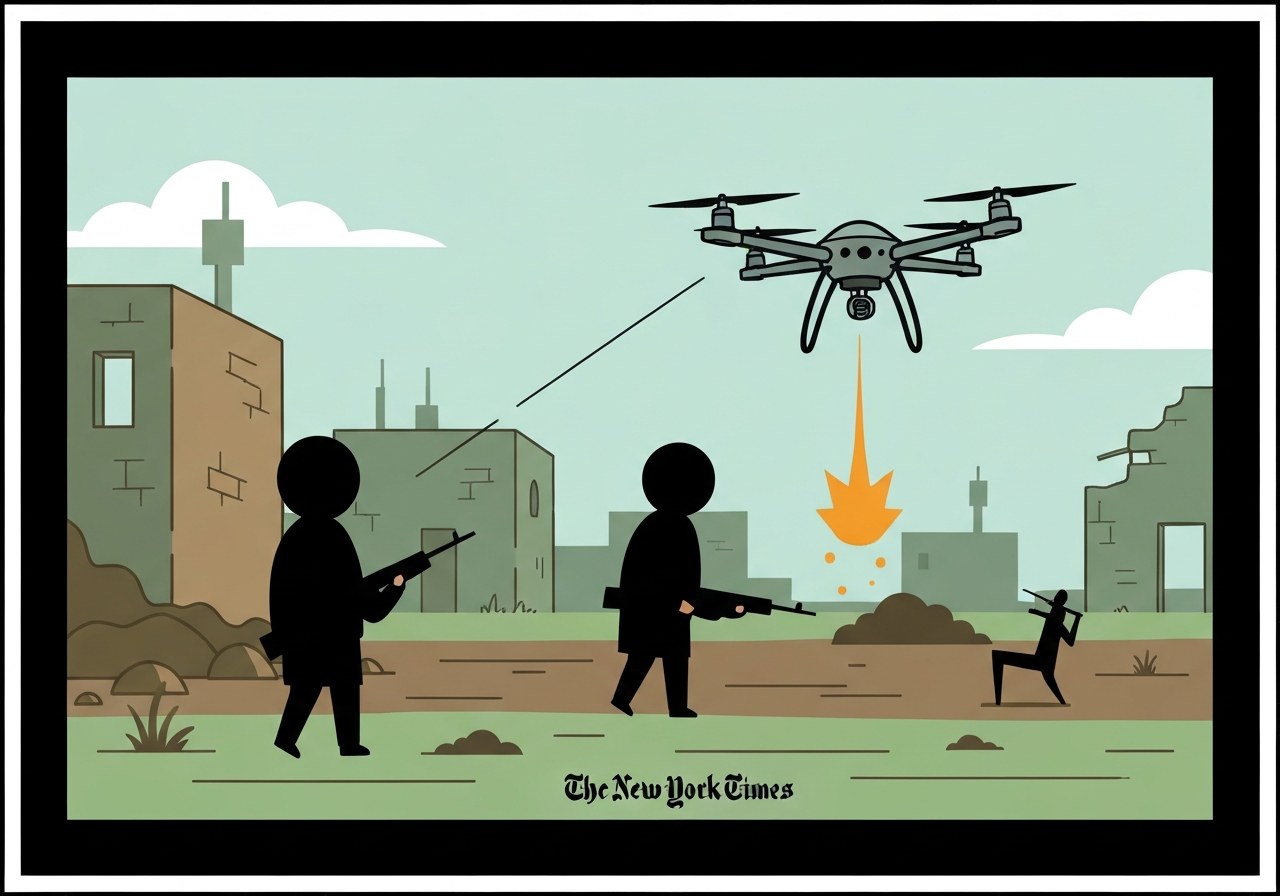
Lead: On March 25, 2026, U.S. Central Command published before-and-after imagery of a facility west of Isfahan that it said was producing Shahed attack drones and that was later struck, promising a blow to Iran’s drone supply. The administration framed the images as evidence that the campaign could degrade Tehran’s capacity to strike Gulf states and obstruct shipping through the Strait of Hormuz. Experts caution, however, that the drones implicated are inexpensive, assembled from widely available components, and can be produced in dispersed workshops, making total disruption difficult. The strike represents a tactical win but leaves open whether wider drone production can be halted.
Key Takeaways
- On March 25, 2026, U.S. Central Command released black-and-white before-and-after photos of a complex west of Isfahan it said manufactured Shahed drones.
- The targeted site lay near Isfahan University of Technology and was described by U.S. officials as severely damaged after the strike.
- Shahed attack drones are low-cost systems built from off-the-shelf parts, including motorcycle engines and 3-D–printed elements, complicating supply-chain interdiction.
- Analysts at the Stimson Center and CSIS warned that dispersed, small-scale workshops make production hard to track and easy to replicate if demand persists.
- Stopping Iran’s drone output is considered by some U.S. and Gulf officials as a necessary step to ensure safe transit through the Strait of Hormuz and to protect regional energy and population centers.
- Officials presented the strike as “another major blow” to Iran’s defense industrial base, but acknowledged local strikes may not eliminate decentralized manufacturing.
Background
Since hostilities intensified in the region, Tehran’s use of Shahed-class drones has become a central concern for Gulf states and maritime traffic through the Strait of Hormuz. These attacks have targeted both energy infrastructure and population centers, prompting coalition partners to press for measures that would secure shipping lanes and deter further strikes. The United States has conducted operations it says are aimed at degrading Iran’s ability to wage drone attacks and to reassure allies reliant on Gulf oil exports.
Shahed drones are notable for their simple designs and reliance on commercially available components, which lowers production costs and allows assembly outside major industrial facilities. Past strikes against larger, centralized sites have had measurable effects, but analysts point to the ease with which small workshops can replicate designs and tools. The decentralization of production complicates both intelligence collection and kinetic disruption; identifying every workshop requires far more granular tracing of parts and networks than targeting a single factory.
Main Event
U.S. Central Command released a pair of images last week showing a modest factory on a tree-lined road west of Isfahan and the same location in ruins after a strike. Officials characterized the action as directed at a site contributing to Iran’s drone output and framed the images as proof of operational progress. The facility, according to the released material, was heavily damaged with collapsed structures and debris fields replacing intact buildings.
In public statements accompanying the imagery, U.S. spokespeople called the operation “another major blow” to Tehran’s defense-industrial capacity and presented it as part of an effort to protect Gulf partners. Gulf governments have reported repeated drone strikes on infrastructure and population centers, and the United States has signaled a commitment to interrupting the flow of these weapons toward the Gulf. Still, officials did not claim that the action would end production writ large.
On-the-record experts emphasized the limits of single-site strikes against a weapon system that can be assembled from common parts. Maximilian Bremer of the Stimson Center noted that when components and fabrication techniques are widely accessible, pinpointing and sustaining interdiction is harder. Yasir Atalan of the CSIS Futures Lab warned bluntly that, if the conflict continues, Iran is likely to scale production across more locations to meet demand.
Analysis & Implications
The strike demonstrates an intent to target supply chains supporting the drone campaign, but it also highlights a structural problem in countering weapons made from commercial components. When a weapons design can be built with sheet metal, off-the-shelf engines, and 3-D-printed parts, the threshold for entry falls and manufacturing becomes geographically diffuse. Intelligence efforts therefore must expand beyond signatures of large factories to include smaller workshops, parts brokers, and the international movement of components.
Operationally, the persistence of cheap drones poses both tactical and strategic dilemmas. Tactically, defending against numerically large, low-cost drones strains missile inventories and air defenses optimized for higher-end threats. Strategically, the continued use of drones to menace shipping and infrastructure raises the risk of escalation between state and partner forces and complicates diplomatic efforts to de-escalate hostilities in the Gulf.
Economically, attacks on energy infrastructure and threats to shipping can raise insurance costs, reroute tankers, and temporarily disrupt supply chains for oil and gas—effects that ripple through world markets. Politically, Gulf states will press partners for reliable protection or interdiction measures, and the United States will face pressure to demonstrate both capability and restraint to avoid a wider conflict.
Comparison & Data
| Item | Characteristic |
|---|---|
| Reported strike date | March 2026 |
| Target location | Facility west of Isfahan (near Isfahan University of Technology) |
| Weapon type | Shahed-series attack drones (low-cost, commercial parts) |
| U.S. claim | Significant damage to production site; described as a blow to defense industry |
The table distills the concrete elements released by U.S. Central Command and media reporting. It underlines that while a specific facility was struck, the defining problem for interdiction is not a single large plant but a dispersed manufacturing model that is harder to eradicate.
Reactions & Quotes
U.S. officials framed the imagery as evidence of pressure on Iran’s ability to produce attack drones, presenting the strike as part of a broader effort to protect Gulf partners and shipping.
“If it’s relatively easy to do, to bend aluminum, to 3-D print, a basic motorcycle engine, then it’s harder to track where it’s coming from.”
Maximilian Bremer, Stimson Center (former U.S. Air Force official)
Bremer’s comment was cited to explain why decentralized production undermines classic targeting strategies. Analysts argue that when fabrication methods and components are common, intelligence must pivot to networks and supply chains rather than only facilities.
“Iran will be able to produce more if this war continues.”
Yasir Atalan, CSIS Futures Lab
Atalan’s remark underscores a core worry among analysts: persistent demand and a secure domestic supply base incentivize scale-up of production, even after some facilities are struck. Gulf governments responded to the imagery by reiterating calls for stronger protections for maritime and energy assets.
Unconfirmed
- Whether the struck Isfahan-site was the primary source of all Shahed drones used against Gulf targets remains unconfirmed.
- No public, independently verified estimate of overall Iranian drone production capacity before or after the strike has been released.
- The extent to which components for these drones rely on foreign-sourced parts versus domestically produced items is not fully established in public reporting.
Bottom Line
The March 2026 strike near Isfahan demonstrates the U.S. capability to identify and strike production sites tied to Iran’s drone effort, and it serves a diplomatic signal to Gulf partners. Yet it does not resolve the fundamental challenge: inexpensive, easy-to-produce drones can be replicated in small workshops, so eliminating a single site is unlikely to halt attacks entirely.
Policymakers face a choice between scaling intelligence and interdiction efforts aimed at supply chains and networks, investing in regional air defenses and ship protections, or pursuing diplomatic measures to reduce demand for these weapons. For Gulf states and global markets dependent on secure shipping through the Strait of Hormuz, the immediate outlook remains fragile unless production and deployment patterns change substantially.
Sources
- The New York Times — media reporting with on-the-record quotes and imagery (March 25, 2026)
- Stimson Center — think tank; expert affiliation for Maximilian Bremer
- Center for Strategic and International Studies (CSIS) — think tank; expert affiliation for Yasir Atalan