
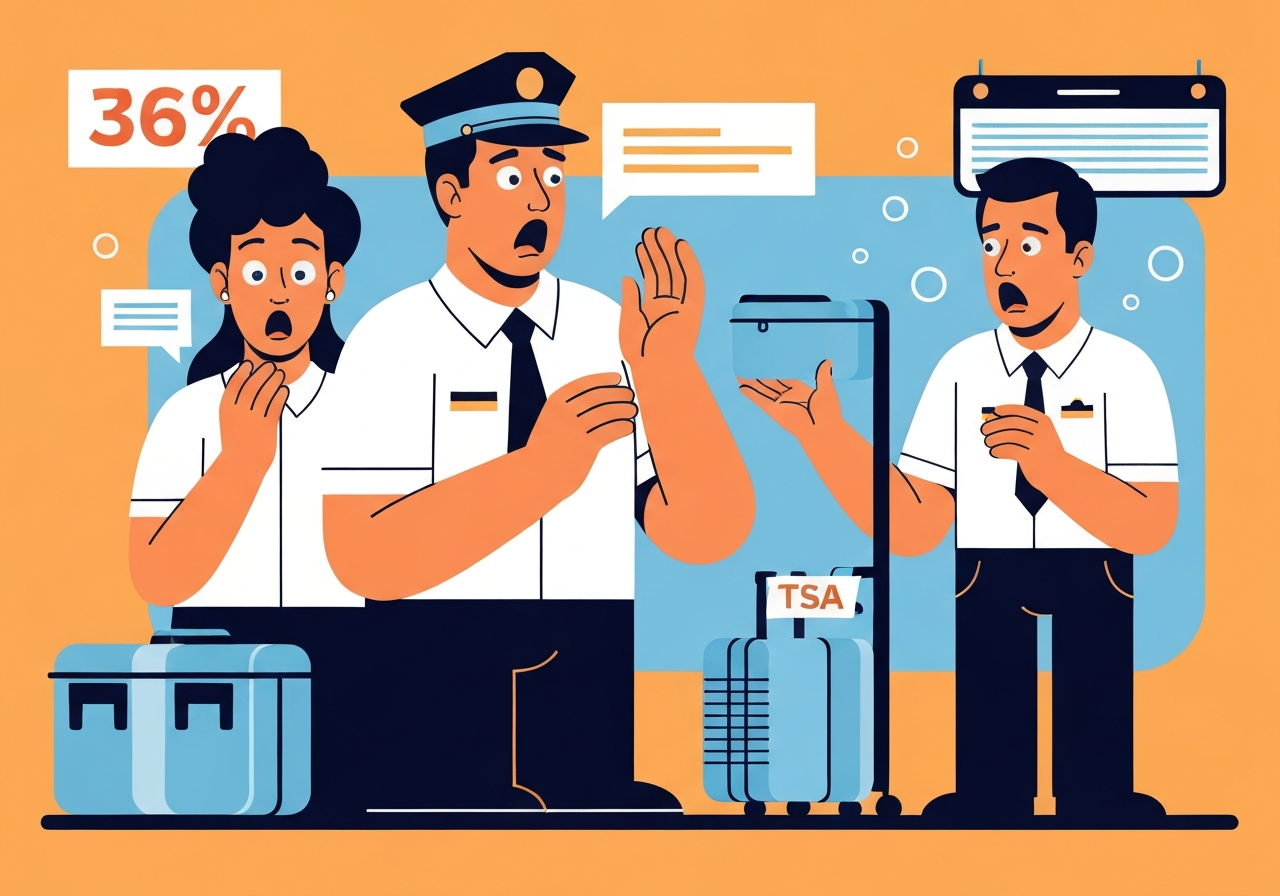
— Travelers at George Bush Intercontinental Airport in Houston faced unusually long security lines after 36% of Transportation Security Administration officers called out of work amid a partial federal government shutdown that suspended pay. Passengers described hours-long waits that stretched through terminals and underground concourses; several missed flights and some slept in the airport. Lawmakers and officials are negotiating funding for the Department of Homeland Security as airlines and passengers felt immediate ripple effects.
Key Takeaways
- 36% of TSA officers at Houston’s George Bush Intercontinental Airport called out on Wednesday, producing multi-hour security lines and delays.
- The staffing shortfall followed a partial government shutdown that temporarily froze paychecks for many Homeland Security employees.
- Some passengers reported waiting between 6 and 8 hours; one traveler, Nay Dedrick of Boston, said she missed a flight and slept overnight at the airport.
- Former U.S. Attorney General Bill Barr was observed waiting roughly two hours in the security queue.
- The Trump administration redeployed ICE and other Homeland Security personnel to assist at 14 airports experiencing overcrowded checkpoints.
- Senate Republicans proposed funding most of DHS but excluding ICE’s deportation division; Democrats insist on reforms to immigration enforcement—negotiations remain unresolved.
- United Airlines CEO Scott Kirby said higher fuel costs tied to the Iran war have prompted a roughly 5% cut in summer flights and recent fare increases of about 15–20%.
Background
The immediate trigger for the lines was a partial lapse in appropriations that affected the Department of Homeland Security, which oversees the TSA. With paychecks paused for some employees, the agency reported elevated callout rates at several airports; Houston experienced one of the most acute impacts, with more than a third of officers absent. Historically, staffing disruptions at security checkpoints have translated directly into cascading flight delays and missed connections, particularly at large hub airports like IAH.
Political negotiations center on a Republican proposal to fund most DHS functions while omitting funding for ICE’s deportation operations; Democrats have refused to accept that framework without fresh limits on immigration enforcement. The stalemate has prompted extraordinary short-term measures, including the temporary reassignment of DHS personnel to airport checkpoints. Airlines and airport operators say the operational strain compounds other cost pressures, including rising jet fuel prices linked to geopolitical tensions in the Middle East.
Main Event
On Wednesday morning, security lines at Houston’s terminals extended through underground corridors and outside checkpoints as TSA staffing fell well below normal levels. Passengers posted images and accounts of serpentine queues; airport staff worked to reroute travelers and open additional lanes where possible. Among those in line that morning was former U.S. Attorney General Bill Barr, who reportedly waited about two hours before clearing security.
Several travelers told local reporters they spent the better part of a day trying to get through security. Nay Dedrick of Boston said she waited “6 to 8 hours” on Monday, missed her flight, slept overnight at the airport and returned to try again the next day. Attributions from passengers to the federal budget impasse were common; many voiced sympathy for TSA officers who continued to report for duty despite unpaid status.
In response to mounting local pressures, the Department of Homeland Security temporarily assigned ICE officers and other agency personnel to assist at 14 airports nationwide with checkpoint congestion. DHS officials framed that as a contingency to keep lines moving while lawmakers seek a funding resolution. Airlines reported that persistent security delays were adding to the operational challenges they face this spring.
Analysis & Implications
The staffing disruption in Houston illustrates how federal funding gaps translate into immediate, visible service failures. TSA is a frontline agency where absenteeism produces real-time bottlenecks that cascade into missed flights, crew duty-time issues and gate crowding. For major hubs, even small percentage shifts in workforce availability can create outsized delays because passenger throughput relies on steady staffing and lane availability.
Politically, the episode raises pressure on congressional leaders to resolve DHS funding quickly. Republicans’ offer to exclude ICE’s deportation unit from an interim funding bill is a clear bargaining position; Democrats’ push for immigration-enforcement reforms keeps a full agreement out of reach. If negotiations continue to stall, airports and carriers may see repeated episodes like Houston, eroding traveler confidence during peak travel seasons.
Economically, airlines face a two-front squeeze: operational disruption from checkpoint congestion and higher fuel prices tied to global tensions. United Airlines’ indication of roughly 5% flight reductions for the summer timetable and fare increases of 15–20% in the prior month reflect cost management steps that will directly affect travelers. Delivering a durable funding fix would remove one layer of uncertainty, but broader cost drivers—fuel, labor, and demand shifts—remain in play.
Comparison & Data
| Metric | Reported Value |
|---|---|
| IAH TSA officer callout rate (reported) | 36% |
| Airports receiving DHS supplemental staff | 14 airports |
| United Airlines planned summer flight reduction | ~5% |
| Recent airfare increase (United estimate) | ~15–20% |
Those figures come from on-site reporting and statements from airline and government officials. The 36% callout rate is specific to George Bush Intercontinental on the reported day; the number of airports receiving DHS assistance and United’s operational guidance provide context for the broader transportation impact.
Reactions & Quotes
Officials and stakeholders voiced frustration and urgency about the operational and political dimensions of the problem.
“This is insane,” said one traveler describing the prolonged security queue in Houston.
Passenger account reported to CBS News
“It’s unconscionable that our politicians haven’t gotten this done…kudos to the security agents for still showing up,” Scott Kirby said, urging lawmakers to reach a deal quickly.
Scott Kirby, United Airlines CEO (corporate statement to media)
“We need strong, strong reforms, and we need to rein in ICE,” Senate Minority Leader Chuck Schumer said as Democrats pressed for changes tied to funding talks.
Senate Democratic leadership statement
Unconfirmed
- Whether the 36% callout rate was sustained throughout the day or fell as additional staff were reassigned remains unconfirmed by TSA public records at the time of reporting.
- Detailed accounts of the exact duties performed by ICE personnel redeployed to airports—beyond general checkpoint assistance—have not been fully documented publicly.
Bottom Line
The incident at Houston’s airport is a clear, immediate example of how federal funding disputes can produce tangible service breakdowns for travelers. With 36% of TSA officers absent on the reported day, the resulting lines disrupted passenger plans and prompted temporary reallocations of DHS staff to stabilize checkpoints.
Resolving the budget impasse would remove one acute pressure point for airports and carriers, but it will not erase broader industry challenges—rising fuel costs and strong travel demand continue to shape airline schedules and fares. Policymakers face intensified pressure to find a politically acceptable, rapid solution to prevent recurring operational blowups at major hubs.
Sources
- CBS News (national news media report detailing on-site reporting)
- U.S. Department of Homeland Security (federal agency homepage, statements and press releases)
- United Airlines Newsroom (airline corporate statements and operational updates)