
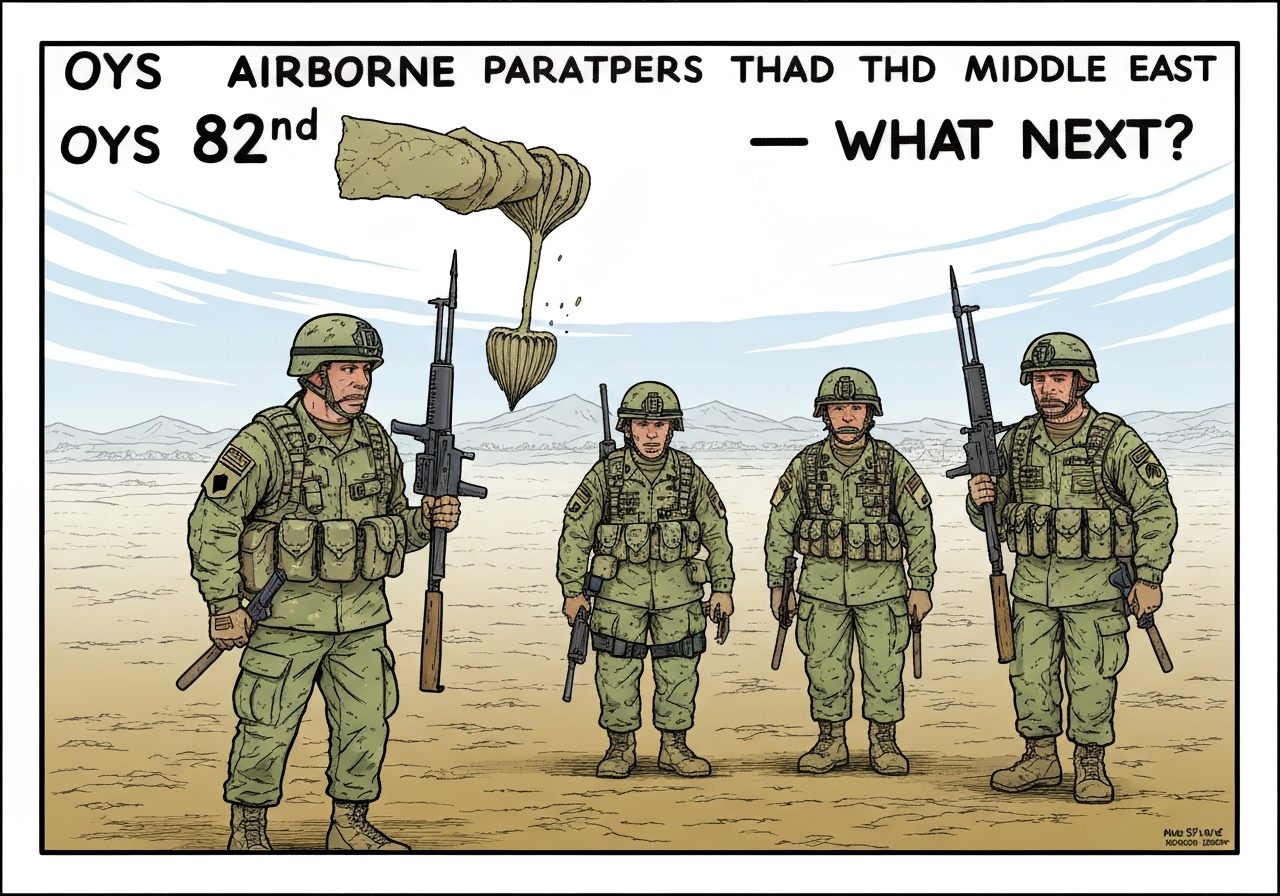
On March 25, 2026, the U.S. ordered roughly 2,000 soldiers from the Army’s 82nd Airborne Division and announced nearly 7,000 additional Army and Marine forces bound for the Middle East, signaling a renewed possibility of ground operations linked to the Iran conflict. The move follows two Marine Expeditionary Unit deployments dispatched on March 13 and March 19 and comes as Tehran rejected a 15‑point U.S. peace proposal on March 25. White House officials framed the buildup as leverage during ongoing diplomacy, while Iranian leaders warned it suggested preparations for a ground campaign. The exact locations and roles of the newly sent ground units have not been publicly confirmed.
Key Takeaways
- The Pentagon ordered about 2,000 paratroopers from the 82nd Airborne Division on March 25, 2026, drawn from the Immediate Response Force that can mobilize within 18 hours.
- Twin Marine Expeditionary Units (MEUs) of roughly 2,200 personnel each left in mid‑March: one on March 13 and a second on March 18–19, expected to reach the region in mid‑April.
- The announced additions bring the surge to nearly 7,000 troops on top of about 50,000 U.S. service members already assigned to the broader conflict zone.
- Administration officials declined to rule out actions such as blockading or occupying Kharg Island, which handles about 90% of Iran’s oil exports.
- Reports vary on Airborne numbers (1,000–2,000), underscoring uncertainty about exact force composition and intended missions.
- The 82nd Airborne is based at Fort Bragg, North Carolina, and is known for forcible‑entry and rapid‑response operations.
Background
The deployments are the latest chapter in an escalating U.S. military posture around Iran following months of indirect and direct strikes, maritime incidents, and intensified rhetoric. U.S. officials say the force posture is meant to deter further Iranian attacks and to provide options for crisis response, including evacuations, strikes, or seizing key locations. Iran has repeatedly denounced the buildup, characterizing it as preparation for more aggressive action, and on March 25 Tehran rejected a 15‑point proposal from U.S. negotiators intended to de‑escalate violence.
Historically, the U.S. has relied on Marine Expeditionary Units for rapid, sea‑based crisis response; an MEU is typically a self‑contained amphibious task force of about 2,200 Marines and sailors sustained for roughly 15 days at sea. The 82nd Airborne functions differently: its brigade combat teams and Immediate Response Force are trained for parachute assaults and rapid forcible entry. Those complementary capabilities—sea‑based and parachute‑borne—expand Washington’s military options in the region.
Main Event
On March 13, the 31st Marine Expeditionary Unit, about 2,200 Marines aboard the USS Tripoli amphibious ready group (including the USS Boxer and USS New Orleans), departed toward the Middle East. A second MEU of roughly 2,200 personnel left Naval Base San Diego on March 18–19 aboard the USS Boxer amphibious ready group (including USS Comstock and USS Portland) and is slated to arrive in the region in mid‑April.
On March 25 the Pentagon directed approximately 2,000 soldiers from the 82nd Airborne Division, including elements of its 1st Brigade Combat Team, to deploy to the Middle East. Media reports indicate those troops are drawn from the division’s Immediate Response Force; official briefings emphasized speed and readiness rather than a defined mission set. The specific staging areas and mission assignments for the paratroopers were not disclosed.
The White House framed the deployments as a pressure tactic while diplomatic channels remain open. Press Secretary Karoline Leavitt told reporters on March 25 that the president would not be deterred by criticism and signaled readiness to use overwhelming force if necessary. Iranian officials portrayed the moves as provocative and warned that further escalation could prompt wider conflict, while U.S. military spokespeople described the step as precautionary and aligned with defensive posture and contingency planning.
Analysis & Implications
The combination of MEUs and 82nd Airborne brigades gives the U.S. a broader palette of military options: seaborne forces enable amphibious raids, evacuations and limited landings, while airborne brigades provide rapid inland access and the ability to seize strategic terrain. That duality complicates Iranian planning and raises the political cost of miscalculation by either side. Still, deploying expeditionary ground forces increases the risk of incidents that can trigger wider combat.
Strategically, moving paratroopers to the theater improves Washington’s ability to threaten or secure critical nodes such as Kharg Island, which handles about 90% of Iran’s oil exports; occupation or blockade of that facility would have significant global economic and political repercussions. Officials have not confirmed intentions to interdict energy infrastructure, but public mention of Kharg signals planners are considering options with high leverage and high risk.
Domestically and internationally, the deployment strains diplomatic messaging. President Trump has repeatedly said he is not putting ground troops into harm’s way, yet the addition of nearly 7,000 forces and public language from the White House creates a credibility gap that both supporters and critics will exploit. Allies may welcome a stronger deterrent posture but will also press for clear objectives and legal justification for any expansive ground action.
Comparison & Data
| Unit | Type | Departure Date | Personnel (approx.) |
|---|---|---|---|
| 31st Marine Expeditionary Unit | Amphibious/MEU (USS Tripoli group) | March 13, 2026 | 2,200 |
| 11th Marine Expeditionary Unit | Amphibious/MEU (USS Boxer group) | March 18–19, 2026 | 2,200 |
| 82nd Airborne Division (1st BCT) | Parachute/Immediate Response Force | March 25, 2026 | ~2,000 (reports vary) |
| U.S. forces already in theater | Combined elements | Ongoing | ~50,000 |
The table shows the incremental nature of the buildup: two sea‑based MEUs (each ~2,200) and a rapid‑reaction airborne brigade (~1,000–2,000 reported) augment a sizeable existing force of about 50,000. Public reporting lists the MEUs’ ships—USS Tripoli, USS Boxer, USS New Orleans, USS Comstock, USS Portland—and indicates staggered arrival windows; these timelines matter because they define decision points for political and military leaders during diplomacy.
Reactions & Quotes
White House messaging emphasized deterrence and readiness while offering few operational details.
“The president does not bluff,” White House Press Secretary Karoline Leavitt said, stressing that the administration is prepared to take strong action if necessary.
Karoline Leavitt, White House Press Secretary (official statement)
Iranian officials responded sharply, framing the deployments as evidence of escalation.
“Increasing foreign forces near our borders is a provocative step and will be met with appropriate measures,” an Iranian official said in a statement, signaling resistance to U.S. pressure.
Iranian government spokesperson (official statement)
Military analysts noted operational implications of combining MEUs and airborne brigades.
“MEUs provide sea‑based flexibility while the 82nd brings high‑tempo inland options; together they create more operational choices but also raise the stakes,” said a defense analyst.
Independent defense analyst (expert commentary)
Unconfirmed
- Precise staging areas and operational orders for the 82nd Airborne troops have not been publicly disclosed and remain unverified.
- Reported Airborne personnel numbers vary between roughly 1,000 and 2,000 in early press accounts; the exact figure is not independently confirmed.
- Whether U.S. planners intend to blockade or occupy Kharg Island has not been officially corroborated; senior officials declined to rule the option out.
- Any plans for a sustained ground invasion of Iran have not been confirmed and appear to be speculative based on current public information.
Bottom Line
The March 25 mobilization of the 82nd Airborne alongside two recent Marine Expeditionary Unit deployments significantly expands U.S. operational options in the Iran theater while preserving plausible deniability of offensive intent. The combination of sea‑based amphibious forces and parachute‑capable brigades complicates Tehran’s calculations and strengthens U.S. bargaining leverage in parallel diplomatic efforts. However, the buildup also raises the risk of miscalculation and escalation: moving troops closer to Iran can produce incidents that rapidly broaden the conflict with strategic and economic consequences such as threats to global oil flows.
For observers, the critical near‑term indicators to watch are where the airborne and amphibious forces are staged, whether their posture shifts from deterrence to active seizure or interdiction (especially around Kharg Island), and how allies and regional actors respond diplomatically and militarily. Absent clearer public orders, much of the situation remains a test of political will, crisis management and the limits of coercive diplomacy.
Sources
- USA TODAY — (news reporting and data compilation)
- Reuters — (international news agency)
- U.S. Naval Institute — (naval analysis and reference)
- U.S. Army — (official military site)
- U.S. Marine Corps — (official military site)
- Stars and Stripes — (military newspaper)