
Lead
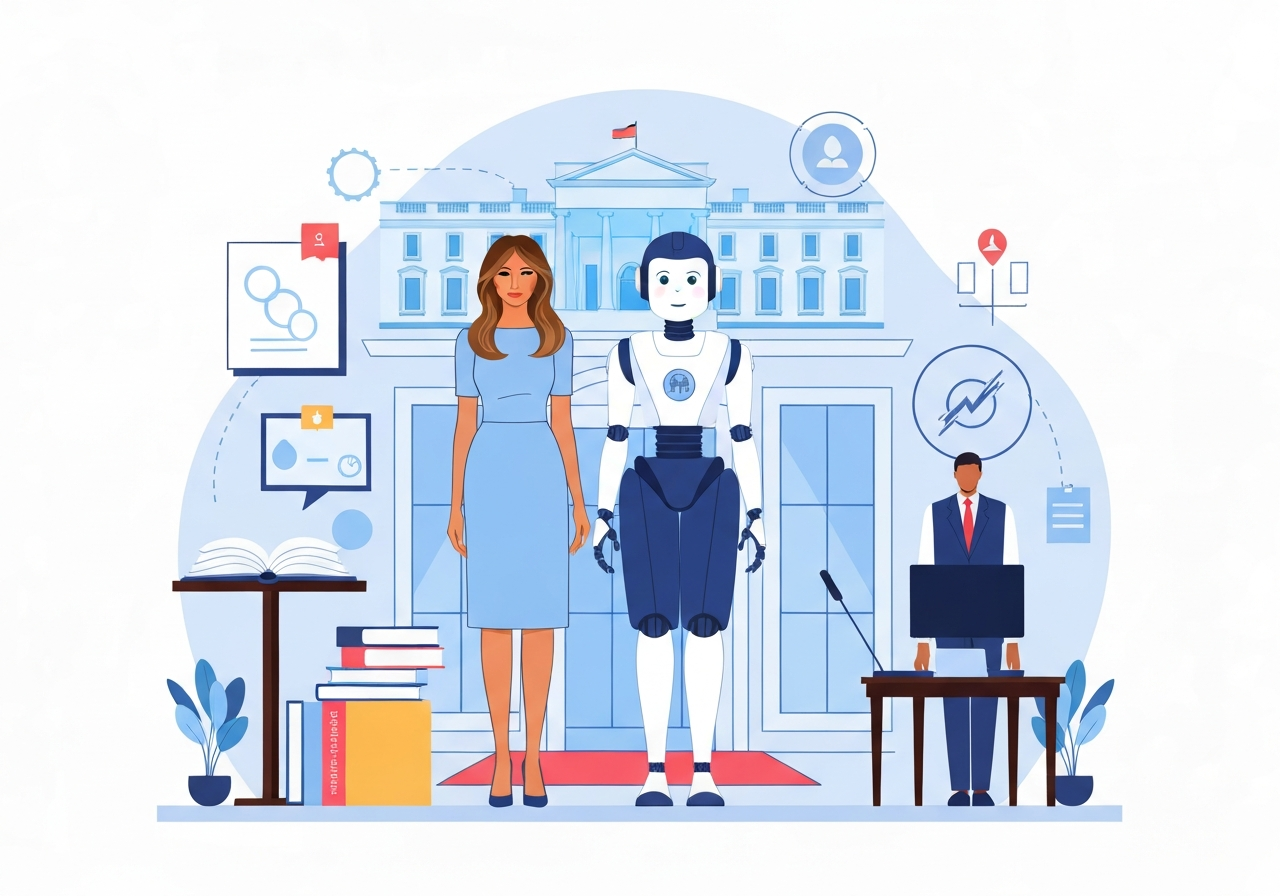
On March 25, 2026, in the White House East Room, former First Lady Melania Trump attended the final day of the Fostering the Future Together global coalition summit accompanied by a humanoid robot. The machine, introduced publicly by startup Figure AI as “Figure 03,” walked the red carpet, scanned the audience and addressed the gathering in multiple languages. The appearance highlighted the summit’s focus on education, innovation and artificial intelligence while drawing immediate media and industry attention. Observers noted both the optics of a robot at a White House event and the policy questions it raises about technology in schools and homes.
Key Takeaways
- Event: The robot accompanied Melania Trump to the White House East Room on March 25, 2026, during the final day of the Fostering the Future Together summit.
- Machine identity: The humanoid identified itself as “Figure 03,” a third-generation model introduced by Figure AI in October 2025.
- Demonstration details: Figure 03 walked alongside the first lady on the red carpet, moved among panelists, scanned the room and spoke in 11 languages before returning down the carpet.
- Company and claim: Figure AI, based in Sunnyvale, California, markets F.03 for household assistance tasks; CEO Brett Adcock posted that he was proud to see the robot at the White House.
- Industry context: The startup competes with established companies such as Boston Dynamics and Tesla, as well as multiple Chinese firms, in developing humanoid robots.
Background
Fostering the Future Together is a global initiative convened to explore ways to empower children through education, innovation and technology. The summit gathered first spouses and education and technology stakeholders to discuss cross-border cooperation on digital skills, equitable access and responsible AI. The presence of a humanoid at the White House underscores how robotics has moved from laboratories and trade shows into public-facing settings and policy conversations. Governments and educators are increasingly debating whether tools like humanoid robots should play instructional, caregiving or domestic roles and under what safety and privacy frameworks.
Figure AI launched its humanoid program amid rising investor and public interest in physically capable robots that resemble human form and movement. The company markets F.03 as a home assistant capable of chores such as laundry, cleaning and dishwashing, positioning it against rivals that emphasize industrial, logistics or research applications. The appearance at a high-profile U.S. venue is both a marketing milestone and a prompt for regulators and buyers to scrutinize claims about usefulness, affordability and safety. International competition is notable: U.S. startups and large firms face parallel efforts in China and elsewhere to commercialize humanoid machines.
Main Event
Melania Trump arrived in the East Room accompanied by Figure 03, which walked slowly beside her along the red carpet from the opposite end of the hallway. The first lady paused at the room entrance while the robot proceeded to circulate among panelists and take a central position for its brief remarks. Cameras tracked the humanoid’s movements as the machine scanned the audience before speaking, an action that became a focal point for on-site reporters.
The robot opened by thanking the first lady and saying it was honored to attend the summit; it then offered greetings in 10 additional languages. After a short address emphasizing technology and education, Figure 03 retraced its steps down the red carpet and exited the room. Melania Trump acknowledged the robot’s participation, calling it her “first American-made humanoid guest in the White House,” a comment that drew applause and social media attention.
Figure AI describes Figure 03 as a third-generation humanoid introduced in October 2025 and intended for domestic help, citing tasks such as laundry and dishwashing in company literature. CEO Brett Adcock posted on social media that he was proud to see F.03 make history as the first humanoid in the White House, a claim his company has amplified in press materials. The startup’s public messaging frames the appearance as both symbolic and practical: a demonstration of how robotics can intersect with education initiatives that emphasize preparing children for technology-driven futures.
Analysis & Implications
The robot’s presence at a U.S. government venue elevates questions about how policymakers will regulate humanoid technologies that operate around people, including children. If humanoids are introduced into schools or homes, policymakers must weigh benefits such as individualized tutoring or household assistance against potential risks to privacy, safety and labor markets. Safety standards, certification processes and clear liability rules will be critical if such devices move beyond demonstrations to regular use in domestic or educational settings.
From an industry perspective, the White House appearance serves as a powerful marketing and legitimacy signal for Figure AI, which competes in a crowded field that includes legacy robotics labs and companies pursuing humanoid designs. Investors, suppliers and partners often respond to such milestones by accelerating funding, distribution talks or pilot programs—but those same stakeholders demand independent validation of performance, reliability and cost. The episode may spur competitors to highlight differences in capability, pricing and intended use cases.
Internationally, the showpiece highlights geopolitical and commercial implications: leadership in humanoid robotics is emerging as one element of broader technological competition between the United States, China and other markets. Access to manufacturing, advanced AI models, sensors and supply chains will influence which companies scale successfully. For educators and school systems, the key question is not only whether humanoids can perform tasks, but whether they improve learning outcomes compared with lower-cost digital tools.
Comparison & Data
| Product | Maker | Notable Date | Primary Use Described |
|---|---|---|---|
| Figure 03 (F.03) | Figure AI (Sunnyvale) | Introduced Oct 2025 | Household assistance; demonstration at White House Mar 25, 2026 |
| Competitor humanoid projects | Boston Dynamics, Tesla, Chinese firms | Ongoing development | Industrial, research, consumer experiments |
The table shows Figure AI’s public timeline and situates the company among broader industry efforts. While Figure 03 has a clear marketing narrative and a recorded White House appearance, many competitor projects are in various stages of testing or limited deployment. Quantitative comparisons—cost per unit, autonomy hours, sensor suites—are largely company-specific and not fully disclosed in public summaries; independent testing will be needed for apples-to-apples assessments.
Reactions & Quotes
Officials and industry figures offered brief public reactions that framed the event as both symbolic and consequential. Reporters noted the unusual image of a humanoid sharing a podium space at a summit devoted to children and technology, and social media amplified clips of the robot’s multilingual greeting.
“Thank you, First Lady Melania Trump, for inviting me to the White House. I am Figure 03,”
Figure 03 (humanoid robot)
The robot’s short address—part scripted introduction, part demonstration—was repeated in several languages and served as the centerpiece of the on-site demonstration. Observers described the moment as choreographed: a designed public interaction intended to showcase naturalistic motion and basic conversational capability.
“It is an honor to see F.03 make history as the first humanoid robot in the White House,”
Brett Adcock (CEO, Figure AI)
Adcock’s social media comment framed the appearance as a milestone for the company and for U.S.-based humanoid development. Industry analysts caution that publicity milestones do not substitute for peer-reviewed performance data or independent safety assessments, but they do influence investor and buyer perceptions.
“It’s fair to state, you are my first American-made humanoid guest in the White House,”
Melania Trump
The first lady’s remark highlighted the domestic provenance claim and underscored the event’s focus on American innovation in education technology. Her comment also served to humanize the encounter and connect the demonstration directly to the summit’s mission.
Unconfirmed
- Whether Figure 03 will be deployed in U.S. schools or in government-funded pilot programs remains unannounced and unconfirmed.
- Public information on the unit price, ongoing maintenance costs and required safety certifications for F.03 is limited; those commercial details have not been verified independently.
- There is no public record yet of government safety testing or federal certification specific to Figure 03’s operation around children; any such approvals have not been confirmed.
Bottom Line
The March 25, 2026 appearance of Figure 03 alongside Melania Trump at the White House turned a technology demonstration into a policy and public-relations event. It spotlights emerging tensions between rapid commercialization of humanoids and the slower development of regulatory standards, particularly where children and educational settings are concerned. Industry players will likely use the publicity to accelerate pilot projects, but broader adoption will hinge on transparent performance data, clear safety rules and affordable pricing models.
For policymakers and educators, the incident should prompt specific questions about testing protocols, privacy protections and measurable educational benefits before humanoids are introduced into classrooms or homes at scale. Observers should watch for follow-up announcements from Figure AI, pilot program proposals, independent evaluations and any regulatory guidance from federal or state agencies as the most reliable indicators of whether such demonstrations translate into practical, responsible deployments.
Sources
- Associated Press (news report)
- Figure AI (company website and literature)
- Brett Adcock social media post (CEO statement on social media)