
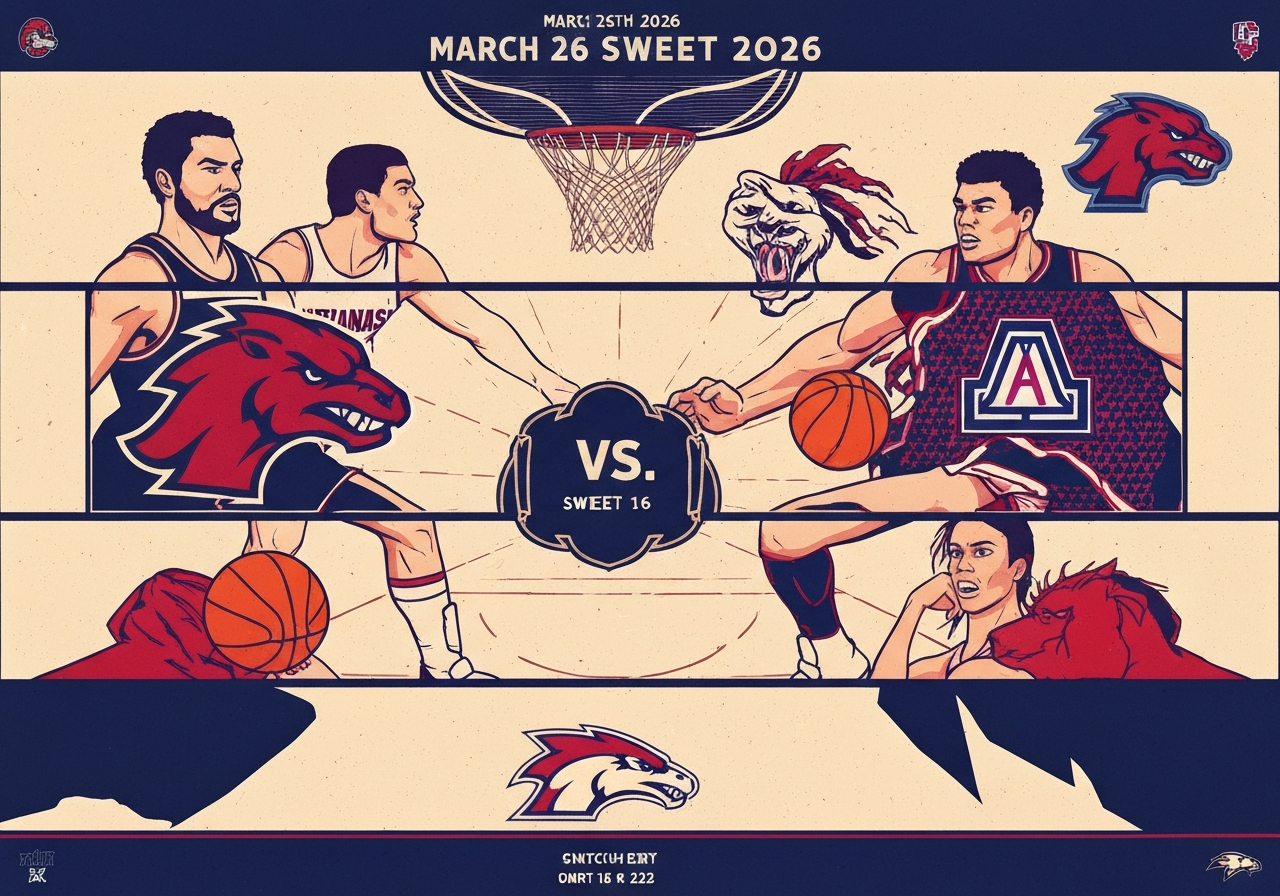
Lead: Arkansas meets Arizona in the NCAA Tournament Sweet 16 on March 26, 2026, in San Jose, California, with tip-off scheduled for 9:45 p.m. ET on CBS. Market pricing shows Arizona as the clear favorite while Arkansas enters as an underdog with questions about depth and rim defense. The matchup pairs Arkansas’s efficient offense and turnover control against Arizona’s physical frontcourt and elite offensive-rebounding. Our betting lean favors Arizona by a double-digit margin, with caveats around last-minute injury and line movement.
Key Takeaways
- Game: Arkansas vs Arizona, Sweet 16 — Thursday, March 26, 2026; tip 9:45 p.m. ET on CBS in San Jose, CA.
- Consensus lines: Arizona listed as the favorite (market around -7.5 to -8.5), moneyline near -375; Arkansas listed +8.5 with ML near +295; totals in the mid-160s (165.5/164.5 reported by different market feeds).
- Edge in rebounds: Arizona offensive-rebound rate ~38%, Arkansas allows offensive-rebound rate ~31% — a major matchup advantage for Arizona.
- Arkansas strengths: 5th-ranked offensive efficiency nationally, best turnover rate (12.2%), 38% 3PT accuracy (top 10), 55% on 2s (approx. 45th).
- Arkansas concerns: Rim defense weak (opponents ~54% on two-point attempts) and limited bench depth if backup big Nick Pringle remains sidelined.
- Arizona profile: physical, foul-drawing bigs (notably a 7-2 presence with high FT rate) and an opportunistic offense that leans on inside play and offensive boards rather than high-volume 3s.
- Tempo and matchup: Arkansas plays a top-20 tempo, Arizona sits mid-pack; matchup favors Arizona’s ability to control transition and exploit Arkansas’s defensive gaps.
- Our betting view: Lean to Arizona covering into the -9 to -10 range (playable to -10.5), while monitoring any late injury news and final line moves.
Background
The Sweet 16 meeting comes after Arkansas survived earlier rounds with an offense that ranks among the nation’s best and a turnover profile that is elite. Arizona reached this stage built on physical interior play and a strong offensive-rebound identity; that second-chance production was decisive in their Round of 32 win where the Wildcats grabbed 22 offensive boards. Both programs have contrasting construction: Arkansas’s spacing and ball security versus Arizona’s toughness and glass dominance.
Coaching narratives and postseason history shape expectations. Arkansas relies on shot creation from guards like Acuff Jr. and Meleek Thomas to offset interior limitations, while Arizona’s frontcourt — including a 7-2 foul-drawing big — creates matchup pressure on smaller rosters. Historical tendencies (coaching performance as underdog and past tournament results) feed bettors’ models and public sentiment entering tipoff.
Main Event
On paper, Arizona’s ability to win the two-point battle and attack offensive boards creates a clear schematic advantage. Arkansas concedes a high opponent two-point shooting percentage (~54%), and Arizona’s size and physicality can convert that weakness into points and extra possessions. If Arizona controls second-chance opportunities, it can mitigate Arkansas’s top-tier offensive efficiency.
Arkansas’s path to staying competitive hinges on flawless offense: low turnover volume, high efficiency inside the arc, and maximal scoring output from Acuff Jr. and Meleek Thomas. Both players are listed as primary shot creators and must produce a combined heavy scoring load — the projection suggests they would need to approach 60+ combined points to create a realistic upset scenario.
Depth and availability are a central storyline. Backup big Nick Pringle missed the prior two games; his availability would expand Arkansas’s rotation to seven players and offer relief for starters Malique Ewin and Trevon Brazile. If Pringle is out, Arkansas risks extended minutes for frontcourt starters and vulnerability to foul trouble, especially against aggressive Arizona bigs who draw fouls at a high rate.
Game speed matters: Arkansas ranks around 16th in adjusted tempo, while Arizona sits near 65th. That differential suggests Arkansas prefers a quicker pace, but Arizona’s ability to contain transition and impose half-court physicality can blunt Arkansas’s strengths and tilt efficiency in the Wildcats’ favor.
Analysis & Implications
From a betting perspective, the market is pricing the matchup as a structural mismatch: Arizona’s interior advantages and offensive-rebound profile directly attack Arkansas’s defensive vulnerabilities. Lines in the -7.5 to -8.5 neighborhood leave room for the sharper books to push toward -9 or -10 where the analyst lean lies. Books will balance early money and late action — heavy Arizona parlay volume has been reported — making late-movement monitoring essential for value hunters.
Strategically, Arkansas’s margin for error is tiny. Their defensive shortcomings around the rim and on the glass mean they must convert at a high rate inside the arc and avoid giving Arizona extra possessions. Arkansas’s elite turnover rate gives them a path, but it requires near-peak offensive execution and a favorable foul environment for Arizona’s frontcourt not to accumulate excessive free throws.
For Arizona, winning the battle of the boards and inducing Arkansas fouls are the clearest routes to control. The Wildcats do not depend heavily on 3-point volume, favoring opportunistic shooting and physical finishing; that style is well-suited to neutralize a smaller rotation if foul trouble reduces Arkansas’s athleticism late. A comfortable Arizona win would validate seeding and set up a deep run projection; a narrow escape by Arkansas would highlight their offensive efficiency but not erase matchup concerns.
Comparison & Data
| Metric | Arkansas | Arizona |
|---|---|---|
| Offensive Efficiency (approx.) | Top 5 | High/Season-long strong |
| Turnover Rate | 12.2% (best in nation) | Higher than Arkansas |
| 3PT Rate / Accuracy | 38% (10th in accuracy) | Low 3PT rate; fewer attempts |
| 2PT FG% Allowed / Made | Allows ~54% on 2s | Efficient inside; defenders contest well |
| Offensive Rebound Rate | — | ~38% |
| Opponent Offensive Rebound Rate | Gives up ~31% | — |
| Adjusted Tempo | ~16th (faster) | ~65th (slower) |
Context: The table highlights contrasting profiles — Arkansas’s offensive precision versus Arizona’s physical interior. The offensive-rebound gap (Arkansas allowing ~31% vs Arizona grabbing ~38%) is one of the sharper single-factor advantages favoring Arizona and a primary reason the Wildcats are favored by multiple points in most markets.
Reactions & Quotes
Betting desk reaction indicates early cash on Arizona and heavy moneyline parlays tied to the Wildcats, with books watching for late Arkansas backers that could shift the spread.
Seamus Magee, BetMGM trading manager (paraphrased)
Our analyst view is a lean to Arizona covering toward a double-digit margin — pick Arizona -9.5 (playable to -10.5) — while advising bettors to monitor Pringle’s status and late line movement before locking action.
Sean, Action Network analyst (paraphrased)
Unconfirmed
- Nick Pringle’s availability for the game remains unconfirmed; reports say he missed the last two games but a pregame update could change the rotation.
- Market discrepancy: some feeds showed Arizona -7.5 and a 165.5 total while other lines reported -8.5 and a 164.5 total; final numbers at lock may differ.
- Specific minute distributions and whether Arkansas will be forced into extended frontcourt minutes due to foul trouble are speculative until the game unfolds.
Bottom Line
Arizona enters the Sweet 16 matchup with the matchup edges that most betting models prize: offensive rebounding, interior size, and the ability to draw fouls. Arkansas’s offensive efficiency and elite ball security provide a path to competitiveness, but the Razorbacks’ defensive holes at the rim and potential depth issues make pulling an upset difficult under current lines.
For bettors: the recommended lean is Arizona to cover into the -9 to -10 range (playable to -10.5) with strict attention to late injury reports and final market moves. Smaller, conditional wagers that hedge around Pringle’s availability or focus on props tied to the Arkansas guards’ scoring are sensible alternatives if you prefer reduced downside exposure.
Sources
- Action Network (sports media; original preview and odds summary)
- BetMGM (sportsbook / trading manager comments reported)