
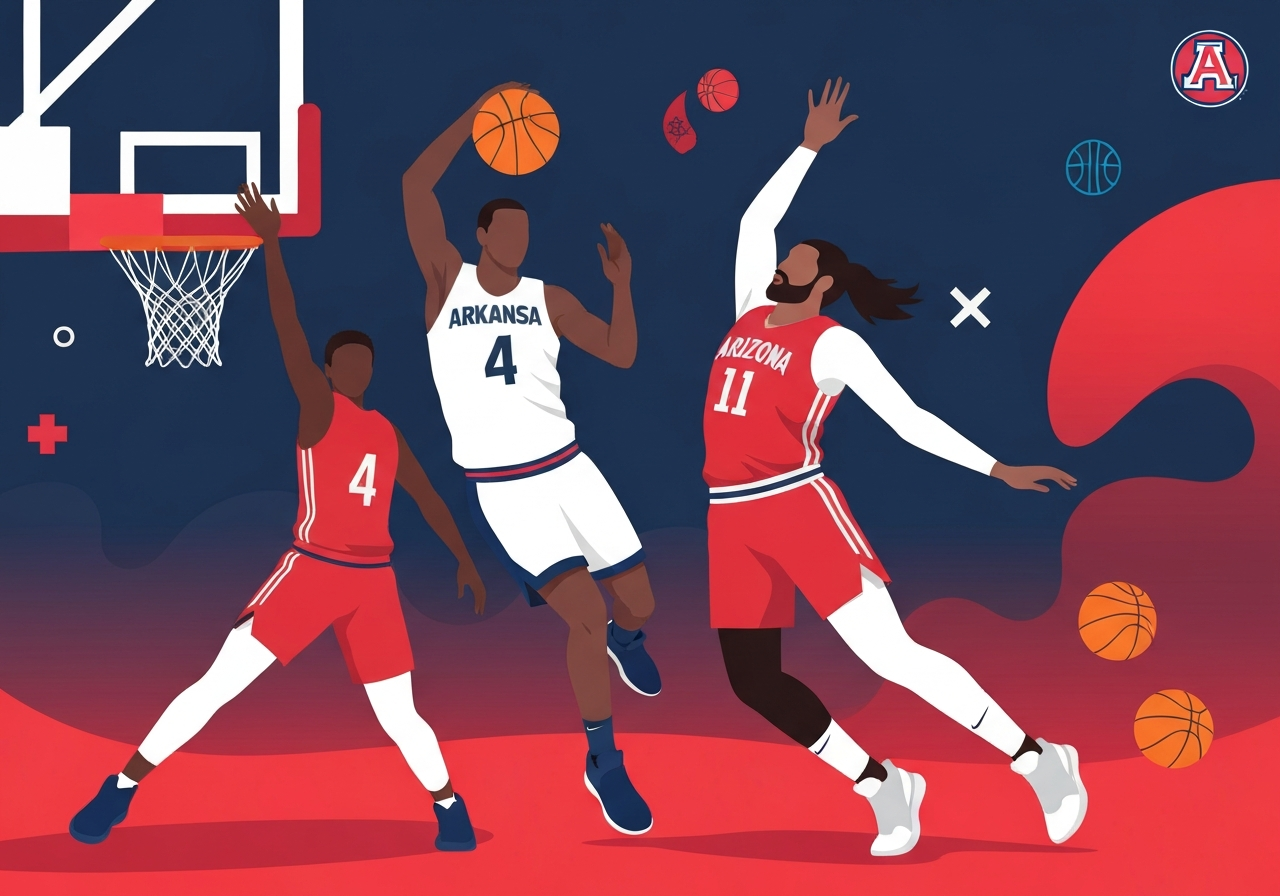
Who: No. 4 Arkansas Razorbacks vs No. 1 Arizona Wildcats. When: Thursday, March 26, 2026, tip-off 9:45 p.m. ET. Where: SAP Center, San Jose, CA. This Sweet 16 matchup pits Arkansas’s high-octane offense against Arizona’s elite interior defense; the market favors Arizona, but several player props and a same-game parlay offer value for bettors tonight.
Key Takeaways
- Projected winner: Arizona — the Wildcats are favored due to superior defensive efficiency and rim protection, and a 12-2 record vs. ranked opponents this season.
- Top single bet: Meleek Thomas Over 14.5 points (+105) — Thomas averages 15.6 PPG and has a recent string of high-scoring outings.
- Assist play: Darius Acuff Jr. Over 6.5 assists is a recommended support leg; he has averaged about 8.2 APG across his last several games.
- Team total angle: Arkansas Team Total Over 79.5 is plausible — Arkansas averages 90.3 PPG and has been clearing team totals frequently.
- Game lines (at publication): Spread Arkansas +8 (-110) | Arizona -8 (-110); Moneyline Arkansas +3000 | Arizona -380; Over/Under 166 (-110).
- Matchup note: Arizona’s Jaden Bradley is expected to take primary defensive responsibility on Darius Acuff Jr., which could free Meleek Thomas for midrange and catch-and-shoot chances.
Background
The 2026 NCAA Tournament’s West Region has delivered the Sweet 16 meeting between Arkansas (No. 4) and Arizona (No. 1). Arkansas reached this stage on the strength of an up-tempo offense that ranks among the nation’s most productive, while Arizona has advanced behind two-way balance and perimeter-to-rim defensive rotations. Both programs feature highly touted freshmen — Arkansas’s Meleek Thomas and Arizona’s Brayden Burries and Koa Peat — whose early-season recruiting profiles translated into major tournament contributions.
Arkansas coach John Calipari has navigated tournament underdog roles previously; as an underdog in NCAA Tournament games he is 7-4 SU and 8-2-1 ATS. Arizona, coached for the season by a staff emphasizing rim deterrence, has been particularly stout in defending paint attempts and limiting second-chance points. The matchup therefore sets a classic contrast: Arkansas’s pace and scoring versus Arizona’s interior defense and rebounding physicality.
Main Event
Arizona will aim to clamp down on interior scoring and contested drives, forcing Arkansas to generate offense through kick-outs and midrange looks. Darius Acuff Jr., Arkansas’s primary creator, will likely draw tight perimeter coverage from Jaden Bradley; that attention should produce passing lanes for Acuff and open looks for secondary scorers. Meleek Thomas, who shoots 2.3 threes per game at roughly a 42% clip and averages 15.6 points, projects to be the main beneficiary of that attention.
Expect Arizona to contest glass and attempt to limit offensive rebounds; Koa Peat’s recent 17-rebound contribution over the last two rounds highlights Arizona’s physical frontcourt presence. Arkansas’s quick possessions can still yield high totals if the Razorbacks convert early in the shot clock, but efficient Arizona transition defense could turn Arkansas’s possessions into tougher half-court attempts. The over/under of 166 suggests oddsmakers see scoring upside, but game tempo may be dictated by Arizona’s ability to slow Arkansas at the rim.
On the other end, Arizona’s scoring is balanced between drive-and-kick creation and freshman scoring bursts from Burries; Burries has reached 18+ points in multiple recent games. If Arizona’s primary scorers hit early, Arkansas may be forced to play faster to keep pace, which opens additional lines for Thomas and Acuff to affect the totals and assists markets. The single-game parlay that pairs Thomas Over 14.5, Acuff Over 6.5 assists, and Koa Peat Over 6.5 rebounds tracks these matchup dynamics.
Analysis & Implications
From a basketball-quality standpoint, Arizona’s edge is structural: rim protection and defensive rebounding both suppress opponent scoring efficiency in the paint. Against Arkansas’s high-volume attack, Arizona’s ability to convert contested two-point field-goal attempts into misses will be decisive. If Arizona forces Arkansas into a higher proportion of long-distance jumpers and contested midrange shots, the Wildcats can generate transition chances to extend leads.
For Arkansas, the path to victory runs through ball movement and creating off-ball spacing. With Acuff drawing help, Meleek Thomas’s midrange and catch-and-shoot three-point accuracy (42% on 2.3 makes per game) becomes critical. The Razorbacks’ offensive depth and pace allow multiple paths to 80+ points, but doing so against elite interior defense is a higher-variance undertaking — one that favors Arizona in a single-elimination setting.
Betting markets reflect these dynamics: a relatively wide spread and a lopsided moneyline favor Arizona, but player prop markets present higher expected-value plays for informed bettors. If Thomas consistently gets midrange pull-ups and open threes, his points prop (Over 14.5) carries +105 value. Conversely, bettors who believe Arizona controls the paint cleanly can target low-scoring team or under props on Arkansas.
Comparison & Data
| Metric | Arkansas | Arizona |
|---|---|---|
| Seed | No. 4 | No. 1 |
| Team PPG | 90.3 | — |
| Top freshman | Meleek Thomas — 15.6 PPG, 2.3 3PG (42%) | Brayden Burries, Koa Peat — key two-way contributors |
| Record vs. ranked opponents | — | 12-2 |
| Published lines | Spread +8 / ML +3000 / O/U 166 | Spread -8 / ML -380 / O/U 166 |
The table highlights the offensive output gap and Arizona’s resume against ranked teams. Arkansas’s 90.3 PPG is among the national leaders and explains why team-total overs are viable. Arizona’s 12-2 mark vs. ranked opponents speaks to the Wildcats’ ability to handle quality competition; that context supports the moneyline favorite despite Arkansas’s offensive firepower.
Reactions & Quotes
“Arizona’s season-long defensive consistency — particularly at the rim — is a key reason the Wildcats are favored in this matchup.”
Analyst consensus (media coverage)
This summarizes the central narrative among national analysts and betting previews: Arizona’s defensive profile has been the defining feature of its season. Multiple preview pieces and statistical profiles point to rim protection and defensive rebounding as the Wildcats’ differentiators.
“Arkansas will rely on Meleek Thomas and Darius Acuff Jr. to generate efficient looks and keep pace on the scoreboard.”
Pre-game commentary (Arkansas coverage)
Local and regional outlets covering Arkansas emphasize the duo’s recent scoring and playmaking outputs. Thomas’s hot streak and Acuff’s assist uptick are widely cited as Arkansas’s primary routes to sustained offense in the Sweet 16.
Unconfirmed
- Late injury or availability updates: there were no major injury reports at publication, but final scratches or minute restrictions could emerge close to tip-off.
- Odds movement: lines listed reflect the publishing snapshot and are subject to change as sportsbooks adjust to handle late bets.
- Exact defensive matchups at tip: coaches may alter on-ball assignments after shootaround; final defensive responsibilities (e.g., Bradley on Acuff) are not official until game tip.
Bottom Line
Arizona is the sensible pick to advance given its interior defense, defensive resume (12-2 vs ranked teams), and ability to control rebounding; that profile makes the Wildcats a robust single-game favorite on March 26, 2026. However, Arkansas’s pace and scoring prowess — 90.3 PPG and multiple hot-scoring freshmen — creates meaningful betting value on player props and team-total overs if the Razorbacks find early offensive rhythm.
For bettors: the clearest edges are player props that reflect matchup structure — Meleek Thomas Over 14.5 and Darius Acuff Jr. Over 6.5 assists are two actionable plays if you believe Arkansas will continue to generate high-value possessions. For lower-variance play, consider Arizona on the spread or moneyline given the Wildcats’ defensive advantages and record versus ranked opponents.