
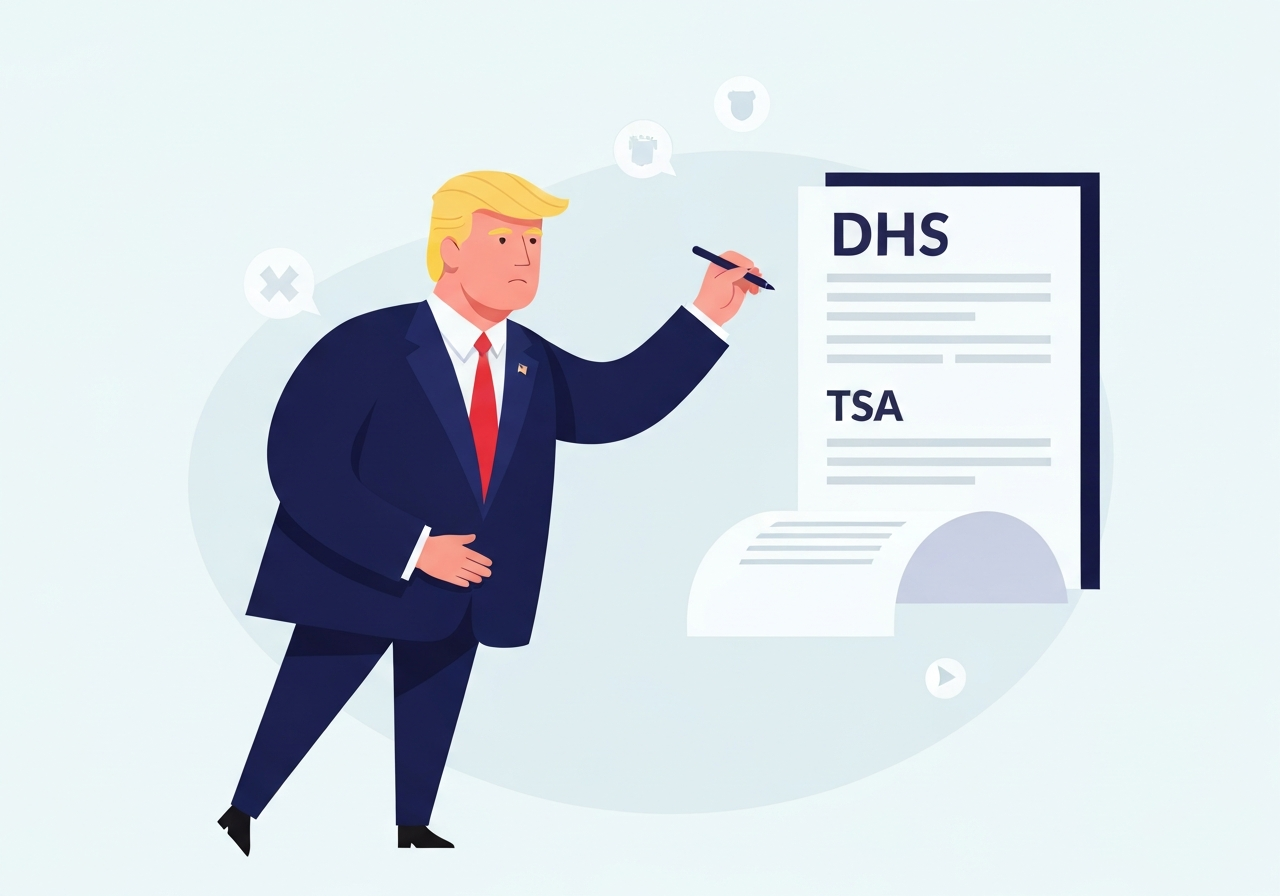
President Donald Trump said on March 27, 2026, that he will sign an executive order directing the Department of Homeland Security to restart pay for Transportation Security Administration officers after they spent more than a month without full pay. The move, announced on social media, comes as absences and departures among TSA staff have caused hours-long lines at major U.S. airports and raised the prospect of service disruptions at smaller facilities. The administration says it will draw on funds from last summer’s One Big Beautiful Bill Act; lawmakers in Congress were still negotiating supplemental appropriations after the Senate approved most DHS funding early Friday. Legal experts and Democrats questioned whether the president can unilaterally restart pay without a clear statutory basis.
Key Takeaways
- President Trump announced an executive order on March 27, 2026, directing DHS to restart pay for TSA officers after more than 40 days without full pay.
- More than 10% of TSA checkpoint officers are calling out daily on average, with some airports reporting callout rates exceeding 40%; hundreds of staff have left the agency.
- The administration plans to use funding from the One Big Beautiful Bill Act; the specific statutory provision to be used has not been identified publicly.
- The Senate approved funding for most of DHS early Friday, but the House had not yet completed action, leaving a legislative solution pending.
- The administration deployed ICE agents to over a dozen airports to help manage lines and said National Guard support is a possible contingency.
- Billionaire Elon Musk reportedly offered to pay TSA workers but was declined by the administration for legal reasons tied to government contracts.
- Active-duty Coast Guard personnel are already being paid from discretionary funds despite the DHS lapse, a precedent noted by officials handling pay questions.
Background
The Department of Homeland Security entered a funding lapse in February after Congress failed to finalize appropriations, triggering a partial DHS shutdown that left many TSA officers without full pay. TSA operations rely on annual and supplemental appropriations; when those lapse, the Anti-Deficiency Act generally bars federal agencies from obligating funds absent congressional authorization. Last summer’s One Big Beautiful Bill Act included tens of billions in additional DHS resources for immigration enforcement, high-profile event security and other measures—funding the administration now cites as a possible source to cover pay.
TSA absenteeism rose quickly as officers missed paychecks, compounding staffing shortages already present at many airports. Airlines and trade groups warned that sustained under-staffing could force delays and potential closures at smaller airports, while major hubs faced multi-hour waits. Political negotiations over DHS funding have been contentious: Senate Democrats pressed for reforms to immigration-focused agencies that House Republicans resisted, producing a stopgap gap that left TSA staff in limbo.
Main Event
On March 27, 2026, the president posted that he would sign an executive order directing newly sworn-in DHS Secretary Markwayne Mullin to restart TSA pay “immediately.” The statement did not specify the legal authority the administration plans to rely on. White House aides told reporters they intend to identify a provision in the One Big Beautiful Bill Act that can be used to cover payroll, but they have not disclosed the precise section or mechanism.
Operationally, the funding gap pushed many checkpoint officers to call out; national averages exceeded 10% for daily absences, with hotspots above 40%. Hundreds of officers resigned or retired rather than continue without steady pay, according to agency and airline sources. The administration sent Immigration and Customs Enforcement agents to more than a dozen airports this week to assist with passenger screening and line management, and officials said they might mobilize National Guard troops if timelines for restoring pay lengthen.
Senate leaders moved to approve funding for most DHS components early Friday, but the House still needed to concur for a legislative end to the lapse. Industry groups, including Airlines for America, urged a rapid resolution and welcomed the executive-order announcement as an interim step to address immediate payroll needs. Legal and budget officials inside the administration were reported to be weighing reprogramming options and statutory interpretations to make the payroll action administrable.
Analysis & Implications
If the president follows through with an executive order, the immediate effect would likely be to blunt short-term operational chaos at airports by restoring paychecks for TSA officers. That would reduce callouts and might speed recovery of staffing levels, but it would not resolve the underlying appropriations dispute in Congress. Restoring pay administratively without an appropriation risks legal challenge under the Anti-Deficiency Act or other statutes governing federal spending.
Politically, the move shifts pressure back to lawmakers: an administrative patch can ease visible pain for workers and travelers, but lawmakers still must pass appropriations or a continuing resolution to provide lasting legal authority. Democrats could argue that unilateral executive action sidesteps congressional appropriations power; Republicans may frame the order as necessary crisis management. Either way, the episode intensifies scrutiny of DHS budgeting and the political bargaining over immigration-related reforms tied to DHS funding.
Economically, prolonged staffing shortfalls at TSA can ripple through the aviation sector via delayed flights, missed connections and higher operating costs for airlines. Airports with high callout rates face reputational damage that could depress travel demand regionally. Restoring pay quickly would mitigate those risks, but uncertainty about back pay timing may leave some employees financially strained even after a fix is announced.
Comparison & Data
| Metric | National / Typical | Reported Peak |
|---|---|---|
| Days without full paycheck | More than 40 days | Over 40 days |
| Average daily callout rate | Over 10% | Some airports >40% |
| Staff departures | Hundreds agency-wide | Concentrated at multiple hubs |
The table contrasts national averages with the worst-affected airports. Even a modest increase in callouts—above the typical 5–10% baseline—can disrupt checkpoint throughput at major hubs. Airports with callouts north of 40% face staffing shortfalls that effectively reduce open lanes and extend passenger wait times into hours, a condition that can persist until payroll and staffing stabilize.
Reactions & Quotes
Industry leaders and officials offered muted praise for the announced emergency step while urging a legislative solution. Airlines and airport operators focused on traveler impacts and the need for rapid, lawful payroll restoration.
“It is not an easy thing to do, but I am going to do it!”
President Donald Trump (social media post)
The president framed the order as an emergency remedy; legal analysts immediately noted the gap between political intent and statutory authority. Administration officials say they will instruct Secretary Mullin to implement pay restarts while identifying the legal path to obligate funds.
“We are grateful to President Trump and Secretary Mullin for implementing a solution to pay tens of thousands of dedicated TSA officers…”
Chris Sununu, Airlines for America
Airline trade groups said restoring pay quickly would reduce passenger delays and help families coping with missed wages. Sununu stressed that even a legislative deal would produce backpay only after administrative processing, so an immediate administrative step could shorten the time officers go unpaid.
“Smaller airports might need to close if staffing shortages continue,”
TSA official (agency statement)
TSA and airport managers warned publicly and privately that prolonged understaffing could force temporary lane reductions or selective closures at lower-traffic airports, amplifying regional travel disruption beyond major hubs.
Unconfirmed
- The specific provision of the One Big Beautiful Bill Act the administration intends to use to fund TSA pay has not been publicly identified or confirmed.
- Whether any legal challenges will be filed to an executive-order pay restart, and the likely outcome of such challenges, remains uncertain.
- The scope and timeline for any National Guard deployments to assist airport operations are unconfirmed.
Bottom Line
The administration’s announced executive order aims to deliver immediate relief to TSA officers and to blunt airport operational disruption as the DHS shutdown extends past 40 days. If implemented effectively, it could reduce callouts and shorten passenger wait times, but it does not eliminate the need for Congress to enact appropriations that legally authorize pay and any required backpay.
Legal and political risks remain: a unilateral administrative funding maneuver may face court scrutiny and will almost certainly intensify congressional debate over DHS priorities, including immigration enforcement reforms attached to funding negotiations. Travelers, TSA employees and lawmakers will be watching both the rollout of any administrative fix and the pace of legislative action in the coming days.