
Lead
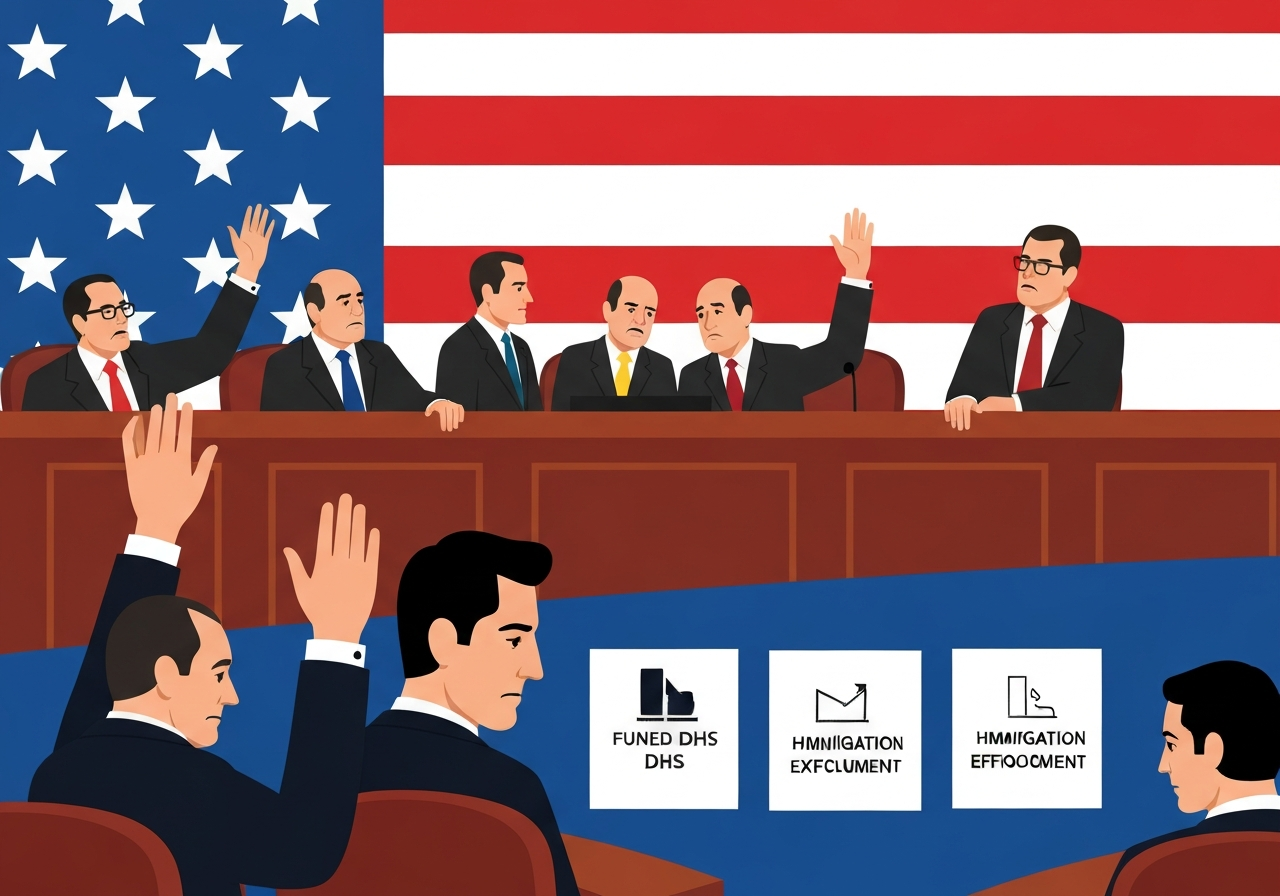
On March 27, 2026, the U.S. Senate approved a spending measure to restore funding for most Department of Homeland Security (DHS) operations after a 42-day impasse, but the package deliberately excludes funding for the department’s primary immigration enforcement activities. The measure, passed overnight, moves to the House for consideration as lawmakers weigh political and operational consequences. The lapse in regular appropriations forced tens of thousands of DHS employees to work without pay or to leave, and contributed to lengthy airport waits during peak spring-break travel. Lawmakers framed the vote as a compromise that preserves critical security and emergency functions while keeping pressure on immigration-policy reforms.
Key Takeaways
- The Senate passed a DHS funding bill after a 42-day stalemate; the legislation does not fund the department’s main immigration enforcement operations.
- The bill now goes to the House; it is unclear whether House Republican leadership will accept the split funding approach.
- The funding lapse left tens of thousands of DHS employees working without pay or quitting, and disrupted travel—TSA reported absences up to 40% at some airports.
- More than 480 TSA officers have resigned during the funding lapse, according to testimony at a congressional hearing.
- Some ICE operations continued using approximately $75 billion allocated under the One Big Beautiful Bill Act, while divisions like TSA relied on staff working without pay.
- House Speaker Mike Johnson called the decision to split DHS funding “shameful,” signaling a potential rejection in the House.
Background
The funding standoff began more than six weeks earlier as Democrats objected to immigration-enforcement tactics used by DHS officers and demanded agency reforms following two high-profile killings of U.S. citizens by federal officers in Minneapolis. Those incidents heightened congressional scrutiny of enforcement protocols, use of force, and accountability mechanisms at DHS. Democrats leveraged appropriations as the principal means to press for policy and oversight changes, refusing to back a full-year DHS appropriation until specific reforms were agreed.
Republicans, by contrast, argued that splitting DHS funding would imperil national security and frontline operations, urging a comprehensive funding solution. The department has been operating without regular appropriations for over a month; some divisions functioned under existing emergency transfers and earlier omnibus allocations, while others—most notably the Transportation Security Administration—faced unpaid staff and service disruptions. The impasse occurred amid high spring-break travel volume, intensifying public and political pressure to resolve staffing and operational shortfalls at airports and border operations.
Main Event
Late on March 27, the Senate voted to fund large portions of DHS but excluded money for the department’s principal immigration enforcement units. The narrowly framed bill preserves operations such as the Transportation Security Administration, FEMA emergency response, and cyber and counterterror programs, while leaving funding for Immigration and Customs Enforcement and related enforcement activities unresolved. Senators briefed reporters after the vote, and leadership said the package was intended to protect public safety functions without surrendering leverage on immigration reforms.
Senate Majority Leader John Thune (R-S.D.) spoke briefly with reporters following a weekly Republican policy luncheon, framing the measure as a pragmatic step to restore essential services. Democrats celebrated the preservation of oversight leverage while acknowledging the practical relief for travelers and emergency responders. The package’s passage in the Senate sets up a politically fraught decision for the House, where some Republicans oppose bifurcating DHS funding.
The funding lapse had tangible operational impacts: tens of thousands of DHS employees were placed on unpaid status or left their jobs, and TSA reported absences reaching 40% at some airports. At a congressional hearing, acting TSA administrator Ha Nguyen McNeil testified that more than 480 officers had resigned during the shutdown, and that workforce instability threatens both short-term travel security and long-term recruitment and retention.
Analysis & Implications
The Senate action reflects a tactical compromise: lawmakers prioritized immediate continuity for visible public-safety and travel-related services while keeping immigration enforcement funding as a bargaining chip. Politically, the move allows Democrats to claim they maintained leverage for reforms demanded after the Minneapolis deaths, while allowing Republicans to argue they secured critical security functions. The split reduces short-term disruption but leaves a major policy dispute unresolved, prolonging uncertainty for frontline workers and communities affected by immigration enforcement.
Operationally, restoring funds for TSA and emergency response units should blunt the acute travel disruptions seen during spring break, but the personnel damage—resignations, unpaid labor, and morale loss—could produce longer-term gaps. Recruitment will likely slow and training pipelines will be strained; even after appropriations resume, rebuilding capacity could take months. The roughly 480 known TSA departures and reported 40% absentee rates at some airports are tangible indicators of workforce erosion that simple funding restores may not quickly reverse.
For immigration policy and oversight, withholding enforcement funding keeps reform demands alive but creates uneven effects: agencies that continued to operate under prior appropriations or emergency transfers—such as ICE using funds from the One Big Beautiful Bill Act—maintained activities, potentially creating friction and legal questions about resource allocation. The split funding approach risks operational incoherence if enforcement and non-enforcement functions must coordinate during emergencies without aligned appropriations and leadership clarity.
Comparison & Data
| Division | Funding Status | Reported Workforce Impact |
|---|---|---|
| TSA | Funded by Senate package | Absences up to 40%; 480+ resignations |
| ICE | Not funded in package; continued under prior One Big Beautiful Bill Act allocations (~$75B) | Continued operations under existing transfers |
| FEMA / Emergency Response | Funded by Senate package | Operations maintained; staffing strains in some regions |
The table above summarizes the immediate funding and workforce consequences reported during the lapse. While the Senate bill restores pay and formal appropriations for many DHS components, the mismatch in funding across divisions could complicate interagency coordination, particularly for border operations that interact with TSA and FEMA during large-scale events.
Reactions & Quotes
Officials and lawmakers offered sharply different assessments after the vote, reflecting partisan and operational tensions.
“We are really concerned about our security posture and what the long term impacts of this shutdown is going to have on the workforce and our ability to carry out this mission.”
Ha Nguyen McNeil, Acting TSA Administrator (testimony to Congress)
McNeil’s testimony emphasized immediate workforce and security concerns tied to absenteeism and resignations at airports.
“It is shameful to fail to fund the agency by breaking it up.”
House Speaker Mike Johnson (R-La.), remarks to reporters
Speaker Johnson’s comment signals a likely House-level clash over whether to accept a split-funding approach.
Sen. John Thune (R-S.D.) described the Senate package as a move to restore essential services while keeping leverage for further negotiations.
Senate GOP leadership briefing
Unconfirmed
- Whether the House will accept the Senate’s split funding approach is unresolved; House Republican leadership has signaled opposition but no formal vote has occurred.
- Long-term retention and recruitment effects from the resignations and unpaid periods are expected but the pace and extent of personnel recovery remain uncertain.
- Any specific, binding reform package tied to immigration enforcement funding has not been finalized; details and timelines for oversight measures remain subject to negotiation.
Bottom Line
The Senate’s vote ends an acute, 42-day impasse by restoring funds for many DHS operations while deliberately excluding core immigration-enforcement resources to preserve leverage for reform. That split reduces immediate travel and emergency-service disruptions but prolongs a politically charged dispute over enforcement tactics and accountability that began after two fatal federal officer encounters in Minneapolis.
Operational recovery will depend on restoring workforce confidence and filling vacancies; even with funding restored for TSA and other divisions, the department faces months of rebuilding. The House’s response will determine whether the compromise holds or whether another appropriations showdown looms—keeping both policy reform and practical operations on a fragile timetable.
Sources
- NPR (news report summarizing Senate vote and congressional testimony)
- Department of Homeland Security (official site — agency statements and guidance)
- Office of Sen. John Thune (official — Senate GOP leadership statements)