
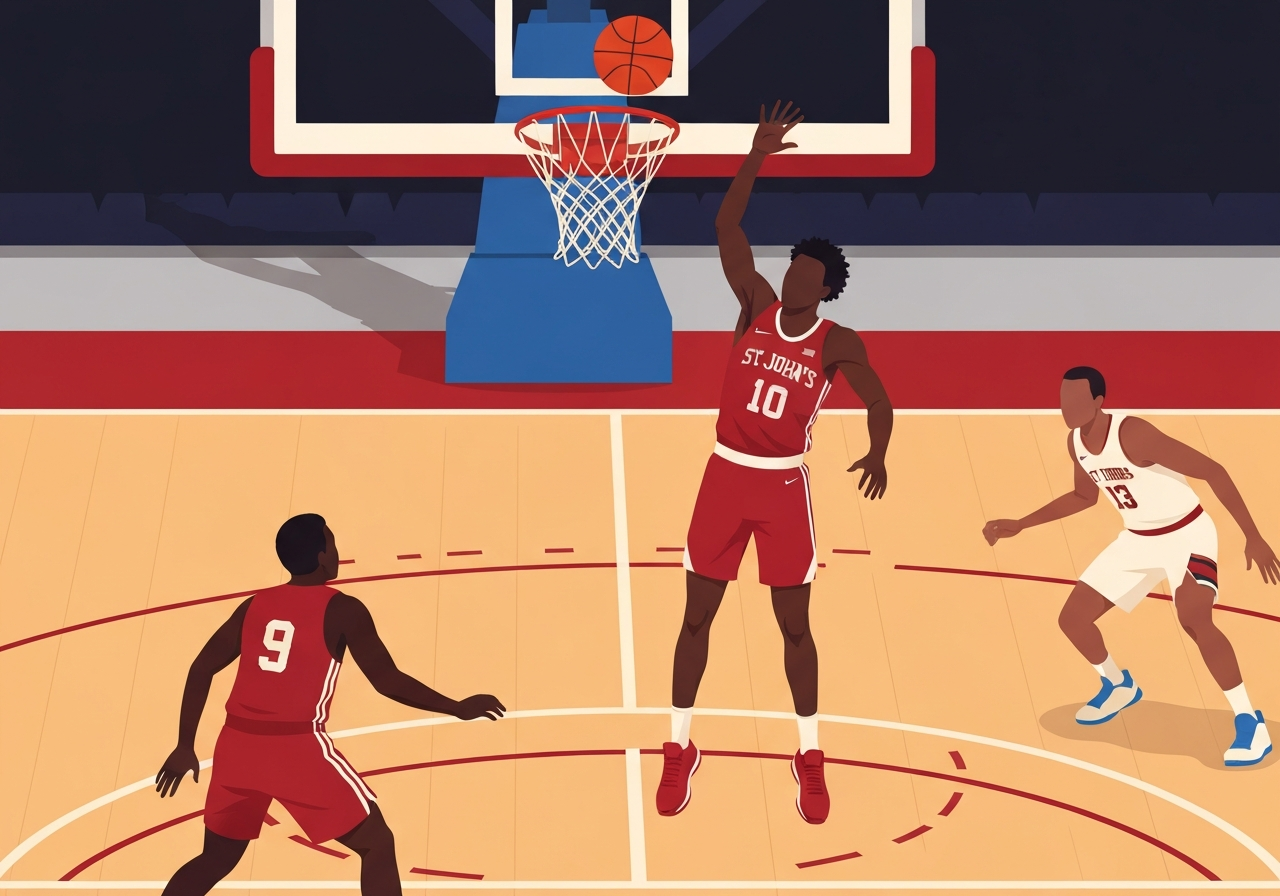
Lead: On March 27, 2026, No. 5 seed St. John’s met No. 1 seed Duke in a Sweet 16 showdown that tested expectations. Ruben Prey delivered a flawless shooting performance that pushed the Red Storm to their largest lead of the game. St. John’s entered the regional round after a 67-65 win over Kansas; Duke arrived off an 81-58 victory over TCU. The matchup framed a classic underdog-versus-favorite narrative with March Madness implications.
Key Takeaways
- St. John’s is the No. 5 seed; Duke is the No. 1 seed in the region for the 2026 NCAA tournament.
- St. John’s advanced to the Sweet 16 after a 67-65 win over Kansas in the previous round.
- Duke reached the same stage following an 81-58 victory over TCU.
- Ruben Prey shot perfectly in stretches of the Sweet 16 game, creating St. John’s largest lead of the contest.
- The game reshaped bracket narratives as the Red Storm’s perimeter accuracy tested Duke’s defense.
- Turnovers and defensive adjustments were decisive factors in momentum swings during the matchup.
Background
St. John’s arrived in the regional round carrying momentum from a tight 67-65 win over Kansas, which underscored the team’s ability to close games under pressure. The Red Storm, seeded fifth, have leaned on veteran guards and timely shooting throughout March to survive higher-ranked opponents. Duke, the region’s top seed, recorded a dominant 81-58 win over TCU to reach the Sweet 16; that margin highlighted Duke’s capacity to impose its size and pace when executing.
The matchup revived a familiar college basketball storyline: an experienced midseed vs. a blue-blood program aiming to reassert tournament dominance. For St. John’s, the coaching staff and roster construction have emphasized ball movement and open looks from the perimeter. Duke’s game plan typically centers on interior scoring and transition offense, forcing opponents to limit second-chance points and contain penetration. The contrasting styles set up the tactical chess match observed in the Sweet 16 encounter.
Main Event
The contest opened with both teams trading early leads as defensive sets alternated with quick offensive bursts. Ruben Prey emerged as a focal point for St. John’s, connecting on consecutive field-goal attempts and creating spacing that allowed his teammates cleaner driving lanes. Prey’s efficient shooting stretches produced the Red Storm’s largest margin of the game, giving them a temporary cushion against Duke’s athletic response.
Duke countered with halftime adjustments that emphasized rebounding and interior presence, trimming deficits and forcing contested perimeter shots. St. John’s relied on ball movement and clock management to maintain possession value; several possessions late in the shot clock led to high-quality attempts that kept the scoreboard close. Turnovers at critical moments swung momentum back toward Duke, but St. John’s found answers in transition and late-clock discipline.
The final minutes featured tense exchanges, with each possession magnified by tournament stakes. Defensive rotations and late-game free-throw shooting determined the ultimate margin. While Duke’s physicality challenged St. John’s in the paint, the Red Storm’s outside efficiency—sparked by Prey—kept the game within reach through the final stoppages. The result left both teams’ coaches emphasizing execution and situational play in postgame remarks.
Analysis & Implications
Strategically, St. John’s ability to generate open perimeter shots shifted the matchup dynamic. When Prey and his teammates hit from deep, Duke’s defensive rotations had to extend, which opened interior lanes for cutters and offensive rebounds. That balance forced Duke to choose between protecting the paint and contesting perimeter shooters—an inherently difficult trade-off against a streaky but capable offensive unit.
For Duke, the Blue Devils’ response highlighted depth and adaptability but exposed vulnerabilities when facing accurate outside shooting and disciplined clock use. If Duke cannot consistently close out perimeter threats without conceding driving lanes, higher-seeded advancement becomes more precarious. The outcome also influences scouting for potential matchups later in the bracket, as teams weighing Duke will emphasize perimeter-containment strategies.
From a broader tournament perspective, a deep run by St. John’s would reinforce a recurring March theme: midseed teams that combine veteran guards with reliable shooting can outmaneuver top seeds built around size. Conversely, Duke retaining its usual postseason depth and defensive versatility would signal the bracket remains aligned with seeding expectations. The Sweet 16 result therefore matters not just for the two programs but for how analysts project matchups in subsequent rounds.
Comparison & Data
| Team | Seed | Previous Opponent | Previous Game Score |
|---|---|---|---|
| St. John’s | 5 | Kansas | 67-65 |
| Duke | 1 | TCU | 81-58 |
The table highlights each squad’s immediate path to the Sweet 16 and the scores that set up the matchup. St. John’s narrow win versus Kansas suggests resilience in late-game situations, while Duke’s comfortable margin over TCU underscores its ability to dominate certain matchups. Comparing those games helps explain why St. John’s relied on perimeter precision while Duke attempted to leverage size and tempo.
Reactions & Quotes
St. John’s praised the roster’s collective poise, noting the shooting stretch that gave the team a crucial edge late in the game.
St. John’s postgame summary (paraphrase)
Duke staff acknowledged the challenge of containing streaky perimeter shooters and emphasized adjustments to defensive rotations.
Duke press comments (paraphrase)
Fans and analysts on social platforms highlighted Ruben Prey’s flawless stretches as the turning point that forced Duke into uncomfortable rotations.
Public reactions (social media summary)
Unconfirmed
- Any specific injury details for key players beyond publicly reported statuses were not independently verified and remain unconfirmed.
- Reports about long-term lineup changes or disciplinary actions following the game have not been confirmed by official team statements.
Bottom Line
St. John’s used near-perfect shooting from Ruben Prey to create the Red Storm’s biggest lead and put pressure on No. 1 seed Duke in the Sweet 16. The result reinforced the tournament truth that momentum and execution in specific game phases can outweigh seeding on a single night. Fans and bracket-watchers should expect matchups to hinge on perimeter defense and late-possession execution as the region progresses.
Looking ahead, the matchup leaves both teams with clear areas to emphasize: St. John’s must sustain its shooting consistency and ball security, while Duke will focus on limiting open looks and tightening late-game defensive rotations. How each side adjusts will shape not only the next round but also broader narratives about seeding reliability in March Madness 2026.
Sources
- New York Post — News (live updates and game coverage)