
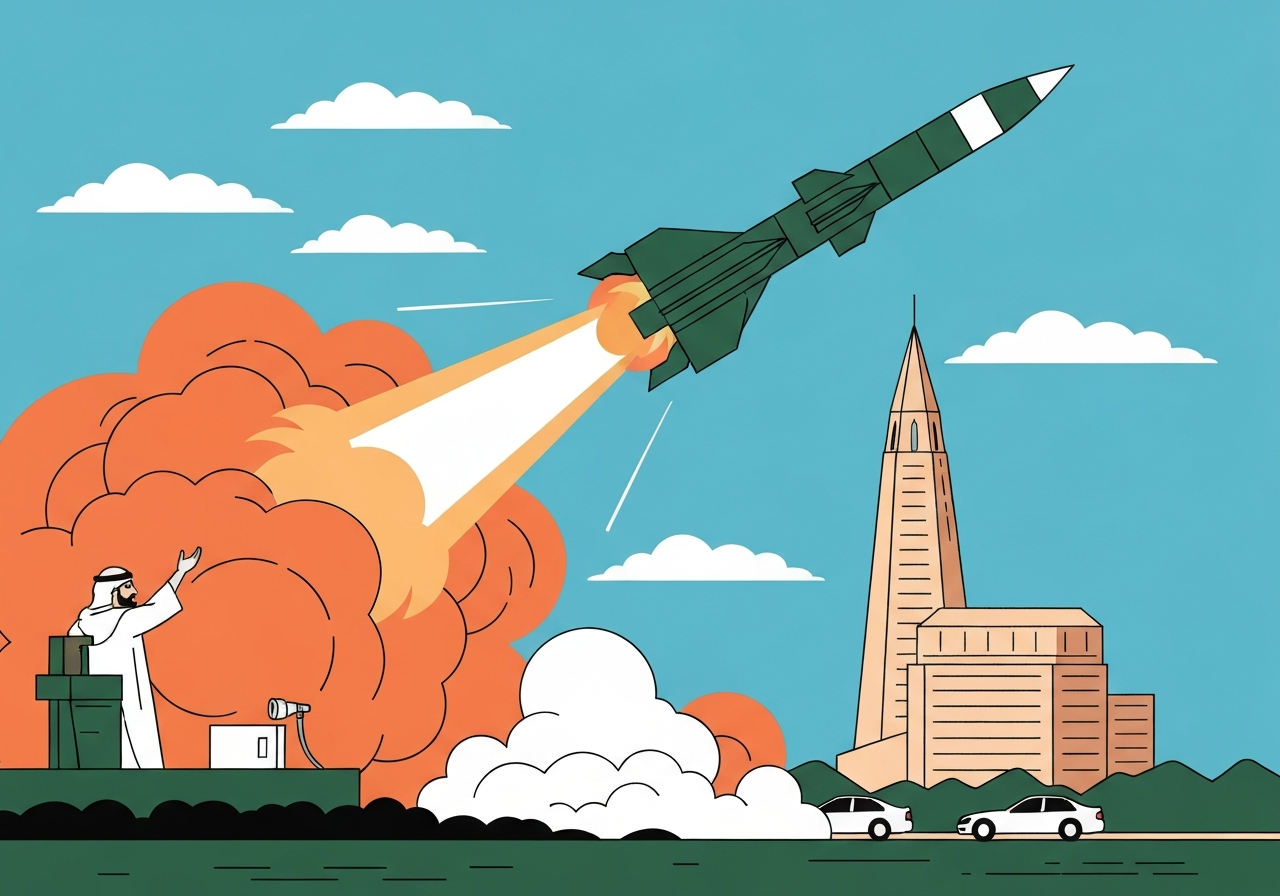
Yemen’s Iran-aligned Houthi movement confirmed it fired a missile at Israel on 27 March 2026, the first Houthi strike on Israel since the Israel–US campaign against Iran began. Israel said it detected a projectile from Yemen while continuing strikes on targets in Tehran; the Houthis said their action responded to repeated attacks on infrastructure across Iran, Lebanon, Iraq and the Palestinian territories. The announcement came hours after US Secretary of State Marco Rubio told reporters after a G7 meeting that the US expected to complete operations against Iran “in weeks, not months.” Analysts warn Houthi entry raises the prospect of a wider regional conflagration and increased disruption to shipping in the Red Sea and Gulf of Oman.
Key Takeaways
- The Houthi movement confirmed a missile launch at Israel on 27 March 2026, marking its first direct strike on Israel in the current Israel–US–Iran conflict.
- Israel reported the launch while it was carrying out strikes on Tehran; Iranian officials said strikes hit the Arak heavy-water and Ardakan yellowcake facilities on 26–27 March with no casualties reported.
- US reporting cited an Iranian strike on Prince Sultan airbase in Saudi Arabia that wounded at least 12 American service members, two seriously.
- Conflict tolls cited in reporting: about 19 civilian deaths in Israel, four Israeli soldiers killed in Lebanon, 13 US military deaths in the wider campaign, roughly 1,900 dead and 20,000 injured in Iran (per IFRC), and nearly 1,100 killed in Lebanon.
- Independent reporting (Reuters) indicated US intelligence could confirm roughly one-third of Iran’s missile and some drone capabilities have likely been destroyed.
- The IRGC said it turned back three ships in the Strait of Hormuz, and US officials warned of continued threats to shipping lanes that carry about one-fifth of global oil shipments.
- ACLED data show more than 850 pro-regime demonstrations in Iran since the war began, suggesting continued mobilisation capacity despite heavy losses.
Background
The broader conflict escalated after a surprise strike on 28 February 2026 that killed Iran’s supreme leader, Ali Khamenei, triggering sustained Israeli and US military operations against Iran. Tehran has since responded with sustained missile and drone strikes against Israel and regional targets; reporting indicates between 10 and 20 missiles or drones have struck Israeli territory on many days during the campaign. The US and Israel have said their aims include degrading Iran’s missile force and nuclear-related infrastructure, while Iran insists its nuclear work is civilian and denies negotiating away strategic capabilities.
The Houthis, a Yemeni movement aligned with Iran, have previously struck shipping and targets beyond Yemen—most notably during support for Hamas after the 7 October attacks on Israel—by targeting vessels and installations across the Red Sea and Gulf approaches. Their ability to strike long-range targets and threaten maritime traffic makes their entry into the campaign particularly sensitive for global trade and energy markets. Regional actors—Saudi Arabia, the UAE and allied maritime forces—are all monitoring and, in some cases, preparing for possible further escalation.
Main Event
On 27 March, Israeli forces recorded what they assessed was a projectile launched from Yemen as Israel continued air operations in and around Tehran. The Houthi media office confirmed the launch and framed it as retaliation for continued strikes on Iranian-linked infrastructure and for attacks on Lebanon, Iraq and Palestinian areas. Israeli officials warned such actions would prompt an expansion of retaliatory strikes on facilities and networks they associate with Iran’s weapons programmes.
Hours earlier, at a G7-related press appearance in France, US Secretary of State Marco Rubio said Washington expected to conclude military operations against Iran in weeks rather than months. The comment came amid mixed signals from US officials in public reports about how long the campaign will continue and what follow-on steps might look like diplomatically or militarily. Soon after Rubio’s remarks, US outlets reported an Iranian strike on Saudi Arabia’s Prince Sultan airbase that wounded a dozen American troops, intensifying concerns about spillover to US forces in the region.
Israel reported targeting facilities tied to Iran’s nuclear programme, including a heavy-water plant in Arak and a yellowcake production site in Ardakan, while also continuing strikes on missile production and storage sites across Iran. Tehran confirmed damage to those two nuclear-linked sites but said there were no casualties and no contamination risk. Separately, Iran’s IRGC said it intercepted and turned back several commercial vessels attempting to transit the Strait of Hormuz, signalling a willingness to restrict shipping tied to adversary states.
Analysis & Implications
The Houthis’ direct strike on Israel signals an important escalation: a non-state, Iran-aligned actor has used its long-range capability against an adversary beyond the immediate Iran–Israel theatre. That raises three broad risks: first, operational—more actors and launch points increase the tempo and unpredictability of attacks and responses; second, economic—further disruption of Red Sea and Hormuz shipping would push oil and freight prices higher and exacerbate global supply-chain strains; third, diplomatic—additional participants complicate efforts to limit the war’s geographic spread or to negotiate ceasefires.
Strategically, the Houthis can influence maritime security far beyond Yemen’s shores by targeting transits through the Bab al-Mandeb, the Red Sea and approaches to the Gulf. Western and regional navies have already repositioned forces; the United States has moved thousands of marines and elite airborne troops to the region, a posture that could be designed to defend shipping lanes or seize strategic islands if ordered. Such options carry high risk of direct conflict with Iranian-backed forces and could draw more regional actors into kinetic operations.
Diplomatically, the picture is mixed. The US has reportedly fed a 15-point proposal to Iran via Pakistan that includes sweeping demands on nuclear and missile capabilities and control of Hormuz-related maritime freedoms; Iranian officials have said the proposal favours US and Israeli interests and declined to accept it wholesale. Mediation channels—reported contacts via Pakistan and Turkey—remain opaque, and public statements from Tehran and Washington send contradictory signals about the likelihood and timeline of substantive negotiations.
Comparison & Data
| Metric | Reported figure |
|---|---|
| Civilian deaths in Israel | 19 |
| Israeli soldiers killed in Lebanon | 4 |
| US military deaths (campaign) | 13 |
| Reported deaths in Iran (IFRC) | ~1,900 |
| Reported injured in Iran (IFRC) | ~20,000 |
| Deaths in Lebanon | ~1,100 |
| Daily missile/drone strikes on Israel | ~10–20 |
| Estimated portion of Iran missile arsenal destroyed (US intel) | ~1/3 |
The table summarises figures provided by multiple reporting outlets and agencies. Numbers differ across sources; some counts come from humanitarian organisations, others from media reporting or unnamed intelligence sources. Trends indicate sustained kinetic activity and meaningful damage to Iranian missile and drone stocks, but no definitive operational collapse.
Reactions & Quotes
Authorities and analysts offered contrasting public assessments as events unfolded, mixing pledges of continued pressure with cautions about escalation.
“When we are done with them here in the next couple weeks, they will be weaker than they’ve been in recent history.”
Marco Rubio, US Secretary of State (press remarks after G7 meeting)
Rubio’s statement signalled US confidence in a near-term operational outcome; however, other developments that same day—reports of wounded US personnel in Saudi Arabia and the Houthi strike—underscore the uncertainty of that timeline.
“Despite the warnings, the firing continues. And therefore attacks in Iran will escalate and expand to additional targets and areas that assist the regime in building and operating weapons against Israeli citizens.”
Israel Katz, Israeli Defence Minister
Katz’s comments framed Israeli strikes as a predictable counter to external support networks; Israeli officials say degrading those networks is central to their campaign objectives.
“This morning … three container ships of different nationalities … were turned back after a warning from the IRGC navy.”
Islamic Revolutionary Guard Corps (IRGC) statement (Sepah News)
The IRGC’s patrols and denials of transit emphasize Tehran’s willingness to exert control in the Strait of Hormuz and to impose costs on adversaries’ maritime traffic.
Unconfirmed
- Exact extent of damage to Iran’s missile and drone stockpiles: Reuters cited unnamed US sources estimating about one-third destroyed, but independent verification is limited.
- Reports of US air-delivered mines in southern Iran are based on expert analysis published by Bellingcat and have not been officially confirmed by US or Iranian authorities.
- The status and timing of any imminent US–Iran negotiations remain unclear; claims of meetings “this week” have not been independently verified by both parties.
Bottom Line
The Houthi missile launch at Israel is a notable widening of the operational theatre, transforming a primarily Iran–Israel–US exchange into a more multi-directional regional contest. Because the Houthis can threaten key maritime routes, their involvement increases the risk of economic fallout and incentivises further military posturing by Western and regional navies.
In the near term, the critical variables to watch are: (1) whether other Iran-aligned groups open new fronts; (2) damage assessments of Iran’s missile and drone forces and how quickly Tehran can regenerate capabilities; and (3) progress or breakdown in behind-the-scenes diplomacy. Even if Washington continues to signal a short operational timeline, on-the-ground indicators and continued strikes suggest a period of sustained instability with high potential for further escalation.
Sources
- The Guardian (international news outlet; original reporting referenced)
- Reuters (international news agency; reporting on intelligence assessments)
- The New York Times (US major newspaper; reporting on Prince Sultan airbase)
- The Wall Street Journal (US major newspaper; reporting on Prince Sultan airbase)
- International Federation of Red Cross and Red Crescent Societies (IFRC) (humanitarian organisation; casualty and medical impact estimates)
- ACLED (Armed Conflict Location & Event Data Project; independent conflict monitoring)
- Bellingcat (independent investigative outlet; expert analysis on munitions deployment)