
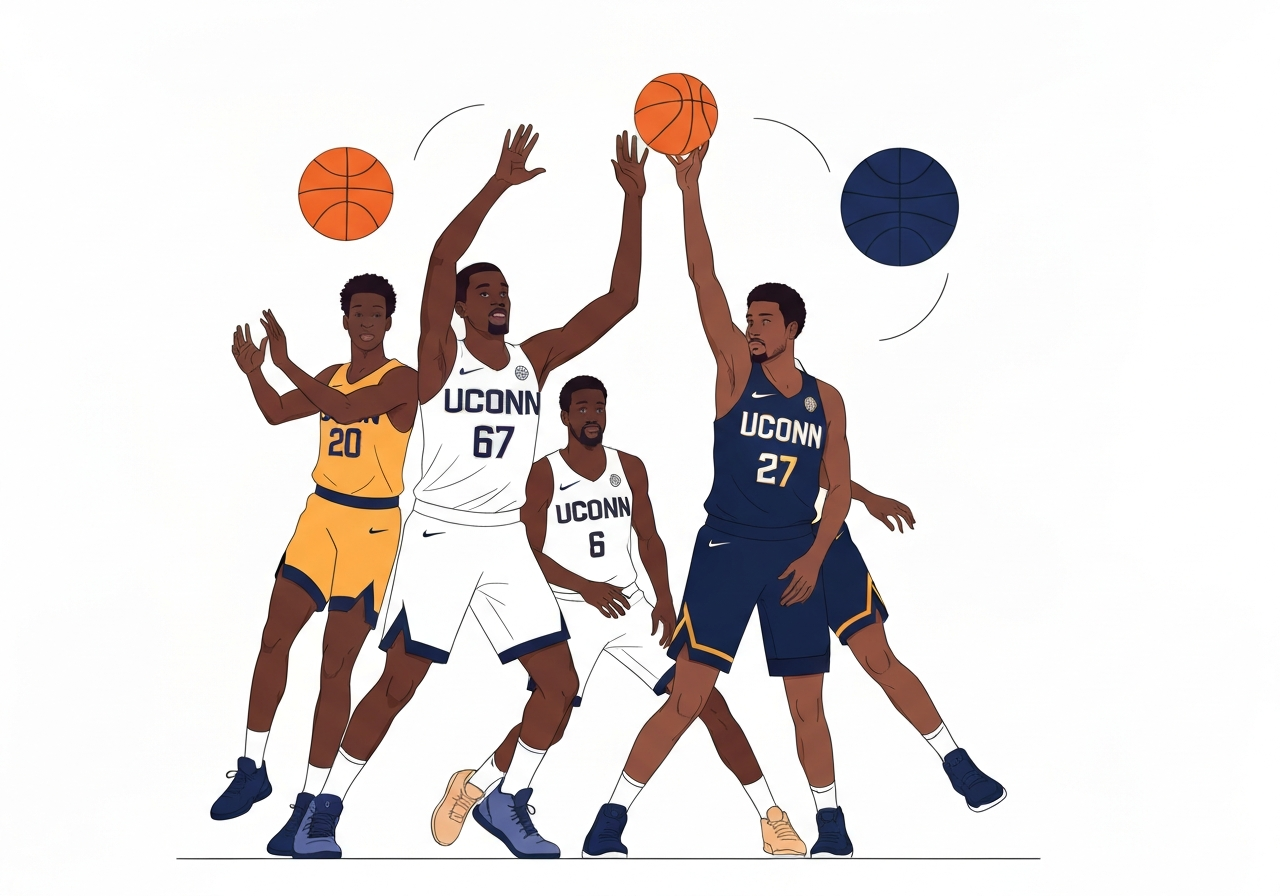
Lead
WASHINGTON — On March 27, 2026, in a tense Sweet 16 matchup, UConn edged Michigan State 67-63 after big-man Tarris Reed Jr. sank critical free throws in the closing minute. Reed finished with 20 points and made all four of his foul-line attempts down the stretch; Alex Karaban added 17 points. The second-seeded Huskies (32-5) held off third-seeded Michigan State (27-8) and advance to the East Region final against top-seeded Duke. Michigan State staged a second-half rally but shot just 4-for-16 from beyond the arc in the game.
Key Takeaways
- Tarris Reed Jr. scored 20 points and, despite a 59% season free-throw rate, made all four attempts in the final minute to protect the lead.
- Alex Karaban contributed 17 points and hit key free throws with 22.5 seconds remaining to push UConn’s lead to three.
- UConn led 61-60 when Reed hit two foul shots with 44.8 seconds left; Michigan State’s Jeremy Fears Jr. then made two at 32.3 seconds.
- Carson Cooper made one of two free throws with 4.6 seconds left and missed the second; Reed secured the rebound and sealed the outcome with two more foul shots.
- Michigan State overcame an early 19-point deficit but could not overcome poor 3-point shooting, finishing 4-for-16 from long range.
- Jaylin Stewart returned from a knee injury, played three minutes and made his only 3-point attempt for UConn.
- UConn improves to 32-5 and will face No. 1 seed Duke in the East Region final; Michigan State finishes the season 27-8.
Background
The Sweet 16 in Washington brought together four programs with a combined 13 national championships, setting heightened expectations and pressure. UConn entered the game as the second seed in the East Region, carrying momentum from a deep NCAA run and a roster built around size and physical defense. Michigan State, the third seed, arrived with veteran leadership and a history of late-game adjustments under coach Tom Izzo.
Throughout the season Reed had been an important inside presence for the Huskies but struggled from the foul line overall, converting 59% on the year. Karaban developed into a secondary offensive engine, known for timely shots and a calming influence in close games. The matchup set up a contrast of UConn’s interior strength and Michigan State’s perimeter and veteran frontcourt experience.
Main Event
The game began with UConn ripping off a 25-6 run fueled by opposing mistakes and three-pointers from Malachi Smith, Solo Ball and Jaylin Stewart; that spurt put the Huskies in front early. Michigan State clawed back, tightening its defense late in the first half and erasing much of the deficit to trail 35-27 at intermission.
Michigan State opened the second half on a 7-0 run and briefly seized momentum, but UConn answered with a sequence that included a steal and dunk by Reed to regain a six-point edge. Coaches and fans were visibly engaged: UConn’s Dan Hurley urged the crowd to turn up the volume and influence the rhythm while both benches traded adjustments.
The teams traded leads late. Jaxon Kohler’s three-point play gave Michigan State a 45-44 advantage with just over 10 minutes remaining, and a short Spartan scoring drought allowed UConn to build a 56-49 cushion. Michigan State worked back into the game, tightening the margin to one or two points in the closing minutes.
With the game in the balance Reed’s late composure at the line proved decisive. Reed hit two free throws with 44.8 seconds left to make it 61-60; Fears followed with two for Michigan State. Karaban then converted a one-and-one at 22.5 seconds, making both ends to extend the lead to three. After a missed Kur Teng 3 and a quick foul on the rebound, Cooper hit one of two with 4.6 seconds remaining and missed the second; Reed grabbed the rebound and sealed the outcome with two final foul shots.
Analysis & Implications
Tactically, UConn’s ability to get to the line and make key free throws was the deciding factor. Michigan State’s offensive resurgence in the second half showed the Spartans’ resilience, but their 4-for-16 mark from distance limited their ceiling in a close game. When a matchup is tight late, margin-of-error plays such as free-throw shooting and defensive rebounds become decisive.
Reed’s late-game performance complicates scouting reports for UConn’s East final matchup with Duke. Teams preparing for UConn must account not only for perimeter threats like Karaban but also for Reed’s presence inside and his improved late-game free-throw focus. If Reed remains reliable at the line, UConn’s probability of winning close games increases significantly.
For Michigan State, the result underscores both the program’s capacity to rally and the need for more consistent long-range shooting. Coach Tom Izzo’s group showed toughness overcoming 19-point early hole, but modern tournament paths often demand more efficient spacing and three-point accuracy to offset physical mismatches inside.
Nationally, the result keeps UConn on a collision course with Duke, setting up a high-profile East final that may resemble a Final Four atmosphere. The game also reinforced the tournament pattern where veteran coaching and late-game execution frequently determine which programs advance.
Comparison & Data
| Item | UConn | Michigan State |
|---|---|---|
| Final score | 67 | 63 |
| Record after game | 32-5 | 27-8 |
| Seed | No. 2 (East) | No. 3 (East) |
| Notable shooting | — | 3-pt: 4 of 16 |
| Top scorers | Reed 20, Karaban 17 | Cooper (FT late), Fears contributions |
The table highlights confirmed boxscore points and team records; ESPN’s full box score provides play-by-play details and minute-by-minute statistics for deeper analysis. Michigan State’s 25% long-range conversion (4-for-16) stands out as a clear differential in a low-possession game.
Reactions & Quotes
UConn center Tarris Reed, reflecting on his late shooting, emphasized preparation and calm under pressure before the final sequence.
“I put in the work and tried to stay composed at the line,”
Tarris Reed Jr., UConn
Michigan State coach Tom Izzo praised his players’ second-half fight but acknowledged fatigue and execution issues late in the game.
“Give our guys credit— they picked away and we played better in the second half,”
Tom Izzo, Michigan State
Dan Hurley highlighted Karaban’s off-court influence and steadying presence as integral to the Huskies’ poise in crunch time.
“He’s a calming influence for me and a steady presence around the program,”
Dan Hurley, UConn
Unconfirmed
- It remains unclear whether Carson Cooper’s missed second free throw with 4.6 seconds left was an intentional miss; available video and reports do not conclusively show intent.
- Full UConn three-point accuracy for the game was not specified in the primary recap and should be checked against the official box score for a complete shooting breakdown.
Bottom Line
UConn advances to the East Region final behind late-game free-throw execution and a balanced scoring night from Reed and Karaban. The Huskies’ ability to close possessions and convert at the line will be a focal point as they prepare for top-seeded Duke in what promises to be a marquee NCAA matchup.
Michigan State exits having demonstrated resilience by overcoming a large early deficit, but inconsistent perimeter shooting and late possession execution ultimately cost the Spartans. Both teams left Washington with clear takeaways: UConn with momentum and matchup questions for Duke, and Michigan State with areas to address heading into the offseason.
Sources
- ESPN game recap (sports media)
- AP March Madness hub (news wire)