
Lead
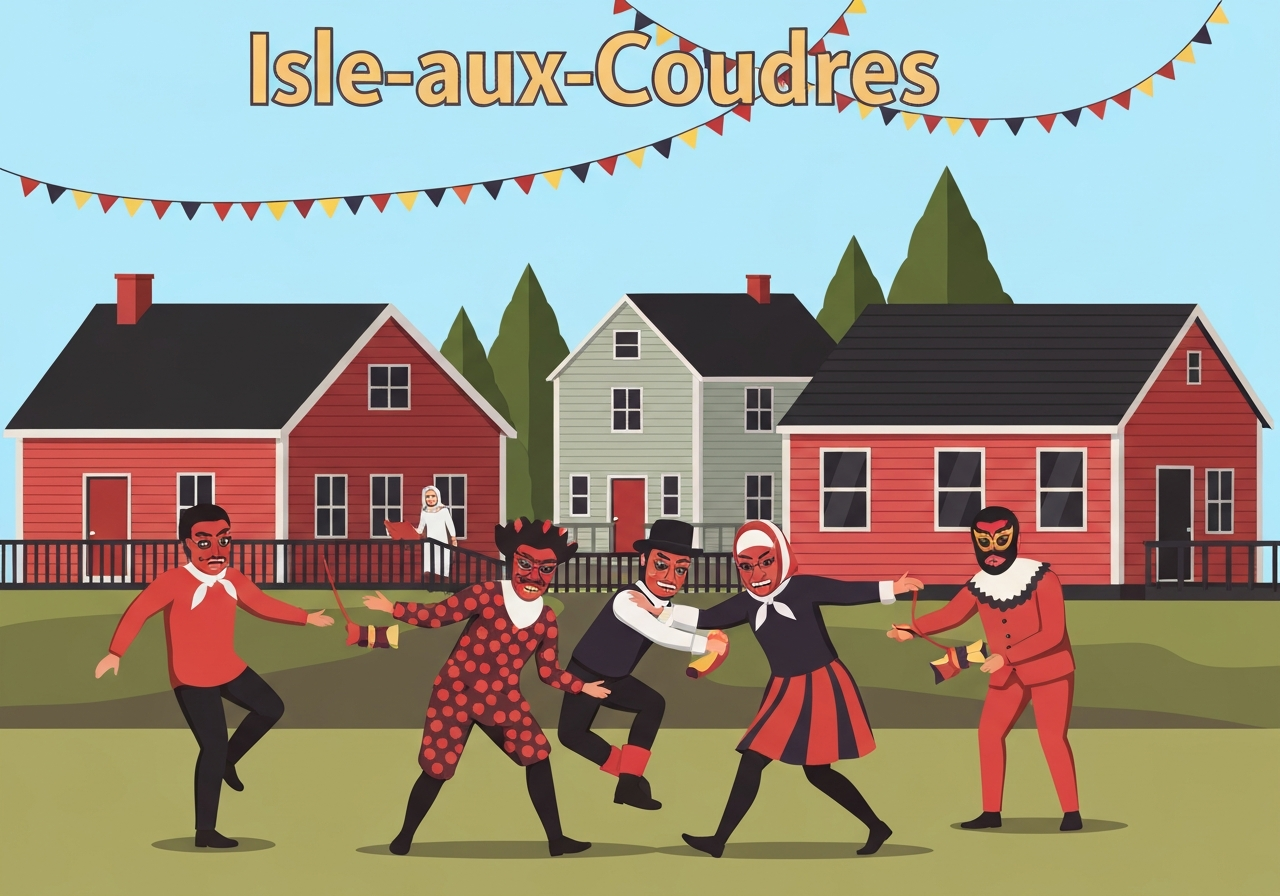
On the evening of March 28, 2026, residents of L’Isle-aux-Coudres, a small island in Quebec’s St. Lawrence River, held their annual Mid-Lent (Mi-Carême) masked festivities. Participants visited homes, bars and community halls wearing wigs, pillows and elaborate masks, performing jigs and music to avoid recognition. The rite, rooted in medieval French practice, endures here even as formal observance of Lent has declined. The gathering combined music—spoons, guitars and button accordions—with a communal ritual of playful concealment and guessing.
Key Takeaways
- Event date: March 28, 2026; the report was filed from L’Isle-aux-Coudres in the St. Lawrence River, accessible only by ferry.
- The celebration is locally known as Mi-Carême (Mid-Lent) and involves masked visitors performing jigs at private and public venues.
- Traditional instruments noted at the event included spoons, guitars and button accordions, led in one instance by homeowner Cyrille Dufour.
- Participants use wigs, hats, pillows under heavy coats and handmade costumes to disguise identity; one participant identified in visuals was Laurence Harvey, 27.
- Mi-Carême traces its roots to medieval France and now survives in a small number of French-speaking Canadian communities, often in isolated islands of the St. Lawrence.
- The ritual functions as both a social event and a local assertion of cultural continuity amid broader secularization in Quebec.
Background
Mi-Carême or Mid-Lent is a masked, music-centered custom with origins in medieval French calendars of festivity tied to the Lenten season. Historically, such mid-Lent revels allowed communities a sanctioned interval of levity between Ash Wednesday and Easter, often featuring disguise, satire and music. In Quebec, the tradition arrived with French settlers and persisted longest in geographically concentrated, francophone enclaves where communal rituals carried cultural memory across generations. Over the 20th and 21st centuries, formal religious practice in Quebec declined; nonetheless, a small number of localities have retained Mi-Carême as a largely secular community celebration.
Islands in the middle reaches of the St. Lawrence River—places with ferry-only access and tightly knit populations—have proved especially resilient repositories for this practice. The relative isolation of communities such as L’Isle-aux-Coudres has helped preserve specific performance elements: door-to-door masked calls, improvised instrumentals and collective guessing games to reveal disguised identities. Local organizers and long-time participants often craft costumes by hand, maintaining a material culture that ties present-day festivities to earlier forms. These pockets of continuity illustrate how cultural rituals can survive institutional change by shifting from religious observance to communal tradition.
Main Event
As dusk fell on the island on March 28, masked groups climbed a snow-covered path to a hilltop house overlooking the river, following a pattern repeated in recent local Mid-Lent gatherings. Upon entering, visitors were prompted to perform a jig before the household; the music and dance served both as entertainment and as a test of anonymity. The homeowner in one scene, identified as Cyrille Dufour, beat spoons while others played guitars and a button accordion, calling out for performers to “let loose”—a call that forced dancers to reveal signature steps and often exposed their identities.
Costuming combined theatrical disguise with local improvisation: wigs and hats covered faces, pillows under heavy coats changed body shapes and masks ranged from handmade papier-mâché to simpler fabric coverings. Participants moved between private homes, bars and community centers, and the aim—by common agreement—was to avoid being recognized while delivering lively performances. When guesses were offered aloud the atmosphere was playful and communal; correct identifications were greeted with laughter rather than reproach. Visual documentation of the night included close-up images of participants preparing costumes and mid-dance, capturing both the craft and conviviality of the evening.
The event drew a cross-section of islanders, including younger adults such as Laurence Harvey, 27, who were shown finishing costume touches prior to joining the processions. Organizers and long-time attendees framed the night as a social anchor: a chance to gather in winter, reinforce neighborly ties and celebrate a shared local past. While the scale of participation was modest compared with commercial festivals, the intensity of engagement—music, guessing, in-person hospitality—was high and central to how the ritual is perpetuated.
Analysis & Implications
Mi-Carême’s persistence on L’Isle-aux-Coudres highlights how folk rituals can outlast the institutional frameworks that spawned them. As church attendance in Quebec has generally declined over decades, the rite has been reframed from a liturgical observance into a communal cultural practice. That reframing allows the custom to function as a marker of local identity rather than as a confessionally charged act, increasing its appeal for residents who no longer observe Lent in a religious sense.
Local continuity depends on intergenerational transmission: older participants teach costume-making, music and the social rules of the night to younger islanders. Where such transmission weakens—through outmigration, demographic aging or shifting leisure patterns—the ritual risks attenuation. Conversely, the event’s uniqueness and photogenic qualities could attract visitors, offering a small tourism benefit but also exposing the tradition to commodification pressures that might alter its character.
Policy choices at municipal and provincial levels could influence the ritual’s future. Recognition by cultural heritage programs can provide resources for preservation without formalizing the event in a way that sterilizes its spontaneity. For fragile practices like Mi-Carême, sensitive support—documentation, workshops, small grants—can help sustain living cultural knowledge while leaving core social dynamics in the hands of the community itself.
Comparison & Data
| Aspect | Traditional Form | Contemporary Isle Practice |
|---|---|---|
| Origin | Medieval France (liturgical social breaks) | Localized folk ritual with secular emphasis |
| Primary settings | European villages, church-linked calendars | Houses, bars, community halls on St. Lawrence islands |
| Instruments | Fiddles, pipes, improvised percussion | Spoons, guitars, button accordions |
The table above outlines continuities and adaptations: while the core structure—masked visits and music—remains, the practice on L’Isle-aux-Coudres operates in a distinctly local and largely secular register. That shift matters for how the event is transmitted, funded and experienced by participants and visitors alike.
Reactions & Quotes
Scenes from the night prompted short, emphatic exchanges that illuminate the ritual’s tone and social rules.
“Let loose!”
Cyrille Dufour (homeowner, leading the music)
Mr. Dufour’s call came as masked visitors were asked to perform jigs and reveal signature steps; his words signaled both encouragement and the communal expectation of spirited display.
“Do we know who it is?”
An onlooker during identity-guessing
The question punctuated rounds of guesses; correct identifications were typically met with good-natured laughter and brief storytelling rather than public embarrassment.
Unconfirmed
- Exact participant count for the March 28, 2026 gathering: available reporting shows several groups and scenes, but a complete tally was not published.
- Specific historical continuity claims tying every costume element directly to a single medieval prototype remain unverified; academic studies document broad links but not one-to-one correspondences.
Bottom Line
Mi-Carême on L’Isle-aux-Coudres on March 28, 2026 exemplifies how localized ritual adapts to changing social landscapes: religious context has faded, but communal performance and craft persist. The celebration operates as a form of cultural memory, reproducing material practices (costume-making, music) and social norms (visiting, guessing) that bind neighbors in shared moments.
The ritual’s future will likely hinge on the island’s demographic dynamics and choices by local custodians about whether to open the event to outsiders or preserve its intimacy. Sensitive documentation and community-led support can help maintain authenticity while ensuring younger residents encounter and learn the practices that sustain the night.