
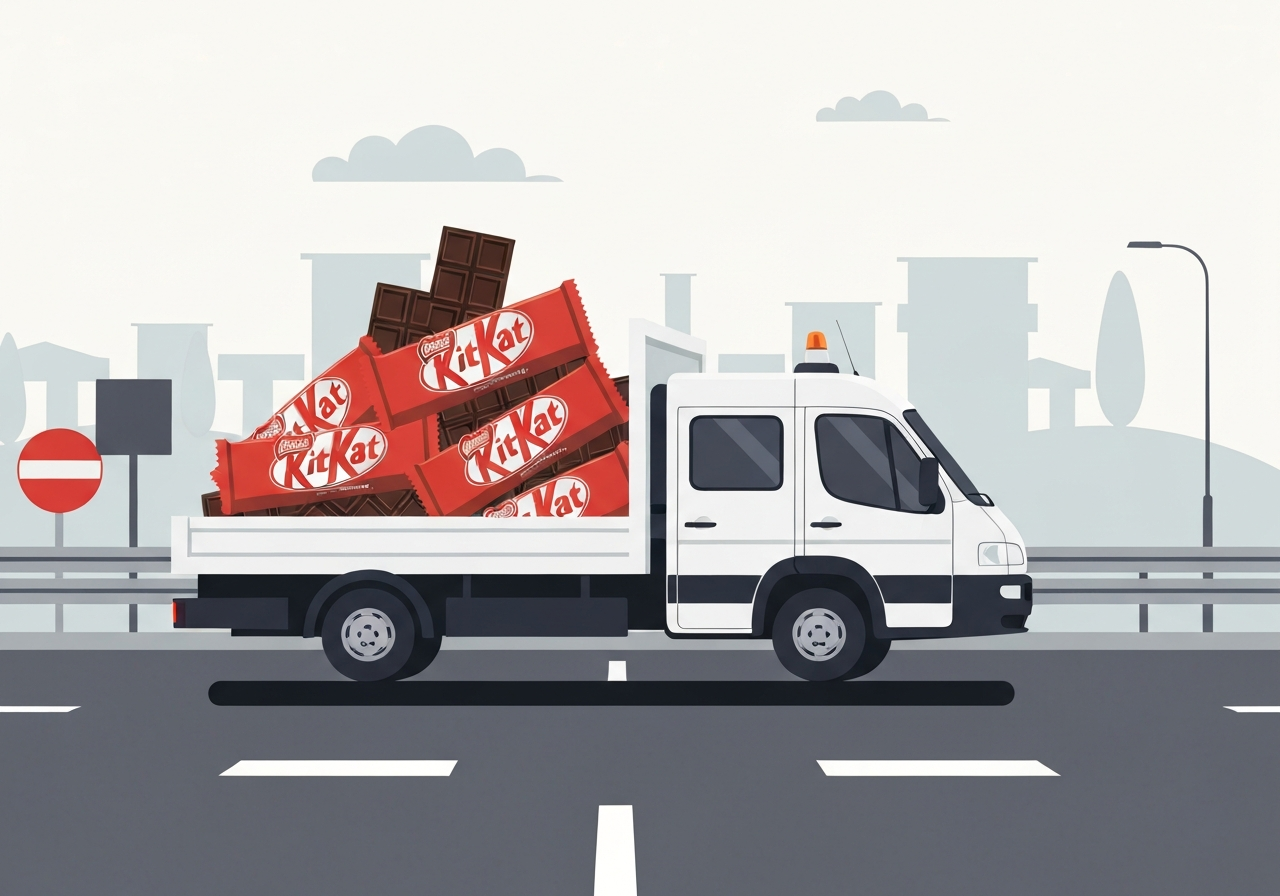
Lead: On 26 March a truck carrying 413,793 KitKat confectionery units—roughly 12 tonnes of a new Formula One-themed chocolate line—was stolen while traveling through central Italy en route to Poland. Nestlé, KitKat’s parent company, confirmed the theft and said it is working with local authorities and supply-chain partners to investigate. The vehicle and the cargo remain missing and no injuries were reported. Nestlé warned the loss could feed unofficial markets if the goods are resold.
Key Takeaways
- 413,793 units of KitKat bars were taken on 26 March; the shipment weighed about 12 tonnes, according to Nestlé and AFP reporting.
- The stolen load comprised KitKat’s new Formula One (F1) line—bars molded after race cars—released after KitKat became an official F1 partner last year.
- The truck departed a factory in central Italy and was bound for Poland when it was intercepted; the vehicle and cargo have not been recovered.
- There were no reported injuries during the incident, Nestlé told The Athletic.
- Nestlé says batch codes can allow authorities to trace stolen products if they appear in secondary markets.
- Company officials described cargo theft as an escalating problem and publicly disclosed the case to raise awareness.
Background
Cargo theft across Europe has risen in recent years, driven by organized opportunism and gaps in last-mile security. High-volume food shipments are attractive because they’re bulky, relatively low-risk to resell, and often move across multiple jurisdictions. Manufacturers and carriers have increasingly reported losses around holiday periods, when volumes and demand spike and convoy patterns can be predictable.
Nestlé is a global food company with complex cross-border logistics for brands like KitKat. The company announced last year that KitKat became the official Formula One chocolate partner, and subsequently introduced an F1-themed confection line. That marketing step increased the profile and novelty value of certain shipments, making them potentially more desirable to resellers or collectors in informal channels.
Main Event
According to Nestlé and reporting by Agence France-Presse, the truck carrying the F1 KitKat consignment left a central Italy factory on 26 March and was heading toward Poland when thieves seized the vehicle and removed the cargo. Company statements and media accounts confirm the 413,793-unit total and an approximate weight of 12 tonnes.
Nestlé said the company is cooperating with local police and supply-chain partners; investigators are cataloguing batch codes and shipment records while canvassing likely transit routes. As of the latest public statements, neither the truck nor the chocolate bars have been located.
The company framed the theft as an example of a broader trend, noting that increasingly sophisticated schemes are being used to target goods in transit. Nestlé also warned that stolen food products can surface in unofficial markets and urged retailers and consumers to be vigilant about provenance and batch verification.
Analysis & Implications
The immediate operational impact is twofold: a direct product loss for Nestlé and potential downstream supply disruption for distributors and retailers, especially with Easter demand rising. A shipment of this size—over 400,000 units—represents a meaningful local inventory shortfall and could cause temporary availability issues for outlets expecting the F1 line.
From a security perspective, the incident highlights persistent vulnerabilities in cross-border freight movement. Trucks that transit multiple countries face jurisdictional complexity: responsibility for monitoring, rapid incident response and evidence sharing can be fragmented between carriers, shippers and local police. That fragmentation helps explain why goods sometimes disappear without quick recovery.
There are reputational and safety risks if stolen consumables enter informal markets. Even where batch codes exist, products handled outside authorized distribution channels may be exposed to tampering or improper storage. Nestlé’s emphasis on batch-code traceability is intended to allow law enforcement to flag and remove diverted goods, but traceability depends on active monitoring by retailers and cooperation from secondary-market platforms.
Comparison & Data
| Metric | Value |
|---|---|
| Units reported stolen | 413,793 |
| Approximate weight | ≈12 tonnes |
| Date of theft | 26 March 2026 |
| Origin | Factory in central Italy |
| Destination | Poland (final distributor) |
To put the loss in context, a single 12-tonnes food load represents a large palletized shipment; losing this much product in one incident is unusual but not unprecedented in regions experiencing concentrated cargo theft. The holiday season—Easter in this case—raises the economic and logistical impact because retailers increase orders to meet higher consumer demand.
Reactions & Quotes
Officials at Nestlé issued public comments as the firm coordinated with authorities and partners.
“We’ve always encouraged people to have a break with KitKat—unfortunately thieves appear to have taken that message too literally and made a break with more than 12 tonnes of our chocolate.”
Nestlé (company statement)
“Cargo theft is an escalating issue for businesses of all sizes; with more sophisticated schemes being deployed on a regular basis.”
Nestlé (company statement)
Media outlets that covered the case noted the theft’s timing before Easter and highlighted concerns that novelty F1-shaped bars could surface in unofficial channels; law-enforcement investigators are pursuing leads along known transit corridors.
Unconfirmed
- Whether any of the stolen KitKat bars have already been sold through informal or online secondary markets remains unverified.
- No public attribution to a specific criminal group or organized syndicate has been confirmed by authorities.
- Details on how the thieves intercepted the vehicle (e.g., forced stop, false paperwork, insider assistance) have not been publicly disclosed.
Bottom Line
The theft of 413,793 KitKat units on 26 March is a substantial single-incident loss that underscores growing cargo-theft risks for packaged-food logistics in Europe. For Nestlé, the immediate priorities are product recovery, protecting consumers from diverted goods and tightening controls on high-value or highly visible shipments.
For retailers and consumers, the case is a reminder to verify provenance and exercise caution when buying unusually priced or out-of-channel food products. For industry and policymakers, it illustrates the need for improved cross-border coordination, better real-time shipment visibility and incentives for carriers to invest in hardened security measures.
Sources
- The Guardian (international newspaper reporting)
- Agence France-Presse (AFP) (news agency reporting referenced)
- The Athletic (sports news outlet cited for company comment)
- Nestlé corporate media/press (official company statements and press resources)