
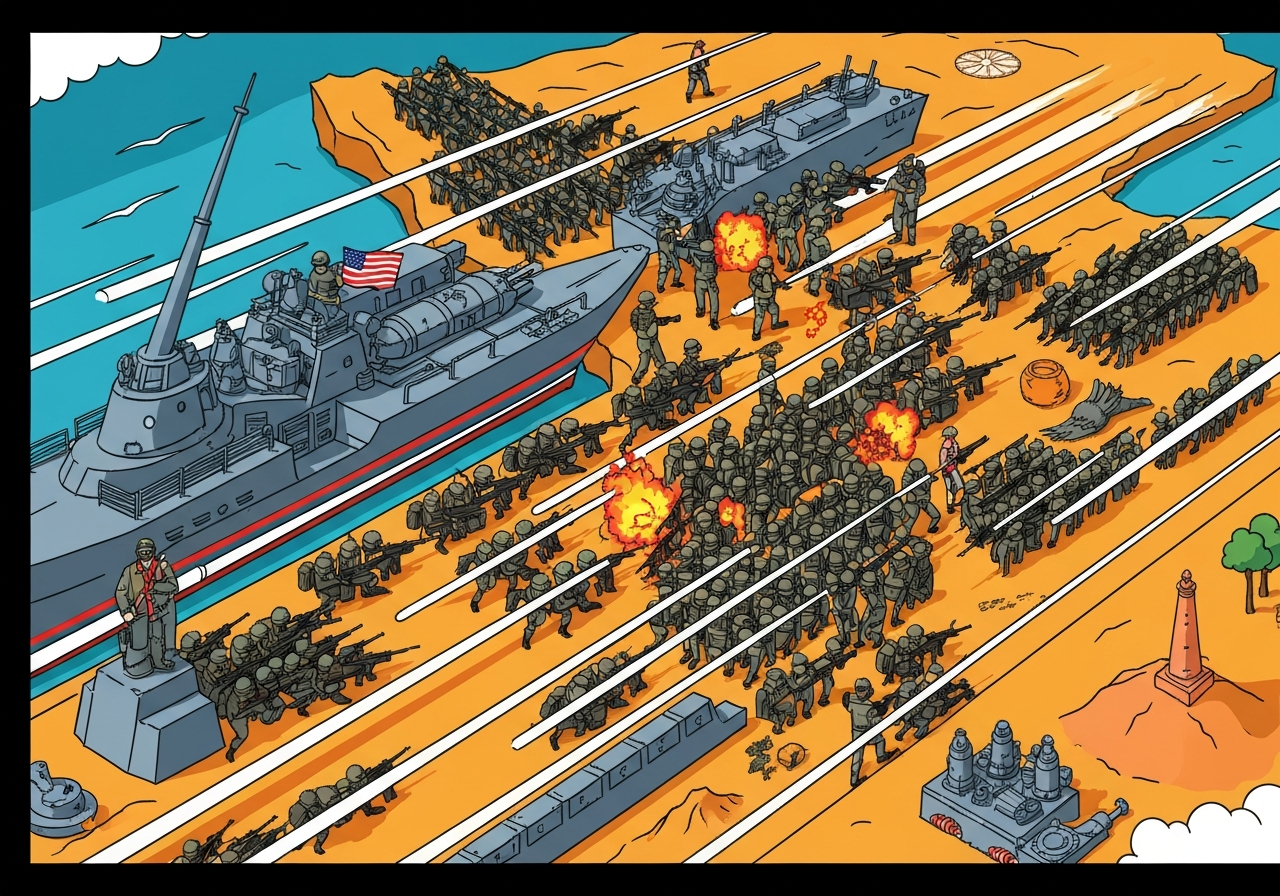
Lead: More than 3,500 U.S. service members, led by the America-class amphibious assault ship USS Tripoli with roughly 2,500 Marines aboard, reached the U.S. Central Command area of responsibility on March 27–28, 2026. The deployment comes amid an intensifying campaign between Iran and U.S.-aligned partners that has seen over 11,000 strikes since Operation Epic Fury began on Feb. 28. The movement follows missile-and-drone strikes on Prince Sultan air base that injured 10 U.S. personnel and comes as regional actors, including Houthi militants, expand their involvement. Washington says the forces increase options for the president while stressing no U.S. ground invasion is planned.
Key Takeaways
- More than 3,500 U.S. troops were ordered into the Middle East; the USS Tripoli carries about 2,500 Marines as part of the Tripoli ARG/31st MEU.
- CENTCOM reports more than 11,000 targets struck since Operation Epic Fury began Feb. 28, 2026.
- At least 10 U.S. service members were wounded, including two seriously, after Iran launched six ballistic missiles and 29 drones at Saudi Arabia’s Prince Sultan air base.
- Washington also ordered the USS Boxer and two additional ships plus another Marine Expeditionary Unit from San Diego to the theater.
- Houthi rebels said they launched a missile this weekend, marking deeper entry into the month-old conflict and threatening Bab el-Mandeb shipping routes.
- About 12% of global trade typically transits Bab el-Mandeb; 10% of maritime trade and 40% of container traffic moves through the Suez Canal annually, amplifying economic risk.
Background
The current escalation traces to a rapid cycle of strikes between Iran, U.S. partners and Israeli operations since late February. The United States launched Operation Epic Fury on Feb. 28, 2026, citing threats to regional bases, shipping and U.S. personnel. CENTCOM has documented more than 11,000 strikes tied to the campaign, a figure that U.S. military officials use to describe the scale of operations across multiple fronts.
Maritime chokepoints are at the center of the crisis. Tehran’s posture around the Strait of Hormuz and reported disruptions there have prompted exporters and governments to reroute crude and commercial traffic through the Bab el-Mandeb and the Suez Canal. Those route changes are economically consequential because a significant share of global seaborne trade and container traffic flows through those narrow passages.
Main Event
On March 27–28, CENTCOM said the USS Tripoli arrived in its area of operations after an order to deploy from its previous base in Japan. The ship, an America-class “big deck,” supports F-35s, MV-22 Ospreys and a range of amphibious assault capabilities, providing both air and shipborne strike options.
U.S. officials also ordered the USS Boxer and two other vessels, together with an additional Marine Expeditionary Unit, to join the theater from San Diego. Military spokespeople framed the arrivals as enhancing presidential flexibility and the range of military options without signaling an intent to introduce ground combat formations into Iran.
The deployments followed a salvo of missiles and drones from Iran that struck near Prince Sultan air base in Saudi Arabia, wounding 10 U.S. service members, two seriously. U.S. leaders have cited those attacks as justification for bolstering forces to protect bases, shipping and partner nations in the region.
Analysis & Implications
The arrival of a sizable amphibious ready group centered on USS Tripoli alters force posture in the region by adding air-deployed strike fighters, transport aircraft and amphibious assets that can perform a variety of missions from strike to evacuation. That flexibility is likely intended to deter further attacks, reassure regional partners and preserve decision space for U.S. political leadership.
Economic consequences are immediate and measurable: disruptions to the Strait of Hormuz and increased attacks in the Red Sea raise shipping insurance rates, reroute tankers, and have contributed to higher fuel prices globally. If Houthi forces expand attacks in Bab el-Mandeb, expect further upward pressure on freight rates and energy markets.
Politically, the deployment navigates a narrow line: U.S. civilian leaders, including Secretary of State Marco Rubio, emphasize achieving objectives without committing ground forces while ordering assets that could support escalatory options. That tension reflects a strategy of calibrated pressure designed to signal resolve without precipitating wider regional war.
Comparison & Data
| Metric | Value |
|---|---|
| U.S. troops deployed (this movement) | 3,500+ |
| Marines aboard USS Tripoli | ~2,500 |
| Targets struck since Feb. 28 (Operation Epic Fury) | >11,000 |
| Missiles/drones reported in Prince Sultan attack | 6 missiles, 29 drones |
| Bab el-Mandeb share of world trade | ~12% |
| Suez Canal share of maritime trade | ~10% (40% container traffic) |
These figures show how rapidly military actions translate into economic and strategic effects: high-strike counts reflect broad targeting across multiple fronts, while maritime transit percentages explain why shipping disruptions have an outsized global impact. The amphibious group’s capabilities—aircraft, helicopters, amphibious ships—provide the U.S. with options short of large-scale ground deployments.
Reactions & Quotes
U.S. civilian leadership framed the deployment as a measured step to preserve options. Secretary of State Marco Rubio told reporters that the United States can reach its goals “without any ground troops,” while also stressing the need for preparedness for multiple contingencies.
“We can meet our objectives without any ground troops.”
Secretary of State Marco Rubio (official statement)
Regional analysts warned that Houthi involvement could broaden the conflict and hit commercial shipping, with economic fallout beyond energy markets. Ahmed Nagi of the International Crisis Group highlighted the potential for wider maritime insecurity if attacks expand.
“The impact would not be limited to the energy market.”
Ahmed Nagi, International Crisis Group (NGO analyst)
CENTCOM’s public posts documented the Tripoli’s arrival and emphasized force posture and deterrence. U.S. military statements framed the movement as reinforcing the theater to protect personnel and maintain operational flexibility.
Unconfirmed
- The precise source and effectiveness of the missile the Houthis claimed to have launched this weekend are not independently verified at the time of reporting.
- Plans to reroute or redeploy the USS Gerald R. Ford from Croatia into the Red Sea remain speculative and unconfirmed by official U.S. defense notices.
- Negotiation details between Washington and Tehran, including the exact contents of the reported 15-point and five-point proposals, were summarized by parties and lack a publicly disclosed, item-by-item confirmation.
Bottom Line
The arrival of over 3,500 U.S. personnel, spearheaded by the USS Tripoli and its embarked Marine unit, is a deliberate effort to increase military options and deter further attacks in an expanding regional conflict. While U.S. officials emphasize that no ground invasion is planned, the deployments increase the risk calculus for all parties and raise the stakes for decision makers balancing deterrence and escalation control.
Economic and maritime impacts will likely persist: alternative routing through Bab el-Mandeb and the Suez Canal cannot fully absorb global shipping flows without higher costs and delays, and further Houthi strikes could amplify that strain. The situation remains fluid; close attention to verified military movements, diplomatic exchanges and shipping incidents will determine whether this posturing stabilizes or widens the war.
Sources
- CBS News — (news report, March 28, 2026)
- U.S. Central Command (CENTCOM) — (official military social media)
- International Crisis Group — (NGO analysis)