
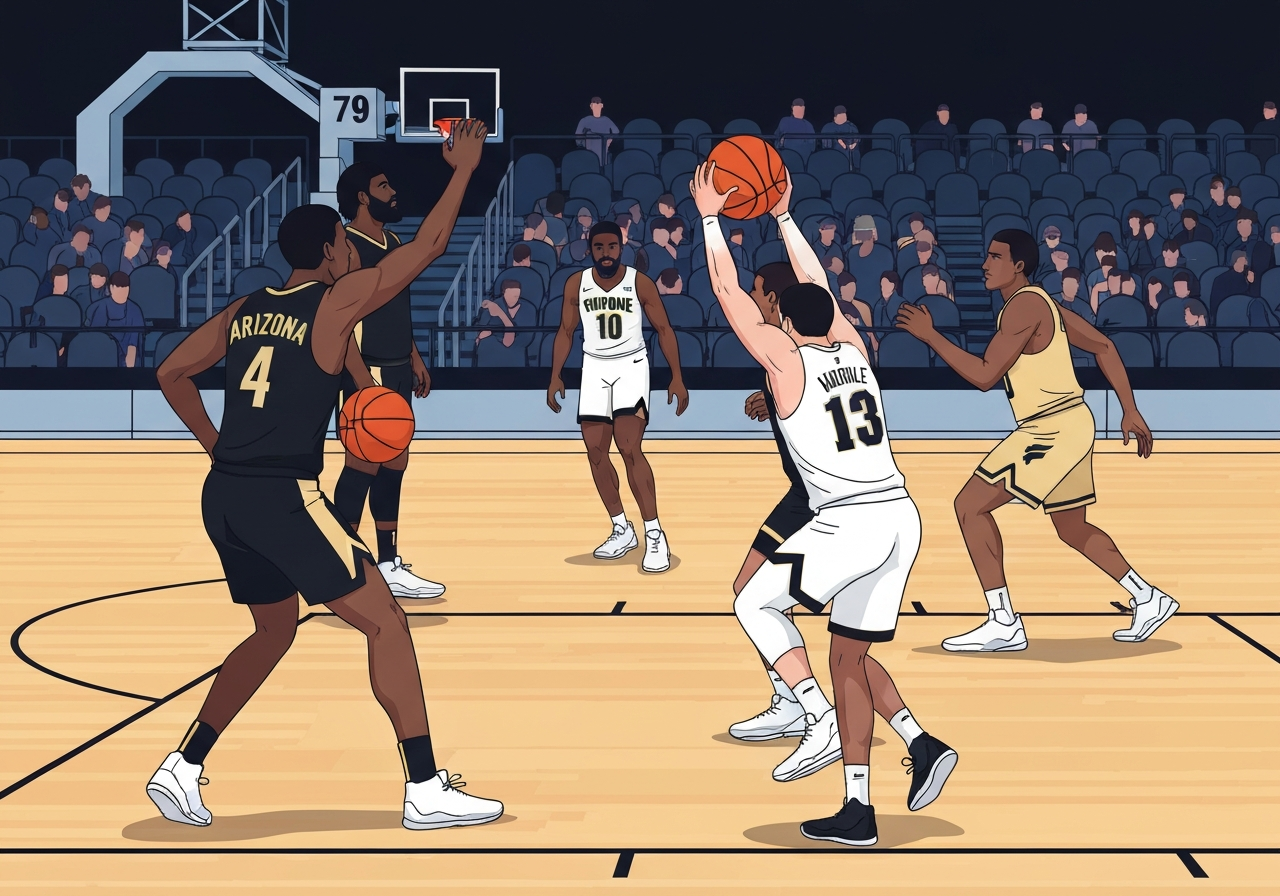
Lead: In an Elite Eight game on March 30, Arizona defeated Purdue 79-64 in a matchup that decided a trip to the Final Four. Purdue led 38-31 at halftime after a strong first-half effort, but a collapsing offense and roster setbacks in the second half allowed Arizona to seize control. The loss ends Purdue’s season and a senior class’ run at a return to the Final Four two years after the program reached the national title game. Key contributors for Purdue included Oscar Cluff (14 points, 10 rebounds) and Braden Smith (11 points).
Key Takeaways
- Purdue led 38-31 at halftime after overturning an early 19-12 deficit; the Boilermakers shot 7-for-14 from three in the first half.
- Oscar Cluff finished with a team-high 14 points and 10 rebounds in 39 minutes, recording a double-double in the game.
- Braden Smith added 11 points (3-for-6 on threes), 4 rebounds and 3 assists in the first half before an apparent ankle injury in the second half.
- Purdue committed six first-half turnovers and was limited to 9-for-28 shooting in the second half, including 1-for-8 from long range.
- Trey Kaufman-Renn picked up his third foul within the opening 39 seconds of the second half, which contributed to a quick momentum swing.
- Purdue grabbed eight offensive rebounds in the game versus Arizona’s four, but could not convert enough second-half opportunities.
- The 79-64 final score eliminates Purdue’s bid to return to the Final Four; Arizona advanced to the national semifinals.
Background
Elite Eight games carry outsized significance in college basketball: a single win produces a Final Four appearance that becomes central to coaches’ legacies and program history. Purdue last reached the Final Four and then the national championship game two seasons ago, ending decades of near-misses for the program. That recent run raised expectations for this senior class and amplified the stakes for any deep tournament game.
Purdue arrived in this matchup as a veteran team built around interior size and perimeter shooting, while Arizona was widely regarded for its length, transition defense and ability to attack the rim. Both programs have national profiles and experienced coaching staffs focused on preparation for do-or-die tournament contests. Historically, Elite Eight games reward teams that can sustain offensive consistency and avoid foul trouble or untimely injuries.
Main Event
The game opened with Arizona building an early margin that forced Purdue to rely on a series of responses. By the end of the first half the Boilermakers had flipped a 19-12 deficit into a 38-31 lead, powered by hot perimeter shooting and active rebounding. Four different Purdue players hit three-pointers in the first 20 minutes, and the team out-rebounded Arizona 20-15 in that span.
Purdue’s bench provided timely minutes in the first half: Oscar Cluff played all 20 minutes, scoring 5 points and grabbing 4 rebounds before the break, and Daniel Jacobsen logged seven minutes in relief of Trey Kaufman-Renn while the latter dealt with foul trouble. Jacobsen’s activity on defense included a blocked shot and energetic positioning, even though he did not record points or rebounds in those minutes.
The second half turned sharply against Purdue almost immediately. Kaufman-Renn collected his third foul within the first 39 seconds of the period, and Braden Smith departed with an apparent ankle injury shortly after, removing two key components of Purdue’s first-half momentum. Arizona exploited those absences and opened the lane repeatedly, drawing free throws and scoring with more frequency.
Purdue’s offense stagnated in the second half: the Boilermakers went 9-for-28 from the field and 1-for-8 from three in the final 20 minutes (their lone three came late and had no bearing on the final margin). Arizona’s surge erased the seven-point halftime lead within the first 4:09 of the half and stretched the advantage into double digits as Purdue struggled to generate secondary offense or consistent stops.
Analysis & Implications
Purdue’s loss highlights how fragile tournament momentum can be when foul trouble and injuries collide. The third-foul on Kaufman-Renn immediately altered lineup construction, forcing Purdue to rely more heavily on younger or less-used frontcourt options. Smith’s ankle issue further reduced perimeter spacing and outside shooting — areas that had been crucial to Purdue’s half-court offense.
Turnovers and late-game shot selection compounded the situation: six first-half turnovers kept Arizona within striking distance despite Purdue’s rebounding edge, and inefficient second-half shooting (9-for-28) undone earlier gains. In single-elimination play, a team that cannot sustain shooting performance across 40 minutes is vulnerable to opponents that can generate consistent paint opportunities and trips to the foul line.
For Purdue’s program, the loss closes a season defined by veteran leadership and a group of seniors who re-elevated expectations after a Final Four run two seasons prior. Programmatically, the defeat will factor into evaluations of depth, late-game execution and how the coaching staff prepares contingency plans for foul trouble. Recruiting and roster management over the off-season are likely to be influenced as the staff seeks to replace minutes lost to graduation and to shore up perimeter depth.
Comparison & Data
| First Half | Second Half | Game | |
|---|---|---|---|
| Purdue Points | 38 | 26 | 64 |
| Purdue 3PT | 7-14 | 1-8 | 8-22 |
| Purdue FG (2H) | — | 9-28 | — |
| Rebounds (1H) | Purdue 20 — Arizona 15 | — | Off Rebounds: Purdue 8 — Arizona 4 |
Context: the table underscores a stark split between halves. Purdue’s first-half three-point accuracy and rebounding created a lead, but the second half’s poor field-goal percentage and low three-point conversion allowed Arizona to erase and surpass that advantage. Offensive rebound totals show Purdue fought on the glass but could not convert enough possessions into points when it mattered.
Reactions & Quotes
“The other team has a say in the outcome as well.”
Matt Painter, Purdue head coach (postgame remark)
“We found ways to attack in the second half and get to the line, which gave us separation.”
Tommy Lloyd, Arizona head coach (postgame remark)
“This group gave us a season full of memorable moments; it’s painful to see it end, but those memories remain.”
Purdue program spokesperson / senior reflections (postgame comments)
Unconfirmed
- Exact count of Daniel Jacobsen’s blocked shots in the first half is unclear from available play-by-play; official box score lists one block but some viewers recall more.
- The long-term severity of Braden Smith’s ankle sprain was not officially announced immediately following the game; further medical updates are pending.
- The degree to which officiating influenced the free-throw disparity is debated among fans and commentators; a formal review or league statement was not issued at the time of reporting.
Bottom Line
Purdue’s Elite Eight exit came down to a clean split: a first half of effective spacing, timely threes and strong rebounding, and a second half of offensive stagnation, foul trouble and an untimely injury. Oscar Cluff’s double-double and early contributions from multiple players were not enough to sustain a full 40-minute effort against a disciplined Arizona team.
For Purdue, the immediate focus will be on honoring the senior class and assessing roster needs in the offseason — particularly depth to handle foul trouble and bench scoring. For fans, the loss stings now but becomes part of a larger program narrative: a recent Final Four appearance, a national title game run two years ago, and a continuing pursuit of college basketball’s ultimate prize.