
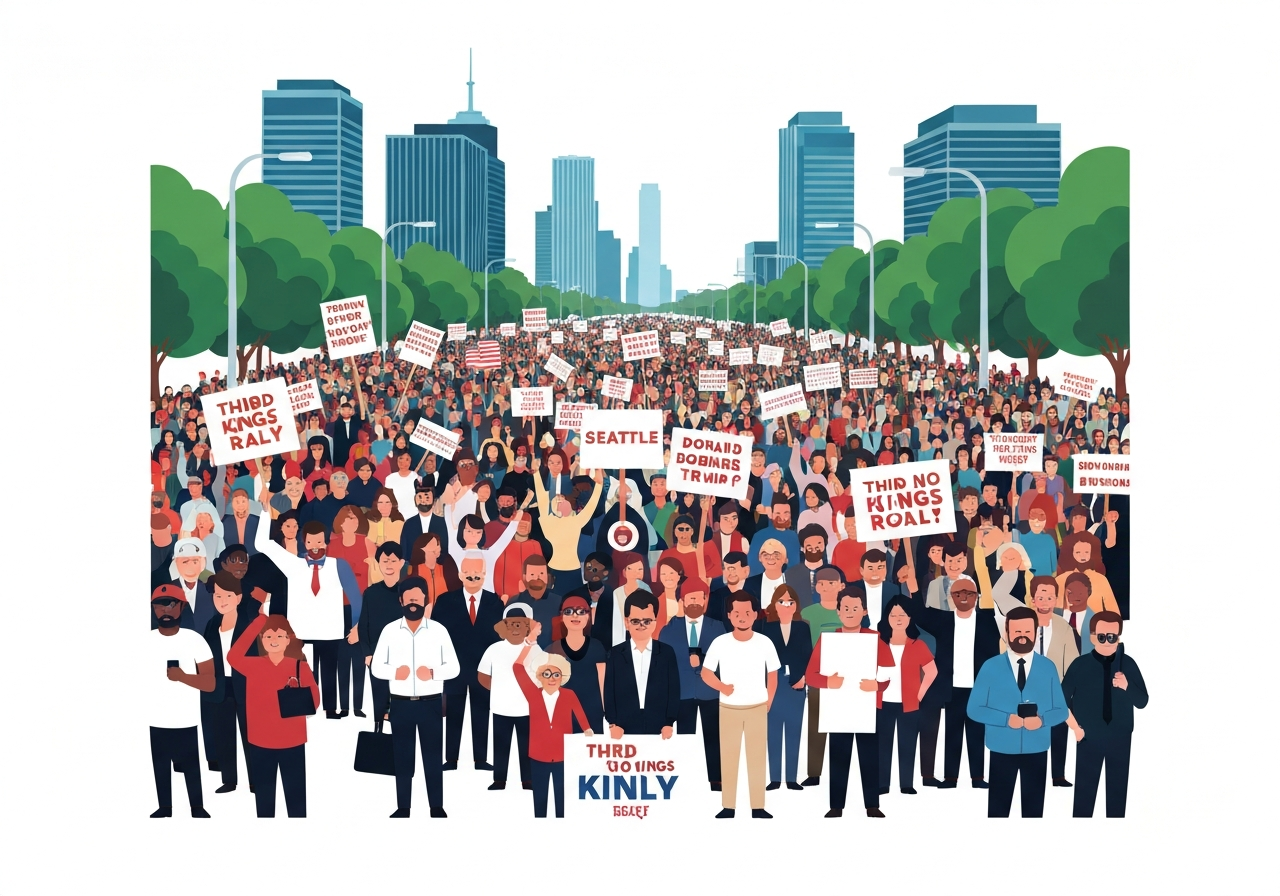
Lead: On Saturday, tens of thousands gathered at Cal Anderson Park and marched through downtown Seattle in the third “No Kings” rally opposing President Donald Trump. Washington’s attorney general, Nick Brown, spoke to a packed crowd that organizers say numbered between 90,000 and 100,000 in the city. The demonstration — part of an estimated 3,100 coordinated events nationwide — focused on opposition to Immigration and Customs Enforcement (ICE), U.S. military actions abroad, and what speakers described as the expanding use of presidential power. The day ended with a multi-block march toward Seattle Center and parallel gatherings across the Salish Sea and the state capital in Olympia.
Key Takeaways
- Indivisible, the event organizer, estimated Seattle turnout at 90,000–100,000; the original No Kings Day in June drew about 70,000 people downtown.
- The third Seattle rally was one of roughly 3,100 No Kings events held across the U.S. on Saturday, with activities in every state.
- Speakers emphasized three demands: “No ICE, No Wars, No Kings,” linking immigration enforcement, foreign military action, and executive authority.
- Smaller nearby cities, including Olympia, Bellevue and Bellingham, reported increased turnout; the Washington State Patrol put the Olympia crowd at about 4,000.
- Speakers included Attorney General Nick Brown, Common Power organizer Charles Douglas, Puget Sound Sage’s Aretha Basu and Minneapolis pastor Sergio Amezcua, a former Trump voter turned critic.
- Organizers and participants cited recent national developments — including U.S. action in Iran and detentions and shootings tied to immigration enforcement — as drivers of protest energy.
- Counterprotests occurred near the state Capitol in Olympia, where opponents focused on state tax policy and criticized Gov. Bob Ferguson.
Background
The No Kings demonstrations began as a large-scale Seattle protest in June, drawing some 70,000 people, and were followed by another sizable rally in October. Organizers with Indivisible and allied groups have since coordinated a rolling series of regional actions. The movement frames itself around resisting what participants call unchecked executive power, and it has grown into a network that stages simultaneous events across the country to amplify local dissent.
Nationally, speakers and participants pointed to a string of recent headline-making developments as context for renewed mobilization: reports of U.S. military engagement in Iran, claims that U.S. forces captured Venezuelan President Nicolás Maduro, and incidents tied to immigration enforcement that have provoked public outcry. Those events have intensified debate over federal authority and the role of agencies such as ICE. In Washington state, officials including the governor have taken legal and rhetorical positions challenging federal policies, which has in turn energized activist networks and civic groups.
Main Event
The day began with crowds arriving by ferry and foot, many carrying signs and banners as they moved toward a midday rally at Capitol Hill’s Cal Anderson Park. The atmosphere combined elements of a political rally and a community festival: live music, food vendors, and elaborate signage were visible alongside organized chants and coordinated speeches. Attendees packed the length of the park and spilled into adjacent streets, creating a long continuous assembly that organizers say extended for blocks.
At roughly noon, Attorney General Nick Brown addressed the crowd, framing his remarks around lawsuits his office has pursued and declaring an absence of personal fear of the president. Master of ceremonies Charles Douglas of Common Power urged attendees to move from protest to local organizing, emphasizing neighbor-to-neighbor power building rather than reliance solely on electoral politics. Other speakers focused on immigration enforcement, the war in Iran, and broad calls to scale back what they described as overreach by federal power.
Keynote speaker Sergio Amezcua, a pastor from Minneapolis who said he voted for Trump in the previous election, told the crowd his views had shifted amid deportations and family separations. Local activists such as Aretha Basu of Puget Sound Sage highlighted ICE operations as a core target of the day’s demands, and Veterans for Peace executive director Michael McPhearson framed opposition to military action as central to the movement. The crowd then marched down Pine Street toward Seattle Center, a procession that spanned many downtown blocks and included families, longtime activists and first-time protesters.
Analysis & Implications
The scale of the Seattle turnout — if the Indivisible estimate is accurate — suggests sustained and possibly widening opposition within the Pacific Northwest. Large, repeated demonstrations can reshape local political narratives and put pressure on state officials to pursue legal or administrative counters to federal policy. Washington state leaders have already used lawsuits and public statements as tools of resistance, and visible public mobilization may encourage additional state-level actions.
Beyond immediate policy impacts, the rallies function as recruitment and organizing opportunities. Speakers repeatedly urged participants not only to protest but to participate in local civic activity, from neighborhood organizing to voter mobilization. That dual focus — public spectacle plus persistent grassroots work — can translate protest energy into longer-term institutional change if organizations maintain follow-through.
Nationally, the coordinated nature of more than 3,000 events magnifies messages and creates synchronized media moments. For political strategists on both sides, such breadth signals capacities for mobilization that may affect fundraising, messaging and turnout in future elections. However, the translation from protest to policy depends on concrete follow-up: litigation, legislation, or durable shifts in electoral behavior.
Comparison & Data
| Event | Approx. Attendance |
|---|---|
| No Kings Day (June, Seattle) | ~70,000 |
| Second rally (October, Seattle) | tens of thousands (organizer estimates) |
| Third rally (this Saturday, Seattle) | 90,000–100,000 (Indivisible estimate) |
| State Capitol gathering (Olympia) | ~4,000 (Washington State Patrol) |
| No Kings events nationwide | ~3,100 simultaneous events (organizer claim) |
These figures come from organizers and law enforcement statements; crowd-size estimates frequently vary depending on methodology and source. Organizers reported sharper growth in smaller neighboring cities compared with earlier rounds, a trend that could reflect more effective grassroots outreach rather than simply larger urban turnouts.
Reactions & Quotes
Several short remarks captured how leaders framed the day; contextual notes follow each quote.
“This to me looks like history is being made. Y’all, I do not fear Donald Trump.”
Nick Brown, Washington Attorney General
Before and after his remarks, Brown cited his office’s litigation against federal actions; his appearance signaled official-state pushback against federal policies and bolstered the rally’s legal framing.
“If DHS and ICE can be created in our lifetime, it can be abolished in our lifetime.”
Aretha Basu, Puget Sound Sage
Basu’s comment summarized a central demand of many speakers: dismantle or radically reform immigration enforcement institutions viewed by protest leaders as tools of political repression.
“I never thought he’d be doing what he’s doing now.”
Sergio Amezcua, Minneapolis pastor and former Trump voter
Amezcua framed his change of heart as personal and political, emphasizing deportations and family separations as catalysts for shifting Latino support in his community.
Unconfirmed
- Some claims cited at the rally about U.S. military capture of Venezuelan President Nicolás Maduro are reported by attendees; independent confirmation of that specific operation is not established in this article.
- Allegations about conditions inside detention facilities and undisclosed ICE practices were voiced by organizers; detailed, independently verified accounts of those conditions were not produced at the rally and remain subject to investigation.
Bottom Line
The third No Kings rally in Seattle demonstrates continued and possibly expanding grassroots opposition to Trump-era policies in the Pacific Northwest. Large turnout — particularly if organizer estimates hold up under scrutiny — gives state leaders and advocacy groups a visible mandate to pursue legal and civic responses to federal actions.
Whether the energy of Saturday’s demonstrations converts into sustained political change will hinge on post-protest organization: litigation, local policy campaigns, and voter engagement. Observers should watch for coordinated follow-up by Indivisible-affiliated groups, any new state legal actions, and turnout trends in upcoming local and national contests as indicators of the movement’s longer-term impact.
Sources
- The Seattle Times — regional news reporting on the Seattle event and local quotes.
- Indivisible — organizer (national political action group) providing crowd estimates and event coordination details.
- Washington State Patrol — official (law enforcement) source for Olympia crowd estimate and public-safety statements.
- Puget Sound Sage — community advocacy organization (source for speaker statements on immigration).
- Veterans for Peace — advocacy group (source for statements on opposition to war).
- Washington State Office of the Attorney General — official (state government) site for information on the AG’s office and legal actions referenced by speakers.