
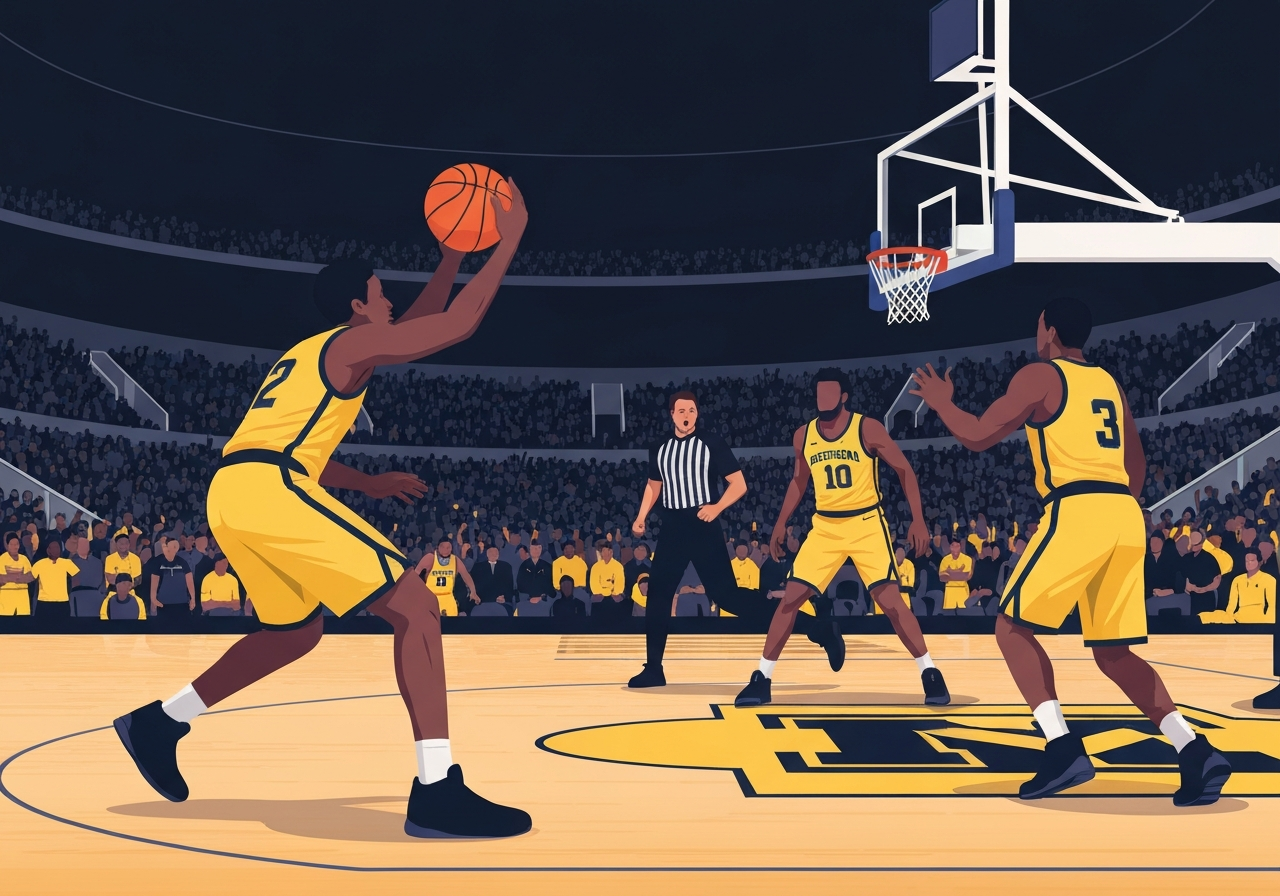
Lead: No. 1 seed Michigan advanced to the national championship after a 91-73 victory over No. 1 seed Arizona in the Final Four on April 4, 2026, in Indianapolis. Michigan built an early advantage and extended it behind hot perimeter shooting and interior control. All‑American forward Yaxel Lendeborg was limited by early foul trouble and a later ankle/knee issue but returned in the second half; Aday Mara led the Wolverines with a career‑high 26 points. Michigan will face No. 2 seed UConn in the title game on Monday.
Key Takeaways
- Final score: Michigan 91, Arizona 73 on April 4, 2026; Michigan advances to the national title game vs. UConn.
- Michigan hit 12 of 27 from 3-point range (44%), while Arizona made 6 of 17 (35%), giving the Wolverines a decisive edge from distance.
- Aday Mara scored a career‑high 26 points and was a primary interior scoring threat against Arizona’s defense.
- Elliot Cadeau recorded a double‑double with 13 points and 10 assists, helping Michigan sustain offensive balance.
- Yaxel Lendeborg played limited minutes after two early fouls and an ankle/knee issue, finishing with 11 points while wearing a left‑leg sleeve.
- Arizona finishes the season 36–3; its two‑point shooting was just 37%, and the Wildcats could not convert enough high‑percentage looks inside.
- Freshmen Brayden Burries and Koa Peat combined for 29 points but shot roughly 30% from the floor and struggled to change the game’s momentum.
Background
The matchup featured two top seeds with contrasting strengths: Michigan’s length and outside shooting versus Arizona’s freshman interior tandem and defensive versatility. Both programs entered the Final Four with high expectations—Michigan seeking a second national title and Arizona looking to cap a 36–3 season. Arizona’s offense this season favored fewer 3-point attempts than most Division I teams, a stylistic choice that has worked in many games but left the Wildcats vulnerable when outside shots did not fall. Michigan relied on a collective attack throughout the tournament, with multiple contributors rather than a single dominant scorer.
Yaxel Lendeborg’s status was a storyline before and during the game; he is an All‑American and the catalyst for much of Michigan’s two‑way play. Early in the semifinal he picked up two quick fouls and later left with an ankle/knee issue, prompting concern about his availability for the title game. Arizona entered the weekend with two highly touted freshmen, Brayden Burries and Koa Peat, whose long‑term prospects include 2026 NBA Draft conversations. The matchup thus framed as experience and depth (Michigan) versus youth and upside (Arizona).
Main Event
Michigan jumped ahead early even with Lendeborg limited to only five minutes in the first half after quick foul trouble. The Wolverines capitalized on Arizona turnovers and strong paint scoring—Aday Mara and Morez Johnson Jr. combined for much of Michigan’s interior damage—building a lead that reached 18 in the first half. Arizona struggled to generate assists (two at halftime) and committed multiple turnovers that translated into easy Michigan points. The Wildcats managed an 11‑2 run at one point to make the game competitive, but their inability to convert consistently inside and from deep kept them behind.
Lendeborg briefly left with an apparent ankle issue late in the first half and was seen receiving treatment; he returned to start the second half wearing a sleeve on his left leg. Even after returning, Lendeborg did not look fully at ease and eventually came out again late in the game with a noticeable limp. Despite that, he added 11 points, while Cadeau orchestrated the offense and finished with 10 assists. Aday Mara scored a career‑high 26 points, finishing as Michigan’s top scorer and helping the Wolverines control the paint and the glass.
Arizona’s freshmen had moments—Koa Peat grabbed 11 rebounds including five on the offensive glass—but the duo of Burries and Peat shot poorly, combining for 5‑for‑24 in one stretch. The Wildcats’ season pattern—few 3-point attempts and reliance on interior offense—left them unable to mount a sustained comeback when Michigan’s perimeter shots fell. By the midpoint of the second half Michigan pushed the lead into the 20s, and Arizona could not close the gap despite historical resilience in prior comebacks this season.
Analysis & Implications
Michigan’s hot 3-point shooting (12‑of‑27) was the single most important factor in the final margin. Hitting above 40% from deep allowed the Wolverines to space the floor and also punished Arizona’s decision to defend more aggressively inside. When a team combines efficient perimeter shooting with size in the paint, it becomes difficult for opponents to find a clear defensive plan—Arizona paid the price for both Michigan strengths in this game.
Arizona’s offensive model, which attempts relatively few 3s compared with most Division I teams, is high variance: when the Wildcats get downhill looks and finish inside they can dominate, but when two‑point attempts fall at only 37% the margin for error vanishes. Against Michigan’s length and rim protection, Arizona’s inside game was repeatedly disrupted. The Wildcats’ season record (36–3) underscores their overall quality, but this matchup highlighted a stylistic vulnerability that stronger defensive teams can exploit.
Lendeborg’s injury introduces a pivotal variable for Monday’s title game. Michigan will prefer to have him near full strength to maximize defensive switches and pick‑and‑roll coverage; his minutes and mobility directly affect lineups and strategic choices. If Lendeborg is limited, Michigan’s depth must absorb more offensive and defensive responsibility, placing greater emphasis on Cadeau’s playmaking and Mara’s interior scoring.
Comparison & Data
| Stat | Michigan | Arizona |
|---|---|---|
| Final score | 91 | 73 |
| 3‑point (made/att, %) | 12/27 (44%) | 6/17 (35%) |
| Leading scorer | Aday Mara — 26 | Brayden Burries + Koa Peat — 29 (combined) |
| Season record | N/A (advanced) | 36–3 |
The table isolates the clearest statistical divergences: Michigan’s perimeter accuracy and Arizona’s combined inside/outside inefficiency. Those differences explain why a game that might have been close instead widened into a 18‑point margin by game’s end.
Reactions & Quotes
Players and coaches framed the result through effort and circumstance, with Arizona emphasizing resolve and Michigan noting the team’s balanced contributions.
“Just our unbreakable spirit. We’ve got to be together through this adversity and we’re gonna be alright.”
Koa Peat, Arizona freshman
Peat’s comment came at the start of the second half after Arizona trailed by 16; he urged cohesion as the Wildcats sought a comeback, reflecting Arizona’s confidence in its past late‑game resilience despite the unfavorable score.
“I feel like it wasn’t as dramatic as it seemed.”
Elliot Cadeau, Michigan guard
Cadeau made the remark in reference to an earlier allergic reaction incident during the week and then helped steady Michigan on the court with a 13‑point, 10‑assist performance that balanced the team’s attack.
“We want to protect him.”
Tommy Lloyd, Arizona head coach
Coach Lloyd’s comment was in context of Arizona’s handling of Bryce James during the tournament and the team’s approach to managing player availability; it underscores how programs weigh player health across a deep postseason run.
Unconfirmed
- Final severity and recovery timeline for Yaxel Lendeborg’s ankle/knee issue remain unclear and will be subject to medical updates ahead of Monday’s title game.
- Any long‑term effect of Lendeborg entering and exiting the game on his conditioning for the title game is speculative until team medical staff release details.
- Projected NBA draft positions for Arizona freshmen are based on mock drafts and scouting assessments, not finalized decisions.
Bottom Line
Michigan’s combination of efficient 3‑point shooting and interior control produced a comprehensive win over Arizona and set up a title‑game meeting with UConn on Monday. Aday Mara’s career night and Cadeau’s playmaking offset concern over Lendeborg’s limited minutes, but his health status will be the chief storyline heading into the championship. Arizona concludes a 36–3 season with questions about offensive execution in elite matchups; the Wildcats’ youth remains an asset for the future despite the semifinal loss.
For Michigan, the challenge ahead is twofold: manage Lendeborg’s recovery and sustain the balanced offensive approach that produced 91 points. The title game will hinge on matchups, rotation decisions tied to health, and which team can impose its preferred style on the other across 40 minutes.