
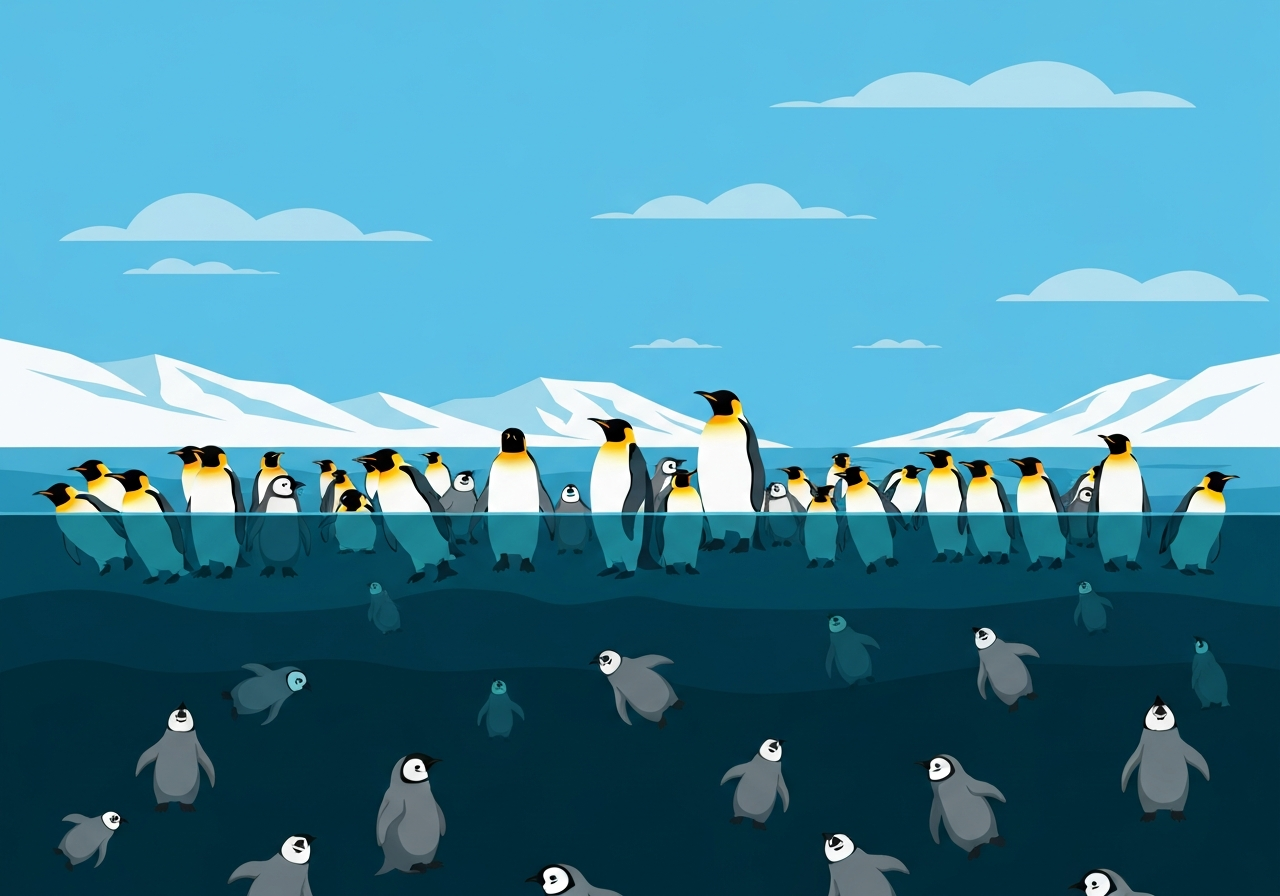
In recent years, large-scale drownings of emperor penguin chicks on Antarctic sea ice have led the International Union for Conservation of Nature (IUCN) to reclassify the species as endangered. The shift follows repeated early breakups of coastal “fast” ice—critical breeding and moulting habitat—most notably colony collapses in the Bellingshausen Sea in 2022 and at least one collapse in the Weddell Sea in 2016. Scientists report thousands of chick deaths when fast ice disintegrates, and project the adult population—currently estimated at 595,000—to fall by roughly half by the 2080s if sea-ice decline continues. Conservation groups are urging immediate emissions cuts and stronger Antarctic protections to reduce other human pressures on the birds’ remaining habitat.
Key takeaways
- The IUCN has upgraded the emperor penguin to Endangered, citing climate-driven loss of sea ice and mass chick mortalities.
- Emperor penguin population is estimated at 595,000 adults; it fell about 10% between 2009 and 2018 and could decline ~50% by the 2080s.
- Four of five known breeding sites in the Bellingshausen Sea collapsed in 2022; a separate Weddell Sea colony collapsed in 2016, causing thousands of chick deaths.
- Adult penguins need fast ice for nine months a year for breeding and moulting; early ice breakup leaves chicks vulnerable to drowning and hypothermia.
- Antarctic fur seals have declined by more than half since 1999, to an estimated 944,000 mature individuals in 2025, largely from krill shortages.
- The southern elephant seal is now listed as Vulnerable after bird flu outbreaks since 2020 hit pup survival in several subpopulations.
Background
Emperor penguins depend on stable coastal sea ice—known as fast ice—for nearly the entire breeding cycle. Pairs incubate eggs and raise downy chicks on that platform until juveniles acquire waterproof feathers and the adults complete their annual moult. That cycle makes any change in the timing or extent of sea ice a direct threat to survival and reproductive success.
Global heating has driven recent record lows in Antarctic sea ice since around 2016, increasing the incidence of premature ice break-up. Researchers monitoring colonies by satellite and field observations have recorded catastrophic events when entire ice platforms disintegrate and chicks, unable to swim or thermoregulate, are thrown into open water. These events have drawn international scientific attention because emperor penguins are a long-lived, slow-breeding species that cannot easily recover from sudden mass mortality.
Main event
In 2022 researchers documented the collapse of four of the five known emperor penguin breeding sites in the Bellingshausen Sea; aerial and satellite surveys indicated the loss involved thousands of chicks. Teams on the ground and in satellite imagery described bodies and dispersal patterns consistent with rapid sea-ice failure rather than localized disease or predation. The timing—during the chick-rearing window—meant most of the young birds were not yet waterproof and drowned or succumbed to hypothermia after exposure.
An earlier event in 2016 saw a Weddell Sea colony suffer a similar rapid collapse, highlighting that the phenomenon is neither isolated nor new. Scientists note that such collapses can be episodic but are projected to become more frequent and widespread as warming trends continue. Field biologists reported the emotional and scientific shock of observing large numbers of dead chicks and the difficulty of responding across remote Antarctic distances.
The IUCN assessment synthesized these field observations with population modelling and sea-ice projections to update its Red List status. The analysis concluded that continued loss of stable fast ice would cut emperor numbers roughly in half by the 2080s under present emissions trajectories. The species therefore moved two threat categories from Near Threatened to Endangered in the latest assessment.
Analysis & implications
The endangered listing signals that climate change is now an immediate extinction driver in Antarctic ecosystems, not a distant risk. Emperor penguins require a predictable nine-month sea-ice window; even a few years of repeated early breakup can reduce recruitment severely and set a population on a long-term downward trajectory. For slow-reproducing species, a cluster of bad breeding years has outsized consequences for population viability.
Beyond the birds themselves, emperor penguins function as a sentinel species whose fortunes reflect broader changes in Antarctic marine systems. A decline in sea ice alters the distribution of krill, the backbone of the Southern Ocean food web, which in turn affects seals, whales and seabirds. The IUCN assessment also flagged a >50% fall in Antarctic fur seals since 1999 and krill displacement to deeper, colder layers as linked drivers.
Policy implications are twofold: mitigation and targeted protection. Rapid reductions in greenhouse-gas emissions are the only way to stabilise long-term sea-ice trends; without that, even well-managed protected areas may not prevent declines driven by changing physical habitat. At the same time, treaty-level protections—limiting tourism, shipping, and local disturbance—could reduce additional stressors and give colonies greater resilience against climatic shocks.
Comparison & data
| Species | Recent estimate / year | Notable trend | IUCN change |
|---|---|---|---|
| Emperor penguin | 595,000 adults (current) | -10% (2009–2018); projected ~-50% by 2080s | Near Threatened → Endangered |
| Antarctic fur seal | 944,000 mature seals (2025) | >50% decline since 1999; krill-driven | Least Concern → Endangered |
| Southern elephant seal | Declining, impacted since 2020 | Major pup mortality from bird flu in several subpopulations | Now Vulnerable |
The table summarises core numbers used by conservation assessments. The emperor penguin figure (595,000 adults) and the 10% decline between 2009 and 2018 are drawn from the IUCN synthesis. Fur-seal and elephant-seal estimates reflect the IUCN findings linking krill declines and disease outbreaks to large-scale demographic change.
Reactions & quotes
Conservation organisations and polar scientists responded with concern and urged urgent action. Their statements combine alarm about the speed of change and calls for policy steps to reduce carbon emissions and protect critical habitat.
“This move to Endangered is a stark warning about accelerating extinction risk from climate change.”
Martin Harper, BirdLife International
BirdLife emphasised that the reclassification should prompt governments to prioritise decarbonisation and stronger protections under the Antarctic treaty. The group coordinated parts of the IUCN assessment and framed the listing as evidence that present policy is insufficient.
“Early sea-ice breakup is already disrupting breeding, feeding and moulting around Antarctica.”
Dr Philip Trathan, marine ecologist
Trathan, who worked on the red-list analysis, highlighted the species’ role as a climate sentinel and warned that further changes in sea-ice dynamics will continue to erode critical life-cycle stages for emperors.
“These icons on ice may be sliding toward extinction unless we act now.”
Rod Downie, WWF-UK
WWF-UK reiterated calls for an international protective designation at the upcoming Antarctic treaty meeting and for policies to limit local human pressures alongside global emissions cuts.
Unconfirmed
- Exact total of chick deaths across all affected Bellingshausen colonies in 2022 is still being tallied and may be updated as field surveys continue.
- Precise contribution of local weather versus longer-term sea-ice trends to any single colony collapse requires further study.
- The effectiveness and timing of a potential “specially protected species” listing at the Antarctic treaty meeting and its practical impact on tourism/shipping remain uncertain.
Bottom line
The IUCN’s decision to list emperor penguins as Endangered underscores that climate-driven habitat loss is now causing acute threats to Antarctic wildlife. Repeated early breakups of fast ice have led to mass chick drownings and are projected to reduce emperor numbers significantly by mid-century under high-emissions pathways.
Addressing the crisis will require both rapid global reductions in greenhouse-gas emissions and targeted Antarctic protections to limit added human pressures. While protections can buy time and reduce stressors, long-term recovery depends on stabilising the physical environment that these species rely on.
Sources
- The Guardian — news report summarising field observations and expert reaction (media).
- IUCN Red List — official conservation assessments and population estimates (international conservation body).
- BirdLife International — coordinated analysis and commentary on red-list findings (NGO/coalition).
- WWF-UK — conservation advocacy and calls for Antarctic protections (NGO).
- British Antarctic Survey — scientific monitoring and field reports on colony collapses (research institution).