
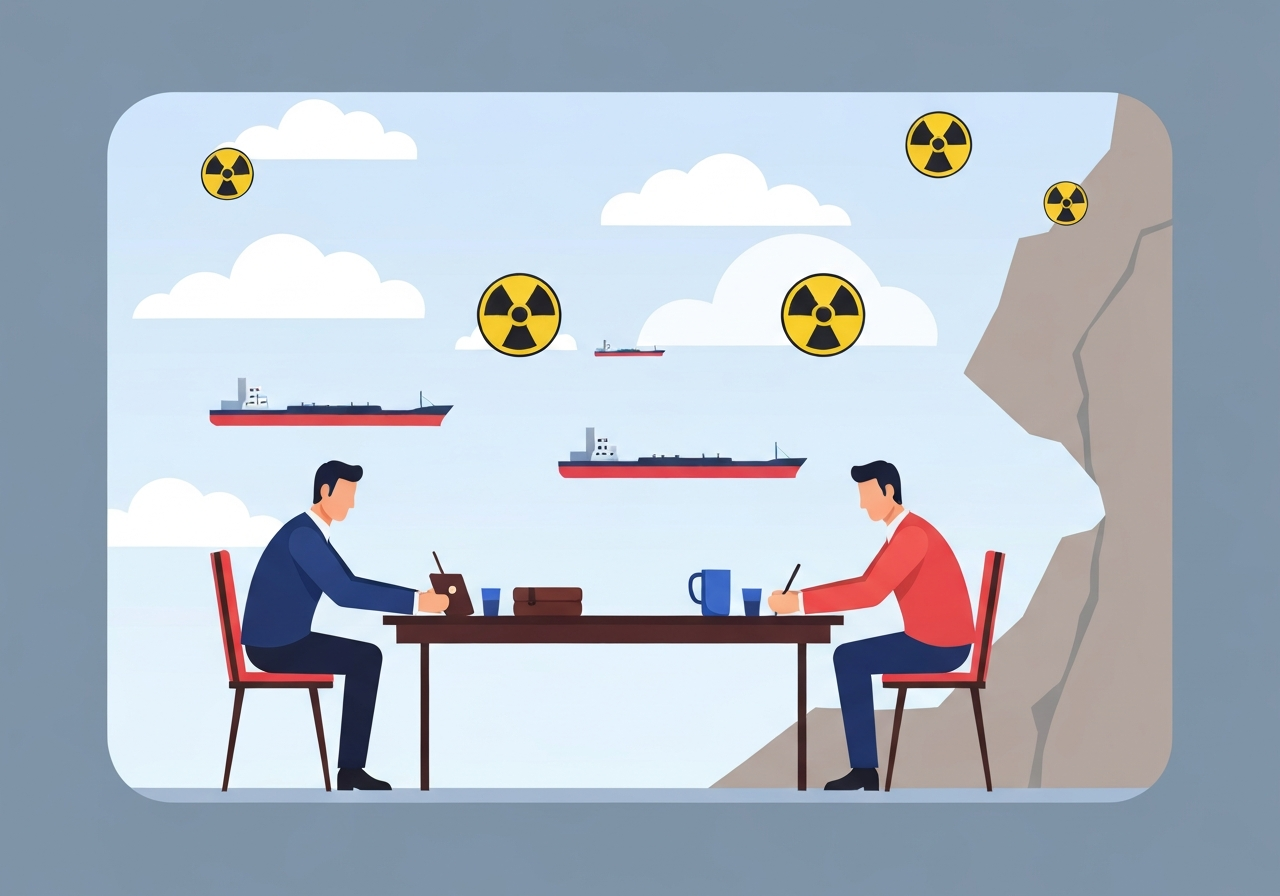
— Negotiations between U.S. and Iranian delegations in Islamabad ended before dawn on Sunday without a permanent cease-fire after roughly 21 hours of talks at the Serena Hotel. U.S. officials said they had presented a final offer that Tehran did not accept; Iranian sources identified three primary sticking points: control of the Strait of Hormuz, nearly 900 pounds of highly enriched uranium, and the release of about $27 billion in frozen revenues held abroad. The two-week truce reached earlier in the week was also in dispute, with the sides differing on whether it covered fighting in Lebanon.
Key Takeaways
- The talks took place in Islamabad on April 11–12, 2026, with U.S. Vice President JD Vance meeting senior Iranian officials for about 21 hours.
- Iran reportedly said it would not reopen the Strait of Hormuz to all maritime traffic until a final peace agreement was secured; the U.S. demanded immediate reopening.
- Iran maintains nearly 900 pounds of highly enriched uranium (HEU) were central to negotiations; how that stockpile would be handled remained unresolved.
- Tehran requested release of roughly $27 billion in frozen oil revenues held in countries including Iraq, Luxembourg, Bahrain, Japan, Qatar, Turkey and Germany; the U.S. rejected that demand.
- Disagreement over whether the short truce applied to Lebanon almost derailed the Islamabad meeting, underscoring fragile mutual trust.
- Iran also sought reparations for damage from six weeks of airstrikes; U.S. negotiators declined to agree to compensation terms during these talks.
Background
Diplomatic engagement followed a period of sustained kinetic exchanges and a two-week temporary cessation of some fighting agreed the previous Tuesday. That brief truce was intended to create space for negotiations but was ambiguously worded, and the participants disputed its geographic scope, notably whether it covered Lebanese theaters. The Gulf region’s strategic geography — especially the Strait of Hormuz, through which a sizable share of the world’s seaborne oil moves — has long given Iran leverage over maritime traffic and international energy markets.
Sanctions and frozen revenues are another legacy of years of confrontation: countries and institutions holding Iranian assets have instructed banks to block transfers under various sanctions regimes, creating reservoirs of funds Tehran seeks to unlock for reconstruction. At the same time, Iran’s accumulation of highly enriched uranium has been a central concern for Washington and other capitals because HEU can be used for weapons and creates severe proliferation risks. These intersecting issues — maritime access, strategic materials, and frozen assets — have repeatedly complicated past talks and shaped negotiating red lines on both sides.
Main Event
The core negotiating session was held at the Serena Hotel in Islamabad, with journalists based nearby at the Jinnah Convention Centre. U.S. and Iranian delegations held marathon deliberations that extended into the early hours of Sunday; U.S. officials described them as the final best offer from Washington. Vice President JD Vance, who led the U.S. side in Islamabad, said after the meeting that negotiators had clarified what they could and could not accept but did not publicly enumerate those limits.
Iranian officials speaking on the condition of anonymity told reporters they were unwilling to remove control over the Strait of Hormuz from their leverage until a final peace agreement was in place. Washington, conversely, insisted the strait be reopened immediately to all commercial maritime traffic to prevent disruptions to global trade. That disagreement over timing and sequencing of concessions was a primary impediment to reaching a durable deal.
Separately, Tehran sought access to roughly $27 billion in frozen revenues held in accounts across several countries — a sum it described as necessary for reconstruction after weeks of airstrikes. The U.S. side rejected unconditional release of those funds. Iranian sources also raised reparations claims tied to six weeks of strikes; the Americans declined to accept those demands in the Islamabad session.
The fate of Iran’s enriched-uranium holdings was another unresolved matter. Iranian officials cited nearly 900 pounds of highly enriched uranium as a negotiating item; U.S. negotiators pressed for clear safeguards or disposition measures. No agreement on verification, transfer, or disposal of that material emerged before the talks concluded.
Analysis & Implications
Control of the Strait of Hormuz is not merely symbolic: denial or restriction of transit can rapidly drive up global energy prices and provoke international responses. If Iran insists on withholding full maritime access until a final settlement, it preserves a potent bargaining tool that could dissuade third-party mediators and heighten the risk of escalatory actions by affected states. That dynamic gives Tehran negotiating leverage but also raises the stakes for any miscalculation in the Gulf.
The presence of nearly 900 pounds of highly enriched uranium presents acute proliferation and security dilemmas. Even absent weapons intent, HEU quantities at that scale demand stringent monitoring, secure handling and, likely, reduction or conversion steps — measures the U.S. and partner states typically press for. Failure to reach a transparent, verifiable approach to Iran’s stockpile could undermine international confidence and complicate broader disarmament and nonproliferation diplomacy.
The frozen $27 billion is both a financial and political lever. Releasing such sums for reconstruction would provide immediate economic relief inside Iran and could be framed domestically as a diplomatic victory for Tehran. For the U.S. and its partners, however, unconditional transfers pose legal and political risks, including the possibility that funds could be redirected to activities inconsistent with foreign policy objectives unless strict oversight and conditionality are imposed.
Comparison & Data
| Issue | Iran’s Position | U.S. Position |
|---|---|---|
| Strait of Hormuz | Keep leverage; reopen only after final peace deal | Immediate reopening to all maritime traffic |
| Highly Enriched Uranium | ~900 pounds of HEU cited as a negotiation item | Demanded clear disposition and safeguards; no agreement |
| Frozen Revenues | Release ≈ $27 billion held abroad for reconstruction | Refused unconditional release during talks |
The table above summarizes positions stated during the Islamabad session. While numbers and country lists (for frozen funds) were provided by Iranian sources, precise legal status and custodial arrangements for each blocked asset remain complex and require additional verification through official channels.
Reactions & Quotes
“We’ve made very clear what our red lines are, what things we’re willing to accommodate them on, and what things we’re not willing to accommodate them on.”
U.S. Vice President JD Vance (official statement)
Vance framed the U.S. position as final and bounded by non-negotiable limits, signaling Washington’s intent to press for immediate measures such as reopening the Strait of Hormuz.
“We will not surrender control of the strait except as part of a final peace settlement.”
Iranian official (anonymous)
Iranian sources emphasized sequencing: Tehran would only forgo a major strategic lever after securing comprehensive guarantees across security, economic, and political domains.
“Access to ports and shipping lanes is central to economic stability; ambiguity breeds market shocks.”
Maritime security analyst
Independent analysts warned that prolonged uncertainty over Hormuz could keep insurance and freight costs elevated, with ripple effects for global energy and commodity markets.
Unconfirmed
- Whether the two-week truce explicitly covered Lebanon remains contested between the delegations and has not been independently verified.
- Specific legal custody and release conditions for the cited $27 billion in frozen funds have not been publicly confirmed by custodial states or banks.
- Detailed arrangements proposed for the nearly 900 pounds of HEU, including storage, monitoring, or transfer destinations, were not released and are unverified.
Bottom Line
The Islamabad talks underscored that strategic geography, sensitive nuclear material, and financial leverage remain core obstacles to a durable U.S.–Iran settlement. Each of the three principal sticking points — Hormuz control, HEU disposition, and frozen funds — touches on both security and domestic political constituencies in Tehran and Washington, complicating compromise.
Future progress will likely depend on sequencing agreements that satisfy verification demands while offering tangible, conditional relief to Iran. Observers should watch for follow-up diplomacy, third-party verification proposals, and any unilateral moves affecting maritime transit or asset custody that could reopen hostilities or derail negotiations.
Sources
- The New York Times (news report summarizing Islamabad talks and officials’ accounts)