
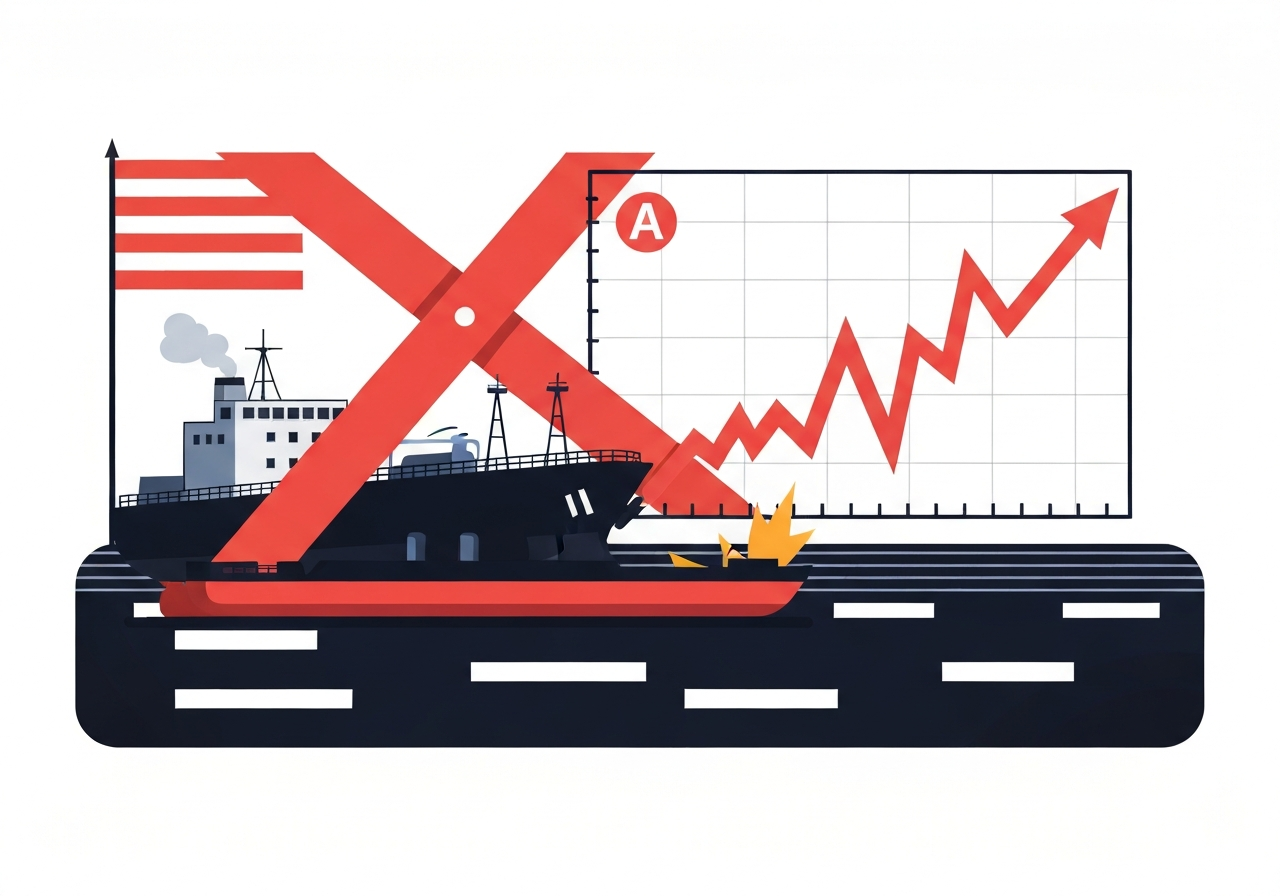
On April 12, 2026, President Donald Trump ordered a blockade of the Strait of Hormuz, prompting a sharp market reaction: Brent crude jumped 7.4% to just above $102 a barrel while stocks and sovereign bonds fell amid fears of disrupted energy flows. Asian equities slid about 1% and S&P 500 futures dropped 0.8% as higher oil prices raised growth concerns; European markets were set to open roughly 1.5% lower. The move followed the collapse of weekend peace talks, and some technology names — notably Taiwan’s MediaTek Inc. — showed resilience due to strong sales momentum. Traders and policymakers reacted quickly, pricing in elevated risk and higher energy costs.
Key takeaways
- Brent crude rose 7.4% to just above $102 per barrel after the US ordered a blockade of the Strait of Hormuz on April 12, 2026.
- Asian shares fell about 1% on the session, while S&P 500 futures were down 0.8%, reflecting immediate growth concerns.
- European markets were indicated to open roughly 1.5% lower, mirroring global risk-off positioning.
- Sovereign bonds sold off alongside equities as investors priced in inflationary pressure from higher energy costs.
- Tec h stocks such as Taiwan’s MediaTek Inc. outperformed peers, supported by robust underlying sales despite broader market declines.
- Market-implied volatility and risk premia widened, suggesting investors expect sustained uncertainty over shipping and energy routes.
Background
The Strait of Hormuz is a strategic chokepoint through which roughly one-fifth of globally traded oil passes, making any military or naval action there a key risk to energy markets. Previous disruptions — including tanker seizures and sanctions-related shipping diversions — have pushed oil prices sharply higher and squeezed global refining and shipping logistics. The ordered blockade comes after weekend peace talks between the US and Iran collapsed, a diplomatic setback that heightened the chance of military escalation. Policymakers and market participants have long viewed the waterway’s security as a barometer for geopolitical risk and global inflationary pressure.
Since early 2026, markets have been sensitive to Middle East developments amid already elevated commodity prices and tight energy market fundamentals. Central banks were monitoring inflation dynamics closely; a sudden rise in crude costs alters growth-inflation trade-offs and complicates monetary policy. Major energy importers and insurers were preparing contingency plans, while oil producers and shipping firms assessed route and insurance-cost alternatives. The current episode follows a pattern where short-term political events produce outsized moves in commodity-linked assets and related financial markets.
Main event
The announcement late on April 12 triggered immediate price moves: Brent crude spiked 7.4% to just above $102 a barrel as traders priced in potential supply interruptions through the Strait of Hormuz. Equity markets responded with a swift risk-off rotation; Asian benchmarks lost roughly 1% and S&P 500 futures were down about 0.8% by late trading. European contracts indicated an about 1.5% lower open, reflecting spillovers from energy price and growth concerns.
Fixed-income markets inversely adjusted — government bonds sold off and yields rose as investors anticipated higher inflation and possible fiscal responses. Oil-linked instruments, energy equities and freight insurers saw the largest immediate repricing. Not all sectors fell equally: technology firms with strong revenue growth and supply-chain resilience, such as Taiwan’s MediaTek Inc., outperformed as investors favored earnings stability over cyclical exposure.
Market commentary from trading floors emphasized the immediacy of the shock: options-implied volatility jumped and commodity curve spreads tightened as participants sought physical barrels and protection. Brokers and exchanges reported elevated volumes in energy futures and related derivatives, while shipping firms signaled contingency routing and cost assessments. Global commodity desks noted a re-evaluation of spare capacity and the time needed to re-route tanker traffic around longer, costlier passages.
Analysis & implications
Higher oil prices will likely feed into headline inflation across importing economies, compressing real incomes and complicating central bank policymaking. For economies running close to capacity, an abrupt and sustained oil-price increase risks slowing consumption and investment while keeping inflation sticky. Policymakers face a trade-off: tighter monetary settings to rein in inflation could deepen the growth slowdown magnified by higher energy costs.
Trade and shipping disruptions through Hormuz raise logistical and insurance costs, which can amplify the inflationary impulse beyond direct fuel prices. Firms dependent on just-in-time supply chains may face input-cost shocks and delivery delays, pressuring margins and potentially prompting production shifts or inventory rebuilding. Energy-exporting nations proximate to the route could see near-term revenue gains, while import-dependent countries face widening trade deficits and fiscal headwinds.
Financial markets may price in a prolonged risk premium: equity valuations could compress from lower earnings forecasts, while sovereign bond yields may rise on inflation upside and fiscal responses. Conversely, defensive and quality-growth sectors could attract flows, sustaining relative outperformance in selected tech and healthcare names. If the blockade persists or provokes retaliation, the macroeconomic outlook for Q2–Q4 2026 would weaken materially, with downside risks to global GDP estimates.
Comparison & data
| Market | Move | Key figure |
|---|---|---|
| Brent crude | Up | +7.4%, to just above $102/bbl |
| Asian shares | Down | ~1% decline |
| S&P 500 futures | Down | -0.8% |
| European open (indicated) | Down | ~1.5% lower |
The table summarizes immediate market moves following the April 12 order. Historical episodes — such as the 2019 tanker seizures and the 2011 sanctions era — show similar short-term oil spikes but differing durations; the persistence of the price shock will depend on whether shipping can be rerouted or diplomatic channels re-open. Traders are watching spare production capacity and OPEC+ responses as potential buffers to sustained price rises.
Reactions & quotes
We will take necessary measures to ensure freedom of navigation and protect international shipping lanes.
White House (official statement)
The White House framed the blockade as a security measure for global shipping; officials emphasized the goal of maintaining navigational freedom while warning adversaries against escalation. The tone signaled intent to control maritime routes perceived as critical to global trade.
The market is recalibrating risk premia; oil and shipping costs are the immediate transmission channels to inflation and growth.
Independent market strategist
Market strategists noted the pathway by which a supply shock translates into macro stress — higher energy bills erode consumption and raise input costs across industries. Analysts cautioned that volatility will likely remain elevated until clarity on shipping operations returns.
We are monitoring freight routes and insurance terms; any shift in routing will add measurable time and cost to shipments.
Shipping industry spokesperson
Shipping industry representatives described operational adjustments under consideration, including longer transit times and higher insurance premiums that would be passed along to shippers and ultimately consumers.
Unconfirmed
- Reports of large-scale Iranian naval deployments in direct response to the blockade remain unverified by independent sources.
- Estimates of how long the blockade will last vary; no official timeline has been provided by US authorities.
- Claims that global insurance rates have already doubled for Gulf transits are circulating but lack corroboration from major insurers at this time.
Bottom line
The US-ordered blockade of the Strait of Hormuz on April 12, 2026, produced an immediate spike in oil prices and a pronounced risk-off move across equities and bonds, illustrating how geopolitical shocks can quickly translate into market stress. Short-term impacts include higher energy costs, greater market volatility and potential disruption to trade flows; the depth and duration of economic effects hinge on how long the blockade and any resulting tit-for-tat actions persist.
Investors and policymakers will closely monitor diplomatic channels, commercial shipping adjustments and spare production capacity as determinants of whether price shocks abate or become entrenched. For businesses and consumers, the near-term outlook points to higher costs and greater uncertainty; for markets, a period of elevated volatility and sectoral divergence appears likely until clearer signals about the blockade’s scope and duration emerge.