
Lead
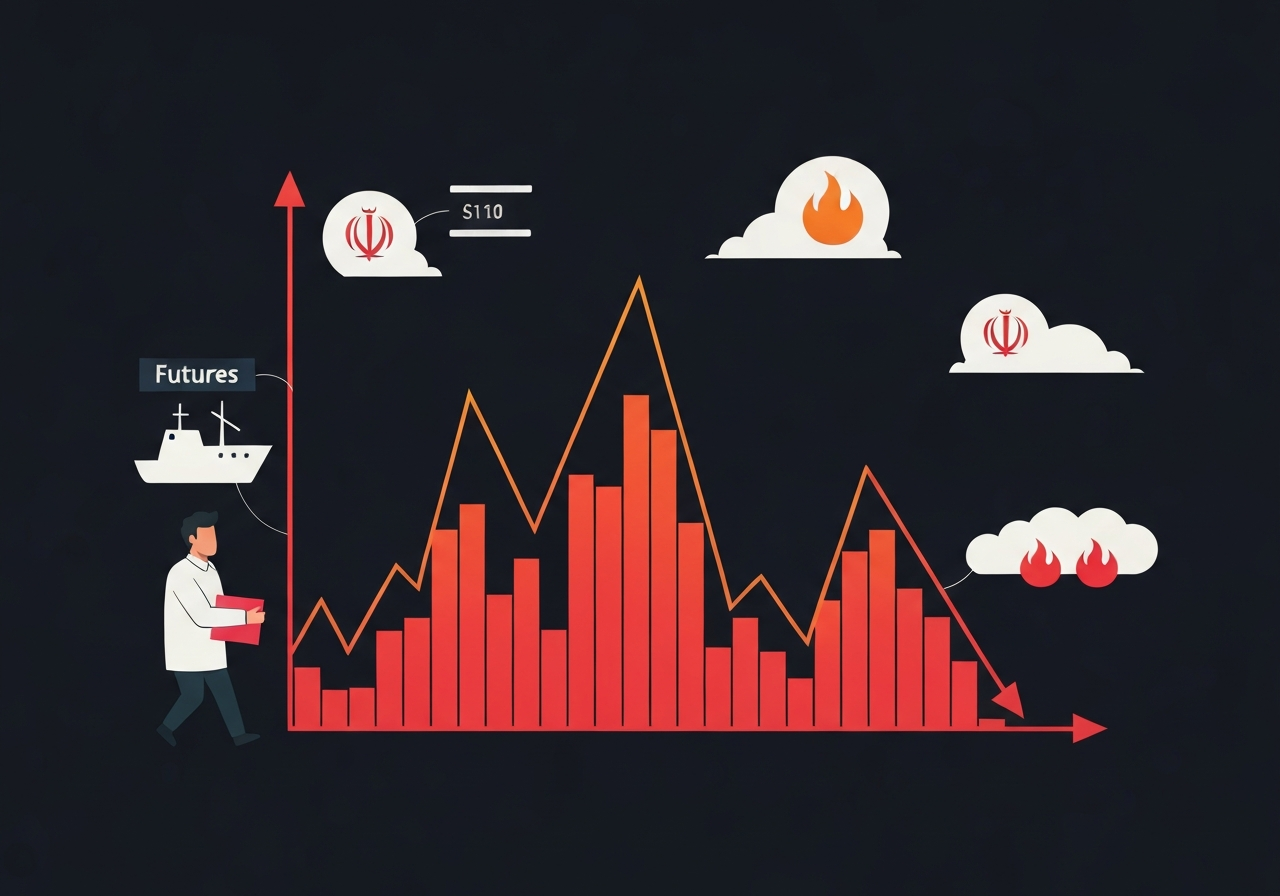
On Monday, April 19, 2026, U.S. stock futures opened lower after the United States said it fired on and seized an Iranian-flagged cargo vessel in the Gulf of Oman, heightening regional tensions and driving oil prices sharply higher. Dow futures fell about 258 points (roughly 0.5%), while S&P 500 futures slipped 0.5% and Nasdaq-100 futures dropped 0.4%. The move followed President Donald Trump’s public statement that U.S. forces have custody of the vessel and renewed threats against Iranian infrastructure. Crude benchmarks jumped roughly 6%, reflecting increased supply-risk premiums for shipping through the Strait of Hormuz.
Key Takeaways
- Dow Jones Industrial Average futures fell by about 258 points, a decline near 0.5% at the Monday open.
- S&P 500 futures lost roughly 0.5% and Nasdaq-100 futures were down about 0.4% as risk assets pared gains.
- West Texas Intermediate futures rose about 6% to above $88 per barrel; Brent crude moved similarly, climbing above $95 per barrel.
- President Trump said the U.S. struck and seized an Iranian-flagged cargo ship, identified by U.S. officials as the TOUSKA, and said U.S. Marines have custody.
- Last week the S&P 500 rose about 4.5% and the Nasdaq Composite gained roughly 7.2%, marking the Nasdaq’s 13th straight daily advance into Friday.
- Airline stocks fell more than 2% premarket amid concerns that sustained higher fuel prices will dampen travel demand.
- Bond yields moved higher as investors priced in inflation and geopolitical risk; markets moved to a more cautious stance globally.
- Crypto-related equities fell after bitcoin dropped over 4% during the weekend before partially recovering above $75,000.
Background
The United States and Iran have been locked in a cycle of escalation for weeks, with a U.S.-led naval blockade on vessels entering and exiting Iranian ports and repeated Iranian attacks on commercial shipping near the Strait of Hormuz. A ceasefire between Iran and Lebanon had briefly eased risk perceptions, helping stocks rally the prior week. Those gains reversed as restrictions on vessel traffic resumed and state media from Iran accused the U.S. of failing to honor commitments.
Markets had priced in a fragile détente: the S&P 500 finished last week with a sizable weekly gain while the Nasdaq logged a historic multiweek rally driven by optimism about potential diplomatic progress and robust earnings in parts of the tech sector. Energy markets, however, remained sensitive to supply-route disruptions because roughly a fifth of global seaborne oil passes through the Strait of Hormuz during normal conditions.
Main Event
According to public statements from the White House and the president’s post on Truth Social, U.S. forces intercepted an Iranian-flagged cargo ship in the Gulf of Oman after it did not heed warnings to stop. Officials said U.S. naval forces fired on the vessel’s engine room and that U.S. Marines now have custody of the ship. The president also reiterated demands for Tehran to accept terms to end hostilities, while warning of strikes on Iranian infrastructure if Tehran did not comply.
The seized vessel was described by U.S. officials as subject to U.S. Treasury sanctions for prior activity; authorities said they are inspecting the ship’s manifest and cargo. Iranian state media responded that the Strait of Hormuz remained effectively restricted because the U.S. had not met its obligations under a recent understanding, and maritime traffic saw renewed uncertainty over the weekend.
Financial markets reacted quickly: crude futures jumped, insurance and freight-cost indicators rose, and risk sentiment in equities softened. Airlines and travel-related names were among the worst hit in premarket trade as investors weighed the impact of higher fuel costs and potential demand destruction from sustained hostilities.
Analysis & Implications
Short-term: The immediate market impact is a classic risk-off move. Higher oil prices increase input costs for businesses and consumers, elevate inflationary pressures and can push central-bank-sensitive yields higher. For equity markets, the most vulnerable sectors are travel, leisure and other consumer-exposed industries, while some energy and defense names may see defensive buying.
Medium-term: If the U.S. blockade and interdiction of vessels continue, shipping companies and insurers will price in a persistent war-risk premium, raising the cost of seaborne trade and potentially slowing trade flows. That could feed through to higher freight rates and broader supply-chain costs, with uneven effects across countries depending on energy import dependence.
Geopolitical risk: The seizure raises the probability of miscalculation or retaliatory actions. Diplomacy via third-party venues (such as the previously discussed talks in Pakistan) becomes more complicated when one side publicly hardens its stance. International actors focused on de-escalation may find negotiating space narrower if threats against civilian infrastructure are publicly amplified.
For markets and policymakers: Central banks will monitor whether commodity-driven inflation becomes more entrenched and whether financial-market volatility threatens credit conditions. Fiscal and regulatory responses would depend on how long the disruption persists and whether insurance and logistics costs materially affect consumer prices.
Comparison & Data
| Metric | Prior Level / Week | Move on Monday |
|---|---|---|
| Dow futures | Weekly close (S&P up 4.5%) | Down ~258 pts (~0.5%) |
| S&P 500 futures | +4.5% week | Down ~0.5% |
| Nasdaq Composite | +7.2% week; 13-day streak | Nasdaq-100 futures down ~0.4% |
| WTI crude | ~$83–$84 (pre-move) | Up ~6% to above $88 per barrel |
| Brent crude | ~$90 | Up ~6% to above $95 per barrel |
The table summarizes market moves before and immediately after the reported ship seizure. While equities had enjoyed sizable gains the prior week, commodity and shipping-price moves reflect a sharp re-pricing of near-term conflict risk. Traders typically react quickly to supply-route risks, which can produce outsized short-term moves in energy benchmarks even if the long-term fundamentals remain unchanged.
Reactions & Quotes
“Right now, U.S. Marines have custody of the vessel,”
President Donald Trump (Truth Social; cited in public statement)
The president framed the action as enforcement of sanctions and a leverage point in talks with Tehran. That language heightened concerns about escalation because it included public threats against Iranian infrastructure if Tehran did not agree to terms.
“After the Nasdaq has rallied for 13 days in a row on hopes for a deal, we ended the week very overbought on a short term basis,”
Peter Boockvar, Chief Investment Officer, OnePoint BFG Wealth Partners (market commentator)
Boockvar’s comment highlights how stretched risk assets were entering the weekend, making them more vulnerable to a geopolitical shock. Market participants noted the tension between recent optimism about a ceasefire and the renewed operational and political risks.
Unconfirmed
- The exact cargo manifest and whether the seized ship carried contraband beyond items that prompted U.S. sanctions remain under inspection and have not been publicly verified.
- Claims about Iranian casualties or damage related to the interdiction have not been independently corroborated by international observers.
- Whether the U.S. action reflects a sustained new policy of interdiction or a one-off enforcement operation has not been clarified by an official, detailed release.
Bottom Line
The reported U.S. seizure of an Iranian-flagged cargo ship and the president’s public comments escalated geopolitical risk and produced an immediate market repricing: equities slipped, yields rose, and oil rallied roughly 6%. Markets that had priced in a tentative détente were left to reassess the odds of prolonged disruption to key shipping lanes and higher energy costs.
Investors should watch three signals over the coming days: official, verifiable statements on the seized vessel’s cargo and legal basis for interdiction; any Iranian response that targets shipping or regional assets; and energy-market behavior—if oil and shipping-insurance rates remain elevated, the economic impact will shift from a near-term shock to a broader inflation and growth story. Policymakers and portfolio managers will need to balance contingency planning for extended disruption with assessing whether moves represent short-lived risk premiums or a regime shift in regional security.