
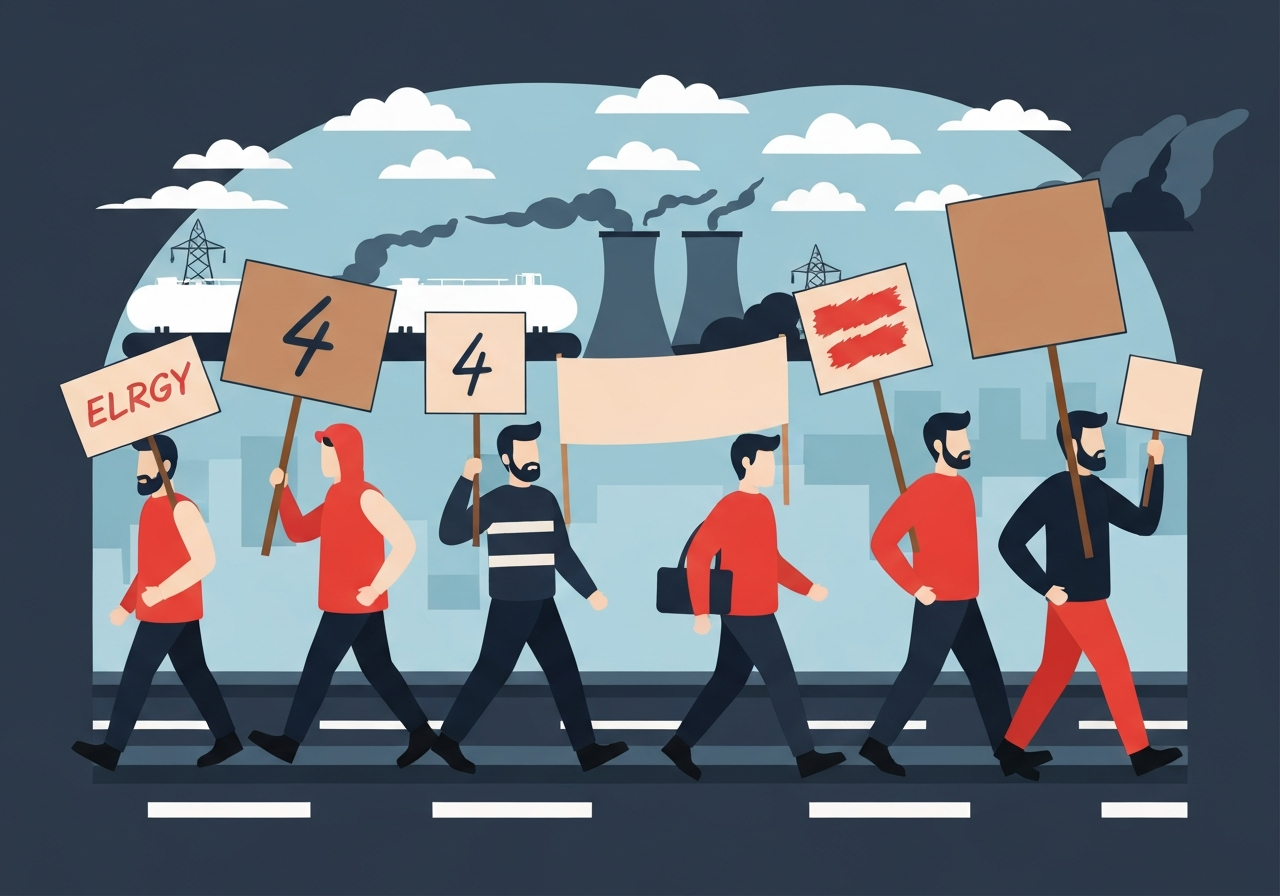
On May 1, International Workers’ Day, labor and activist groups staged demonstrations worldwide — from Casablanca and Istanbul to Paris, Santiago and multiple U.S. cities — linking rising household energy and living costs to the war involving Iran. Protesters called for higher wages, stronger labor protections and peace as pickets, marches and selective boycotts disrupted streets, shops and some transport hubs. Governments and unions offered competing narratives about the causes of price rises and how to respond, while several locations reported arrests and clashes. The events underlined widening worker concerns about purchasing power and public policy amid international tensions.
Key takeaways
- May Day demonstrations occurred on May 1 across Asia, Europe, Africa and the Americas, with tens of thousands reported in France and hundreds detained in Istanbul.
- Organizers emphasized rising energy and living costs as a central grievance, linking some increases to the Iran war’s effect on global fuel markets.
- In Morocco, transport workers staged horn-blaring and vehicle stoppages in Casablanca in protest at fuel price rises that outpaced wage growth.
- Turkey saw mass detentions in Istanbul where authorities restricted access to Taksim Square, a recurring flashpoint for May Day protests.
- In the United States protests ranged from festive rallies with cultural performances to disruptive actions — including a two-hour road closure outside San Francisco’s international terminal and arrests near the New York Stock Exchange.
- Portugal’s unions mobilized thousands against proposed labor-law changes, including measures to ease dismissals and reduce miscarriage bereavement leave.
- France’s long-standing May Day holiday became an additional flashpoint after a parliamentary proposal to expand allowed work on the date sparked national outcry and a government bill to permit limited retail openings.
Background
May Day, or International Workers’ Day on May 1, has been a focal point for labor movements for more than a century. It commemorates late 19th-century struggles for an eight-hour workday, including the 1886 Chicago demonstrations and the subsequent Haymarket affair; a monument in Chicago’s Haymarket Square memorializes activists from that era. The holiday is a public day off in many countries, and unions traditionally use it to rally on wages, pensions and workplace protections.
Since late 2023 and into 2024, heightened tensions and military activity in and around Iran have contributed to volatility in global energy markets, exacerbating fuel and electricity costs in many regions. Governments, employers and unions have debated who should shoulder those additional costs: workers facing stagnant wages or companies and states through subsidies and regulation. These debates set the stage for May Day demands that framed inflation and energy price shocks as issues of social justice as well as economic policy.
Main event
In Morocco’s largest city, Casablanca, taxi drivers and bus operators staged noise protests and selective stoppages to dramatize the gap between rising transport costs and frozen pay. Akherraz Lhachimi of the Moroccan Labor Union said daily expenses have climbed while wages remain unchanged, echoing similar messages from unions elsewhere. South Africa’s Congress of South African Trade Unions leader Zingiswa Losi told demonstrators workers were “suffocating” under higher food, power, transport and healthcare costs, and staged rallies in several cities.
Turkey’s authorities declared central areas off-limits and detained hundreds in Istanbul when demonstrators attempted to reach Taksim Square, a site of repeated May Day confrontation since the 2013 protests. In Santiago, Chile, a protest escalated into clashes and vandalism, with police deploying water cannon and tear gas to disperse parts of the crowd. Portugal saw coordinated union rallies across the country opposing proposed labor-law reforms that unions say would weaken worker protections.
France’s May Day carried extra significance amid a heated public debate over whether the recently sacrosanct holiday should allow more retail work. Tens of thousands marched across French cities; only essential services remained open, and the government proposed limited exceptions for bakeries and florists after union backlash. The custom of giving lily-of-the-valley flowers on May 1 was visible in street scenes and symbolic of broader resistance to rolling back hard-won labor protections.
In the United States — where May Day is not a federal holiday — a coalition called May Day Strong urged a day of economic disruption under the slogan “workers over billionaires,” promoting no school, no work and no shopping in selected locations. Demonstrations ranged from family-friendly gatherings with Native American dancers and mariachi bands to direct-action tactics: protesters briefly closed a road outside San Francisco’s international terminal and activists attempted to chain themselves near the New York Stock Exchange, leading to multiple arrests.
Analysis & implications
May Day 2024 illustrated how international conflict, domestic policy and local labor conditions can converge into a single political moment. Where supply shocks from geopolitical events push fuel prices up, lower- and middle-income households feel the impact most sharply because energy and transport costs are a larger share of their budgets. Unions are using this leverage to press for immediate relief measures — such as subsidies or wage adjustments — while framing the debates as matters of economic justice.
Political implications vary by country. In France the backlash to proposals easing work on May 1 highlighted the electoral sensitivity of perceived attacks on social protections and could constrain legislative maneuvering. In Portugal and elsewhere, labor mobilization against specific legal changes signals unions retain capacity to shape policy debates beyond symbolic marches. In democracies with active protest cultures, visible May Day actions may influence upcoming local or national campaigns on living standards.
For governments, the challenge is balancing fiscal capacity and political risk: subsidizing energy or indexing benefits protects households but strains budgets; letting prices adjust can deepen social unrest. Businesses confronted with higher operating costs may resist wage increases, increasing the potential for strikes or industrial action. Internationally, if energy market volatility persists because of the Iran war, further rounds of protest or political pressure are likely in energy-importing countries.
Comparison & data
| Location | Notable developments |
|---|---|
| France | Tens of thousands marched; national holiday debate; limited retail openings proposed |
| Turkey (Istanbul) | Hundreds detained attempting to access Taksim Square |
| Morocco (Casablanca) | Taxi and bus drivers staged horn protests and parking actions over fuel costs |
| United States | Mixed actions: cultural rallies, airport road closure, arrests near NYSE |
| Portugal | Several thousand rallied against proposed labor-law changes |
The table summarizes reported events and crowd descriptions from May 1. While turnout estimates are uneven across countries, the pattern is consistent: unions and community groups prioritized messages about wages, public services and the cost of living. Historical context: in 2006 about 1 million people protested U.S. immigration policy, and the labor movement’s May Day roots trace to the 1886 Chicago demonstrations and Haymarket affair, where violent confrontations led to convictions and four executions.
Reactions & quotes
European union bodies framed the day as a rebuke to policies they say force workers to bear the economic cost of international conflict.
“Working people refuse to pay the price for Donald Trump’s war in the Middle East.”
European Trade Union Confederation
The ETUC statement, representing 93 trade union organizations in 41 European countries, tied workplace grievances directly to foreign policy choices and called for protective domestic measures. The message underscores how unions are connecting labor demands with geopolitical critique rather than focusing solely on workplace bargaining.
French officials and business representatives presented competing views on preserving the May 1 holiday and small-scale retail openings.
“May 1 is not just any day; it symbolizes social gains from a century of building the labor code we know in France.”
Serge Papin, France Small and Medium-sized Businesses Minister
Papin’s comment accompanied government proposals to allow limited retail openings for bakeries and florists, an attempt to defuse tensions while recognizing the holiday’s cultural importance. Unions, however, warned that any expansion of permitted work undermines long-standing labor protections.
On the U.S. streets activists linked immigration enforcement and domestic workplace issues to broader critiques of administration policies.
“We’re seeing tons and tons of attacks on working people and on oppressed communities.”
Kathryn Stender, Party for Socialism and Liberation activist
Stender spoke at a Chicago rally where thousands gathered; U.S. demonstrations combined demands for immigrant rights, economic measures and opposition to specific federal policies. Arrests in several cities reflected tensions between disruption tactics and law enforcement responses.
Unconfirmed
- Precise causality between the Iran war and local fuel-price increases varies by market; many factors influence prices and direct attribution is not uniformly documented.
- Exact counts of arrests and damaged property across all locations remain incomplete, with some authorities providing only provisional or partial figures.
- Long-term impacts of these May Day actions on specific legislation or corporate wage decisions are speculative and dependent on subsequent political negotiations.
Bottom line
May Day 2024 showed labor movements across continents using the holiday to spotlight the squeeze on household budgets, especially energy and transport costs, and to press for policy responses that protect wages and benefits. Governments face a dilemma between short-term relief measures and longer-term fiscal constraints, while employers confront pressure to raise pay or absorb higher operating costs.
Where protests were largest or most disruptive, they reflected not only frustration with immediate price rises but also deeper anxieties about eroding social protections and shrinking purchasing power. If energy price volatility continues amid geopolitical tensions, unions and activist coalitions are likely to sustain pressure through strikes, targeted boycotts and coordinated campaigns ahead of upcoming legislative cycles.
Sources
- Associated Press — (news report compiling international coverage)
- European Trade Union Confederation (ETUC) — (trade union federation statement)