
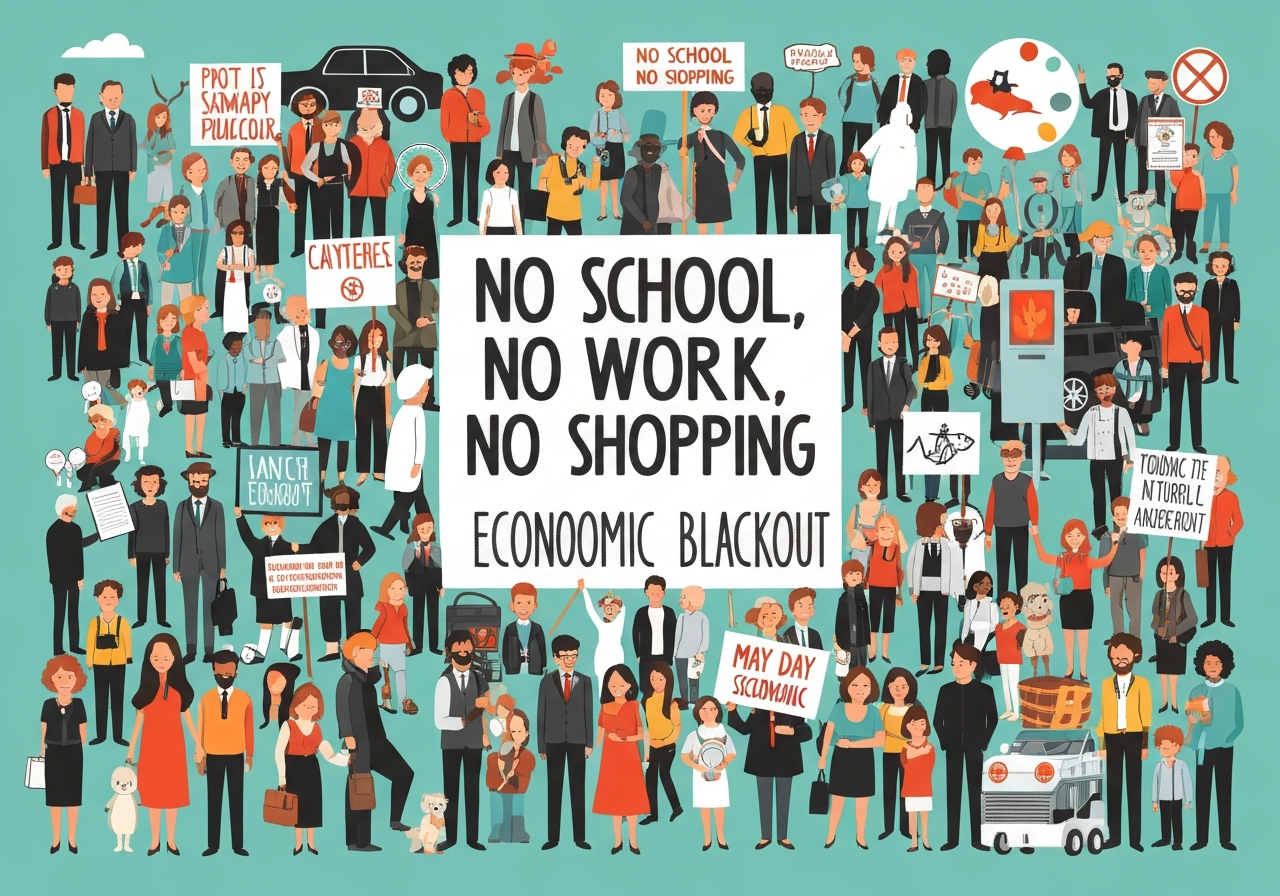
Thousands across the United States are preparing to take part in an economic blackout on , with organizers coordinating roughly 3,500 “May Day Strong” events nationwide. Participants have been urged to observe “no school, no work, no shopping,” with planned walkouts, marches, block parties and evening gatherings in cities and towns across the country. The mobilization brings together labor unions, immigrant-rights groups, progressive political organizations and campus activists pressing a unified agenda that includes taxing the wealthy, opposing ICE operations and antiwar demands. Organizers say the day is a step toward broader disruption tactics, including plans to build momentum toward a coordinated general-strike strategy.
Key Takeaways
- Organizers report roughly 3,500 May Day Strong events scheduled nationwide on , ranging from local walkouts to large marches.
- Coalition members include labor unions, immigrant-rights groups, the Democratic Socialists of America and organizers behind the No Kings protests.
- At least 15 North Carolina school districts have approved teacher participation in a statewide “Kids Over Corporations” rally for public education funding.
- The Chicago Teachers Union successfully secured May Day designation as a “day of civic action,” enabling teacher participation in events across Chicago.
- Organizers point to a January Minnesota action, when tens of thousands in the Twin Cities walked out in response to federal immigration enforcement, as a model for coordinated disruption.
- UAW president Shawn Fain has urged unions to coordinate contract expirations to aim for a general strike on , a plan organizers say this year’s actions will help test.
- Student and youth groups, including campus Sunrise Movement chapters, are organizing local walkouts and teach-ins to expand participation beyond traditional union bases.
Background
May Day has a long history as a day of labor protest and international solidarity; in the United States it has frequently been used to spotlight workers’ rights, immigrant protections and economic inequality. This year’s May Day overlays that tradition with a broader coalition of groups that have recently mobilized around immigration enforcement, public education funding and corporate power. The May Day Strong coalition is positioning the day as both a mass demonstration and a rehearsal for sustained disruption tactics that organizers argue are necessary to counterbalance concentrated wealth.
Organizing for a nationwide economic blackout reflects several recent trends in U.S. activism: a rising willingness by public-sector unions and student activists to engage in coordinated days of action, the use of local walkouts to amplify national demands, and increasing collaboration between labor and immigrant-rights organizations. Activists cite prior coordinated disruptions—most notably a large January action in Minnesota where tens of thousands left school or work—to justify the viability of a wider, sustained campaign.
Main Event
On May Day, participants across the country are scheduled to leave workplaces and campuses, block commercial corridors for periods of the day, and gather in evening demonstrations. Organizers have promoted a distributed playbook that encourages local groups to choose actions suited to their communities, from brief work stoppages to prolonged street encampments and cultural events intended to draw community support. In some cities, teacher unions worked with school districts to clear the way for educator participation; in others, student walkouts are expected to be the main vehicle for disruption.
Leaders of constituent organizations have framed the blackout as a test of collective capacity. Coalition organizers described the day as both symbolic—declaring that production and consumption are voluntary—and strategic, a way to measure readiness for larger coordinated labor actions. The Chicago Teachers Union and several North Carolina districts are notable examples where institutional support helped widen participation among educators and families.
Local public-safety officials in multiple jurisdictions said they expected protests to be largely peaceful but prepared for localized disruptions to transit and commercial activity. Organizers emphasize nonviolent tactics while urging broad public engagement, including cultural programming and community block parties meant to sustain turnout into the evening. Several cities reported permits filed for marches and rallies, while many other events are being organized informally through local coalitions and student groups.
Analysis & Implications
The May Day economic blackout reflects an evolution in U.S. protest strategy, blending traditional labor tactics with contemporary coalition-building that links workplace power to consumer pressure and civic noncooperation. For unions, the day offers an opportunity to broaden public sympathy for labor demands by connecting contract fights to visible disruptions in everyday life. If participation matches organizers’ goals, the blackout could strengthen bargaining leverage for localized contract negotiations and shift public conversation toward structural questions about corporate power and inequality.
Politically, the convergence of unions, immigrant-rights groups and left-leaning political organizations complicates how officials, media and the public will interpret the events. The coalition’s platform—calling for taxing the rich, opposing ICE enforcement and resisting militarism—ties workplace grievances to broader systemic critiques, which could attract new supporters but also risks alienating moderate constituencies. How local elected officials respond—whether by negotiating, accommodating, or policing the demonstrations—will shape the movement’s short-term momentum.
Economically, the direct effect of a single day of reduced consumer activity is likely to be uneven: concentrated losses in specific retail corridors or service sectors may be visible, but a nationwide blackout’s macroeconomic impact would depend on duration and participation intensity. Still, even modest localized disruptions can have outsized symbolic power if they persist or recur, increasing reputational pressure on employers and municipal governments to address organizers’ demands.
Comparison & Data
| Year / Item | Notable Detail |
|---|---|
| 2026 | Organizers report ~3,500 May Day Strong events across the U.S. |
| January 2026 (Minnesota) | Tens of thousands in Twin Cities walked out in response to federal immigration agents. |
| 1946 | Taft-Hartley Act cited by organizers as a historical barrier; coalition frames current tactics as workarounds. |
| 2028 (planned) | UAW and allied organizers aim for coordinated contract expirations targeting for a general strike push. |
The table places the current mobilization in historical and tactical context. Organizers cite federal labor law changes dating to the mid-20th century as reasons a full legal general strike has not occurred in recent decades, and argue that distributed economic blackouts and synchronized contract expirations are practical alternatives. The January Minnesota action is referenced as a proof of concept for mass school- and work-leave actions, while the proposed 2028 date reflects a multi-year strategy requiring alignment across multiple unions and organizing networks.
Reactions & Quotes
Organizers and union leaders framed the day as a strategic build toward greater non-cooperation.
“We are asking people to take a step into further exerting their power in all aspects of their lives — as workers, as students, as members of local organizing hubs.”
Leah Greenberg, Indivisible (organizer, No Kings coalition)
Teacher leaders emphasized accountability to students and the role of schools in larger community struggles.
“As educators, we feel a very real accountability to the young people in the families that we serve.”
Stacy Davis Gates, Chicago Teachers Union (union leader)
Student organizers described the day’s tactics as a direct challenge to the economic power of wealthy elites.
“It’s our labor, our spending, and our participation that keeps the whole system running, and if we don’t work, they don’t have profits.”
Sanshray Kukutla, Purdue University Sunrise Movement (student organizer)
Unconfirmed
- Organizers’ claim that this year’s actions represent “more than twice” the number of events as last year is a coalition estimate and has not been independently verified.
- The extent to which the economic blackout will produce measurable revenue losses for major corporations on May 1 is unconfirmed and will depend on variable local participation.
- Plans to use synchronized contract expirations to achieve a general strike on are aspirational and contingent on broad union coordination that has not yet been publicly formalized across all major unions.
Bottom Line
The May Day economic blackout on represents a notable escalation in U.S. organizing tactics, uniting labor, immigrant-rights groups, students and progressive political organizations around coordinated disruption. Whether the actions achieve their immediate goals—amplifying demands and demonstrating capacity for future coordinated labor campaigns—will depend on turnout, public response and how local institutions and officials react.
In the short term, the day will test organizational capacity, messaging discipline and the political calculus of municipal and corporate actors. Over the medium term, organizers hope that distributed tactics like this can build momentum toward more synchronized labor strategies, including the UAW’s proposed 2028 timeline; that goal remains uncertain and will require sustained alliance-building and tactical planning.
Sources
- The Guardian (news report summarizing organizers’ plans and statements)