
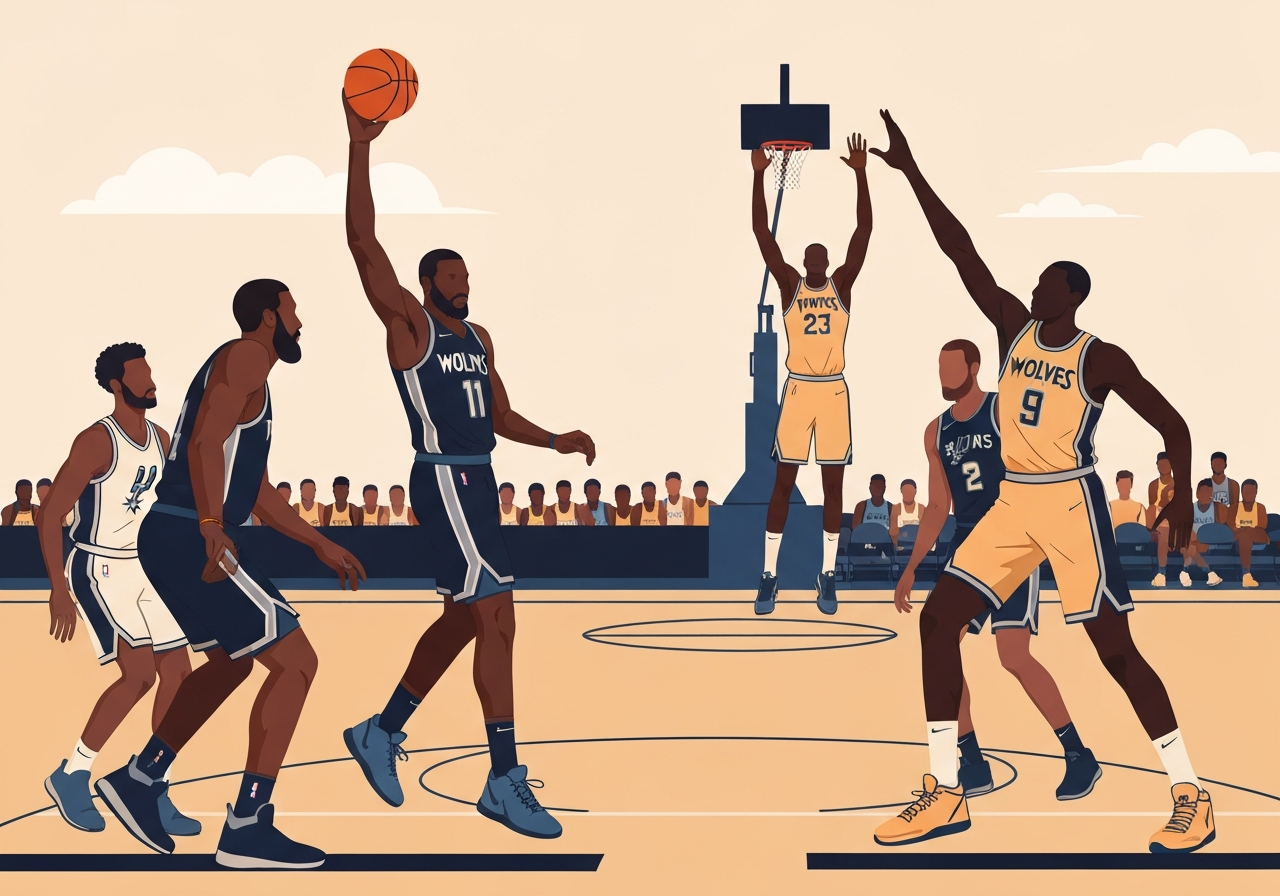
Anthony Edwards made a surprise return on Monday night at the Frost Bank Center, ten days after hyperextending his left knee, and helped the Minnesota Timberwolves beat the San Antonio Spurs 104-102 in Game 1 of the Western Conference semi-finals. Edwards scored 18 points—including 11 in the fourth quarter—after being cleared to play about 90 minutes before tipoff. Victor Wembanyama paced the Spurs with 15 rebounds and set an NBA postseason record with 12 blocked shots, but Minnesota held on for the one-possession win. The result gives the Timberwolves an immediate advantage in the best-of-seven series while raising questions about recovery timelines and matchup adjustments for the Spurs.
Key Takeaways
- Anthony Edwards returned 10 days after hyperextending his left knee on 25 April and recorded 18 points, with 11 coming in the final quarter, in Minnesota’s 104-102 Game 1 win in San Antonio.
- Victor Wembanyama registered 11 points, 15 rebounds and an NBA postseason single-game record of 12 blocked shots, anchoring a dominant defensive performance despite the loss.
- Edwards was cleared to play roughly 90 minutes before kickoff; Minnesota staff described an accelerated rehab involving pool work, resistance training and targeted therapy.
- The Frost Bank Center crowd was sold out for the opener; the defeat was only the Spurs’ second home series-opening loss in their past 17 such games.
- Minnesota coach Chris Finch emphasized medical staff work and Edwards’ motivation after the first-round series win as reasons for the quick return.
- Elsewhere on Monday, the New York Knicks routed the Philadelphia 76ers 137-98, with Jalen Brunson scoring 35 points—27 of them in the first half—continuing New York’s high-margin playoff run.
Background
The Western Conference semi-final matchup between the Timberwolves and Spurs entered Game 1 with clear storylines: Minnesota carried momentum after closing out a first-round series, while San Antonio leaned on the once-in-a-generation defensive presence of Victor Wembanyama. Edwards had suffered a hyperextended left knee and a bone bruise on 25 April in Game 4 of Minnesota’s opening-round series against Denver, an injury that initially made him a doubtful participant for the start of the San Antonio series.
Edwards has been the fulcrum of Minnesota’s attack this season and in the three regular-season meetings with the Spurs averaged 36.7 points, 4.0 assists and 3.0 rebounds, by his own account enjoying the matchup with Wembanyama. The Spurs, meanwhile, entered the series riding a strong home-court playoff record; a loss in Game 1 would be notable given their recent string of wins in home openers.
Main Event
The game’s early tone was set when Edwards drained a three-pointer with 1:27 left in the first quarter and emphatically declared to the Spurs bench, “I’m back,” underscoring the messaging around his return. He never became a volume scorer in the contest but was decisive late, producing 11 of his 18 points in the fourth quarter as Minnesota fought off a San Antonio push. The closing minutes were tight: the Timberwolves managed to protect a slim margin through a combination of timely offense and defensive stops.
Wembanyama’s impact was unmistakable on the defensive end. He collected 12 blocked shots—an NBA postseason single-game record—while also cleaning the glass with 15 rebounds. His rim protection changed several possessions and kept San Antonio within striking distance throughout, but he could not single-handedly lift the offense; his 11 points left scoring to role players and possessions that the Spurs failed to convert late.
Minnesota coach Chris Finch and the team’s medical staff pushed a quick but careful rehabilitation plan. Finch said the decision to play was made after thorough evaluation, and that Edwards was “in” when cleared roughly 90 minutes before tipoff. Edwards credited lead medical staff and conditioning work—pool sessions, resistance bands and targeted therapy—for speeding up his availability.
Analysis & Implications
Edwards’ early return and Minnesota’s Game 1 victory create a two-fold effect: it sustains the Timberwolves’ competitive depth and forces the Spurs to adjust both offensively and defensively. With Edwards on the floor, Minnesota’s spacing and ball-handling options improve, making double teams on Wembanyama more consequential and opening driving lanes for cutters and shooters late in games.
For San Antonio, Wembanyama’s record-setting block performance is both encouraging and incomplete. The defensive dominance around the rim is elite and will demand sustained attention from opponents, but the Spurs must convert that defense into consistent offense. The limited scoring output from Wembanyama in this game means San Antonio will need better shot creation from guards and wings or more efficient finishing around the basket to swing a series.
There are also broader league implications about load management and rapid return-to-play decisions. Edwards’ clearance within ten days of a hyperextension—compounded by a bone bruise—illustrates how teams balance short-term competitive gain against injury risk. Medical teams, player preferences and playoff urgency all factor into these calls, and this case will likely be cited in future discussions about risk tolerance in postseason settings.
Comparison & Data
| Item | Timberwolves | Spurs |
|---|---|---|
| Final score | 104 | 102 |
| Leading scorer (Game 1) | Anthony Edwards (18) | Victor Wembanyama (11) |
| Rebounds | — | Wembanyama 15 |
| Blocks (playoff record) | — | Wembanyama 12 |
| Injury/return | Edwards: hyperextended knee, bone bruise; returned after 10 days | — |
The table above isolates the headline numbers from Game 1. Minnesota’s margin of victory came despite Wembanyama’s historic defensive night; the Wolves’ balance and late execution edged out San Antonio by two points. Outside this series, New York’s 137-98 win over Philadelphia on the same night stands in contrast: Jalen Brunson’s 35-point outburst fueled a historically large playoff streak of high-margin wins for the Knicks.
Reactions & Quotes
Teammates and opponents acknowledged the competitive nature of Edwards’ decision to return and the edge it gave Minnesota late in the game. San Antonio guard Dylan Harper framed Edwards’ performance as typical of an established star.
“That’s kind of who he is. Superstar in this league. He’s going to come back and have games like that even though he hasn’t played for a little bit.”
Dylan Harper, San Antonio Spurs guard
The Timberwolves’ coach and Edwards himself highlighted medical staff work and personal motivation in the quick recovery.
“He loves to play the game. We dodged a bullet when it happened. Our medical staff has done an unbelievable job… He was super motivated by the fact that we were able to get that first series.”
Chris Finch, Minnesota Timberwolves head coach
Edwards credited targeted rehabilitation in short order while downplaying any narrative that he returned because of the Spurs’ matchup rather than a desire to be with his teammates.
“I think I got the best physical therapist in the world with David Hines… just trusting him and working through all the pain… band work, pool running, a lot of resistance. So yeah, he got me right.”
Anthony Edwards, Timberwolves guard
Unconfirmed
- Whether Edwards’ knee will tolerate back-to-back games in this series without increased risk remains unconfirmed and will depend on postgame evaluations.
- It is not yet clear which tactical adjustments the Spurs will implement to translate Wembanyama’s rim protection into higher offensive output in future games.
- Any long-term implications of the bone bruise on Edwards’ availability later in the postseason are currently unknown pending further medical assessments.
Bottom Line
Monday’s opener underscored two contrasting headlines: Anthony Edwards’ rapid, effective return gave Minnesota a narrow and valuable Game 1 road victory, while Victor Wembanyama’s franchise-defining defensive night produced an NBA postseason blocks record but not a win. The result shifts immediate pressure onto the Spurs to find consistent scoring support for Wembanyama and forces Minnesota to manage Edwards’ recovery while leveraging his impact.
Expect the series to be defined by adjustments—San Antonio must convert defensive disruption into points, and Minnesota must decide how to balance Edwards’ minutes with long-term health. Both teams will re-evaluate schemes and rotations ahead of Game 2 as medical updates and tactical shifts become clearer.
Sources
- The Guardian (news media report)
- NBA (official league site and box scores)
- Sportradar (sports-data provider)