
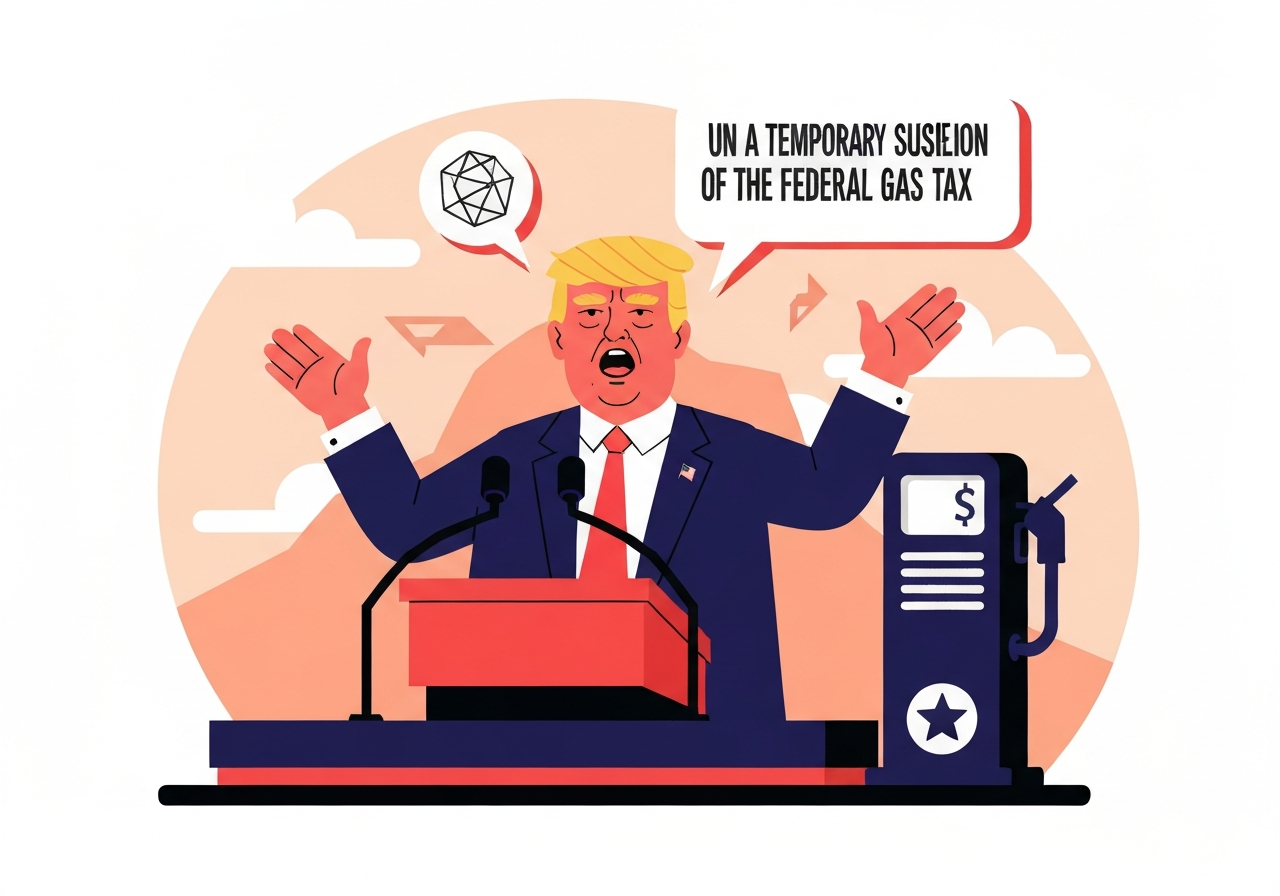
Lead: On May 11, 2026, President Donald Trump told CBS News he intends to suspend the federal gas tax “for a period of time” as pump prices surge amid the Iran war. He framed the move as temporary, saying the tax would be reinstated as prices fall. The proposal would require congressional approval and, according to reporting, could cost the federal government roughly $500 million a week while raising concerns about highway funding. Lawmakers from both parties reacted quickly, with some Republicans pledging bills to pause the levy and Democrats circulating alternative measures.
Key Takeaways
- President Trump said in a May 11 CBS News interview he plans to pause the federal gas tax “for a period of time,” tying the measure to recent price spikes.
- AAA data show national gas prices have risen more than 50% since the Iran war began on Feb. 28, peaking above $4.52 per gallon on Sunday.
- The federal excise tax is 18.4 cents per gallon for gasoline and 24.4 cents per gallon for diesel; pausing it would forego about $500 million in federal revenue each week, per the report.
- Revenue from the federal gas tax is credited to the Highway Trust Fund, which finances road and transit projects nationwide.
- Republican Sen. Josh Hawley announced plans to introduce legislation to suspend the tax, and Rep. Anna Paulina Luna said she will file a companion House bill this week.
- Trump rejected calls for an airline bailout despite jet fuel costs having more than doubled since Feb. 28; one carrier, Spirit Airlines, recently ceased operations amid pressure from fuel expenses.
- Trump criticized Iran’s latest diplomatic offer as “totally unacceptable,” and reiterated claims about the Strait of Hormuz and prior U.S. maritime operations.
Background
U.S. federal motor fuel excise taxes have long funded the Highway Trust Fund, a primary source for highway and certain transit programs. At 18.4 cents per gallon for gasoline and 24.4 cents for diesel, these levies are modest per gallon but generate steady revenue when volumes are high. The fund has faced recurring shortfalls in recent years, prompting transfers and legislative debate about its long-term solvency and alternative funding mechanisms.
The immediate trigger for the recent price surge is the conflict involving Iran, which began affecting global shipping and commodity markets after Feb. 28, 2026. Analysts have flagged the closure of, or restrictions in, the Strait of Hormuz as a key supply-risk factor; Iran’s actions have pushed crude and refined fuel prices higher, exerting upward pressure on retail gasoline and jet fuel worldwide. Policymakers now face competing pressures: voters demand relief at the pump, while transportation agencies warn that removing a dedicated revenue stream would hamper infrastructure spending.
Main Event
In a televised interview on May 11, President Trump stated his intent to remove the federal gas tax temporarily. He described the pause as contingent on prices and suggested the tax would “phase back in” once pump costs eased. The president framed the step as immediate executive priority, though he acknowledged that changing federal excise taxes requires congressional action.
Following the interview, Republican Sen. Josh Hawley said he would file legislation to suspend the federal gas tax, and Rep. Anna Paulina Luna of Florida indicated she would introduce a House bill this week citing the president’s remarks. The moves add to a patchwork of proposals from lawmakers of both parties: several Democrats had already proposed pausing or reducing the tax as consumers grapple with higher prices.
The report notes that temporarily halting the excise tax would remove an estimated $500 million in federal receipts each week. Highway and transit planners warn that those losses would have to be replaced from other budget lines or would result in delayed or canceled projects. At the same time, the White House rejected broad airline bailout demands despite jet fuel costs more than doubling since Feb. 28; the administration said a formal bailout request had not been presented and characterized carriers as “doing not badly.”
Analysis & Implications
Pausing the federal gas tax is politically attractive as a visible, headline-grabbing form of relief at the pump, but the mechanics complicate its efficacy. Because the tax is a fixed cents-per-gallon levy, cutting it delivers a uniform per-gallon reduction rather than a percentage drop tied to crude prices; the actual consumer savings depend on the margin retailers and refiners pass through. With prices already elevated, a temporary 18.4-cent cut would ease but not erase recent increases.
Legally and procedurally, the excise tax cannot be suspended by the president alone; Congress must enact legislation to alter the rate or pause collections. That means any pause would be subject to partisan bargaining, competing budget priorities and the congressional calendar. Estimates that a full pause would cost roughly $500 million per week come from the same reporting and hinge on current fuel consumption; lower volumes or partial suspensions would change the fiscal math.
Strategically, diverting or foregoing Highway Trust Fund revenue could delay maintenance and capital projects across states that rely on predictable federal matching funds. Transportation officials warn that short-term consumer relief might be offset by long-term infrastructure deterioration, higher future costs, or the need to find alternative revenue sources. Some policy experts argue targeted rebates or direct tax credits would better balance relief with funding integrity.
Comparison & Data
| Item | Current Value |
|---|---|
| Federal gasoline excise tax | 18.4 cents/gal |
| Federal diesel excise tax | 24.4 cents/gal |
| Estimated federal revenue lost if paused | ~$500 million/week (reported) |
| Gas price increase since Feb. 28 | >50% (AAA) |
| Retail peak reported | Above $4.52/gal (Sunday) |
This table summarizes the fixed excise rates and the near-term fiscal estimate reported in coverage. The excise taxes are statutory cents-per-gallon levies, so the nominal per-gallon reduction from a pause is straightforward; the budgetary effect and market pass-through are more complex. Analysts emphasize that the $500 million weekly figure is an aggregate estimate tied to current consumption and could fall if demand drops.
Reactions & Quotes
“Yup, we’re going to take off the gas tax for a period of time, and when gas goes down, we’ll let it phase back in.”
President Donald Trump — CBS News interview
Context: The president framed the proposal as temporary and tied to market movements; he also acknowledged that any change would need congressional action.
“I will introduce legislation to suspend the federal gas tax,”
Sen. Josh Hawley (R)
Context: Hawley’s announcement signals a fast legislative response from some Republicans; whether such bills can clear both chambers and be reconciled with budget rules remains uncertain.
“The airlines are doing not badly,”
President Donald Trump — on airline bailout
Context: Trump said no formal bailout request had been presented to the administration, even as carriers face higher jet fuel costs and at least one budget carrier recently stopped operations.
Unconfirmed
- Whether Congress will pass a suspension of the gas tax remains uncertain; proposals have been announced but no legislation has been enacted as of May 11, 2026.
- Precise fiscal impact of any pause depends on consumption levels and the duration of the suspension; $500 million per week is an estimate tied to current usage and may vary.
- Mr. Trump’s statements about restarting or escalating maritime operations in the Strait of Hormuz are policy claims that were not accompanied by a formal administration plan at the time of the interview.
Bottom Line
The president’s pledge to temporarily suspend the federal gas tax is a politically resonant proposal aimed at immediate relief but faces clear legal, fiscal and policy constraints. Any pause would need congressional approval and would reduce dedicated funding for roads and transit at a time when many jurisdictions already report thin margins in infrastructure budgets.
For consumers, a short-term excise cut would lower per-gallon prices by a fixed amount, but total savings depend on broader market dynamics and whether retailers pass the full reduction through to motorists. Policymakers will need to balance visible near-term relief against longer-term infrastructure funding risks and consider more targeted alternatives if the goal is sustained consumer assistance without undermining capital programs.
Sources
- CBS News (News report, May 11, 2026)
- AAA — Gas Prices (Industry data and price tracking)