
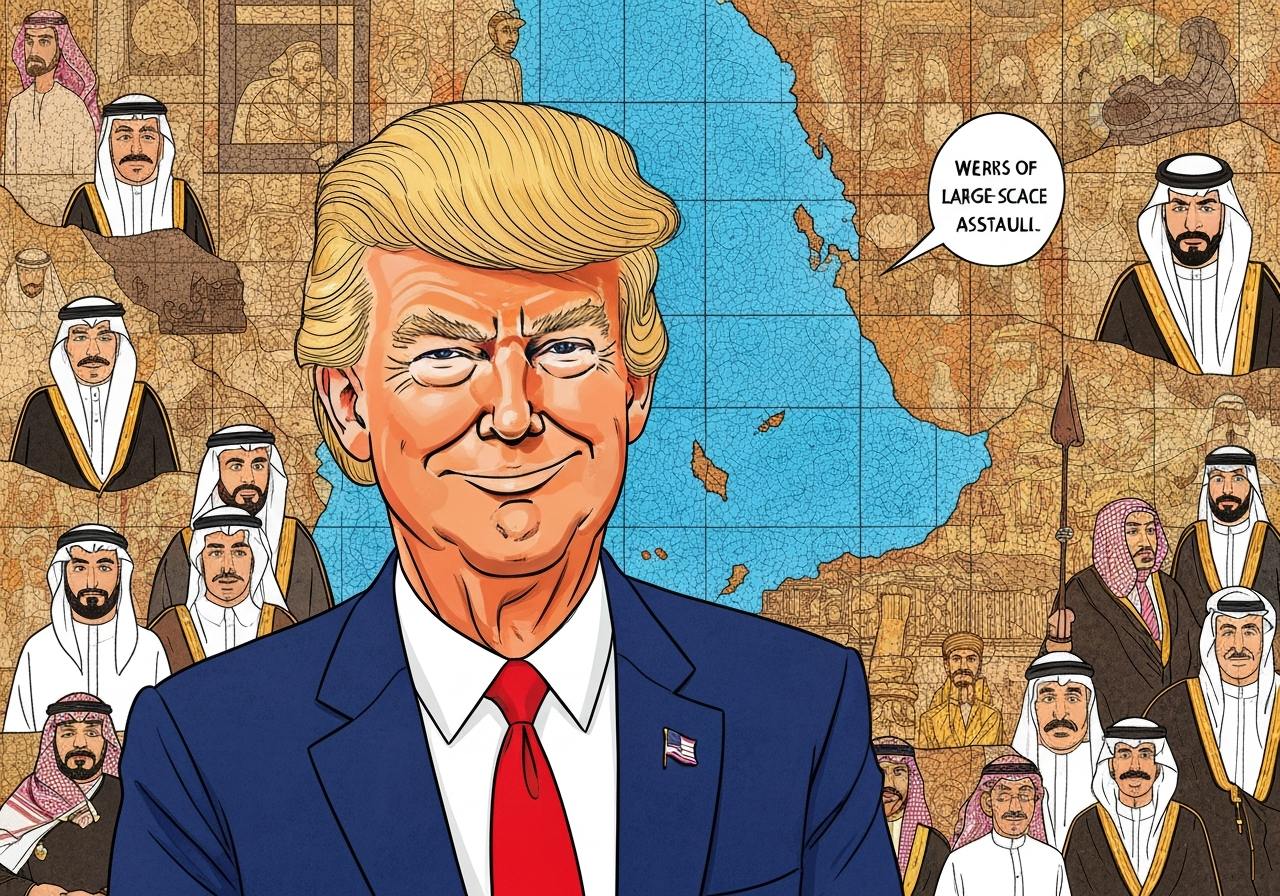
Lead: US president Donald Trump said on 18 May 2026 that he postponed a planned military strike on Iran at the request of Gulf leaders and that intensive negotiations are now under way. He posted on his Truth Social account that Qatar, Saudi Arabia and the UAE urged him to hold off while talks proceed, and he asserted any deal would bar Iran from obtaining nuclear weapons. Trump added the US military remains ready to launch a “full, large scale assault” on short notice if an acceptable agreement is not reached.
Key takeaways
- Donald Trump announced a delay to a planned attack on Iran on 18 May 2026 after, he said, requests from the Emir of Qatar, Sheikh Tamim bin Hamad Al Thani; Saudi Crown Prince Mohammed bin Salman; and UAE President Mohamed bin Zayed. This was posted on his Truth Social account.
- Trump said “serious negotiations” are under way and insisted any outcome will include a prohibition on nuclear weapons for Iran; he simultaneously warned of readiness for a “full, large scale assault” if talks fail.
- The Global Sumud flotilla of 54 vessels and 426 people was intercepted by Israeli forces about 250 nautical miles (463 km) from Gaza; organisers said 39 boats were intercepted and 44 Turkish nationals were among participants.
- The IAEA reported that off‑site power to Unit 3 at the UAE’s Barakah plant was restored after a drone strike caused a fire outside the inner perimeter; authorities said no radioactive release occurred.
- The US Treasury announced a 30‑day extension for tankers already carrying Russian oil to enter markets, a temporary waiver meant to ease price shocks linked to the Iran war.
- Iran’s Revolutionary Guards reported strikes on groups near the Iran–Iraq border they described as linked to US and Israeli actors; independent verification is limited.
- Lebanese authorities said Israeli strikes have killed over 3,000 people in Lebanon since 2 March 2026; the Lebanese health ministry reported 3,020 dead and 9,273 wounded through 18 May 2026.
Background
The region has been in sustained turmoil since late February 2026, when US and Israeli strikes on Iranian targets triggered a widening conflict that has involved cross‑border exchanges, attacks on shipping, and damage to energy infrastructure. The strait of Hormuz — a chokepoint for global oil flows — has been a focal point, with Tehran announcing measures to control passage and the US seeking diplomatic channels to reopen trade routes.
Diplomatic actors in the Gulf and beyond have been actively engaged in shuttle diplomacy to prevent further escalation. Gulf monarchies face acute economic and security pressures from disruptions to oil and shipping; they have been publicly and privately pressing for de‑escalation while pursuing their own strategic interests with both Washington and Tehran.
Domestic politics in Washington also shape the calculus: sudden military decisions carry wide geopolitical risk and domestic political consequences. The administration’s prior waivers on sanctions and the Treasury’s approach to Russian oil reflect the economic spillovers of the regional war and the urgency of stabilising markets before US domestic political deadlines.
Main event
On 18 May 2026, President Trump posted that he had been asked by key Gulf leaders to postpone an attack scheduled for the following day because “serious negotiations” were taking place. He named Qatar’s emir, the Saudi crown prince and the UAE president as the interlocutors and framed the pause as respecting allied counsel while insisting that a deal would bar Iran from nuclear weapons.
In the same post, Trump named senior US officials — including a “Secretary of War, Pete Hegseth,” and a Chairman of the Joint Chiefs identified as “General Daniel Caine” — and said he had instructed US forces to stand ready for a rapid, large‑scale assault should negotiations fail. Those personnel claims mirror language in his post but have not been independently confirmed by Pentagon releases at the time of writing.
Parallel events heightened tensions across the region: Israel intercepted a large humanitarian flotilla bound for Gaza, detaining participants and boarding multiple vessels; organisers reported loss of contact with some on board. Separately, a drone strike damaged an external generator at the Barakah nuclear plant in the UAE, briefly disrupting off‑site power to Unit 3 until it was restored, according to IAEA notification.
Economic fallout is already visible. The US Treasury’s temporary extension to allow certain Russian oil tankers to discharge cargo was framed as a measure to blunt fuel price spikes caused by the effective closure of the Hormuz route. Energy analysts warn global inventories may take many months to recover from the current disruptions.
Analysis & implications
Trump’s public claim that Gulf leaders asked him to stand down serves multiple political functions: it projects allied consensus behind his policy, creates diplomatic cover for a pause, and signals leverage to Tehran. If accurate, the request also shows Gulf capitals’ preference for a negotiated de‑escalation that limits direct US‑Iran military confrontation while preserving their own security relationships with Washington.
Operational readiness paired with diplomatic engagement is a classic coercive diplomacy posture: threaten force while negotiating concessions. The risk is that the simultaneous public threat of a “full, large scale assault” could harden Iran’s negotiating stance, reduce trust, and increase the probability of miscalculation or rapid escalation if an incident occurs.
Economic measures such as temporary sanction waivers on certain oil shipments are pragmatic attempts to stabilise markets, but they are politically costly and temporary. They reflect the scale of the supply shock described by the International Energy Agency and underline how regional conflict now has direct, measurable effects on global prices and domestic politics in consuming countries.
Humanitarian and legal dimensions remain acute. Interceptions at sea, attacks near nuclear installations and heavy civilian casualties in Lebanon and Gaza deepen international scrutiny. Any negotiated settlement would need to address not only immediate security guarantees but also accountability, reconstruction, and mechanisms to prevent renewed hostilities.
Comparison & data
| Metric | Reported figure |
|---|---|
| Lebanon deaths (2 Mar–18 May 2026) | 3,020 |
| Lebanon wounded (to 18 May 2026) | 9,273 |
| Gaza fatalities since Oct 2025 ceasefire | 877 |
| Flotilla vessels / participants | 54 vessels, 426 people |
| Distance of flotilla from Gaza when intercepted | ~250 nautical miles (463 km) |
These figures capture the immediate human cost and the scale of maritime operations. They also show why regional actors and international agencies are urging restraint: the conflict’s human toll and the economic disruptions to oil and shipping create powerful incentives to find diplomatic solutions quickly.
Reactions & quotes
“This Deal will include, importantly, NO NUCLEAR WEAPONS FOR IRAN!”
Donald J. Trump (Truth Social post)
Context: Trump used emphatic language to underscore his negotiating objective while also reiterating a readiness to use force if diplomacy fails.
“Normalising war is never acceptable, normalising slaughter is never acceptable.”
Catherine Connolly (President of Ireland)
Context: Ireland’s president expressed public concern about the humanitarian toll and called for adherence to international law after a flotilla incident involving her sister.
“Off‑site power to Unit 3 at Barakah was restored; safety systems were not compromised and no release of radioactive material was reported.”
International Atomic Energy Agency (IAEA notification)
Context: The IAEA conveyed technical reassurance following a drone strike that caused a generator fire outside the plant’s inner perimeter.
Unconfirmed
- Trump’s claim that the Emir of Qatar, the Saudi crown prince and the UAE president jointly requested a postponement has not been independently confirmed by statements from those governments at the time of reporting.
- The named US officials in Trump’s post — specifically “Secretary of War Pete Hegseth” and “General Daniel Caine” as Chairman of the Joint Chiefs — are presented as assertions in the post and have not been corroborated by official Pentagon releases.
- Reports that the US formally offered a 30‑day waiver on Iranian oil imports were attributed to Tasnim; the White House had not issued a confirming statement at the time of publication.
Bottom line
The White House posture announced by President Trump on 18 May 2026 blends a temporary diplomatic pause with an explicit threat of major military action. If Gulf leaders are indeed pressing for talks, that represents an important regional push for de‑escalation; however, the public pairing of negotiation and threat narrows diplomatic space and raises the odds of misstep.
Beyond the immediate signalling, the episode highlights three pressures shaping policy: the humanitarian emergency in Lebanon and Gaza, the economic imperative to stabilise oil and shipping routes, and the domestic political need in consuming countries to avert sustained price shocks. The coming days will be decisive: either negotiators secure a framework that reduces the risk of direct conflict, or military readiness and public threats could precipitate a rapid and dangerous escalation.