
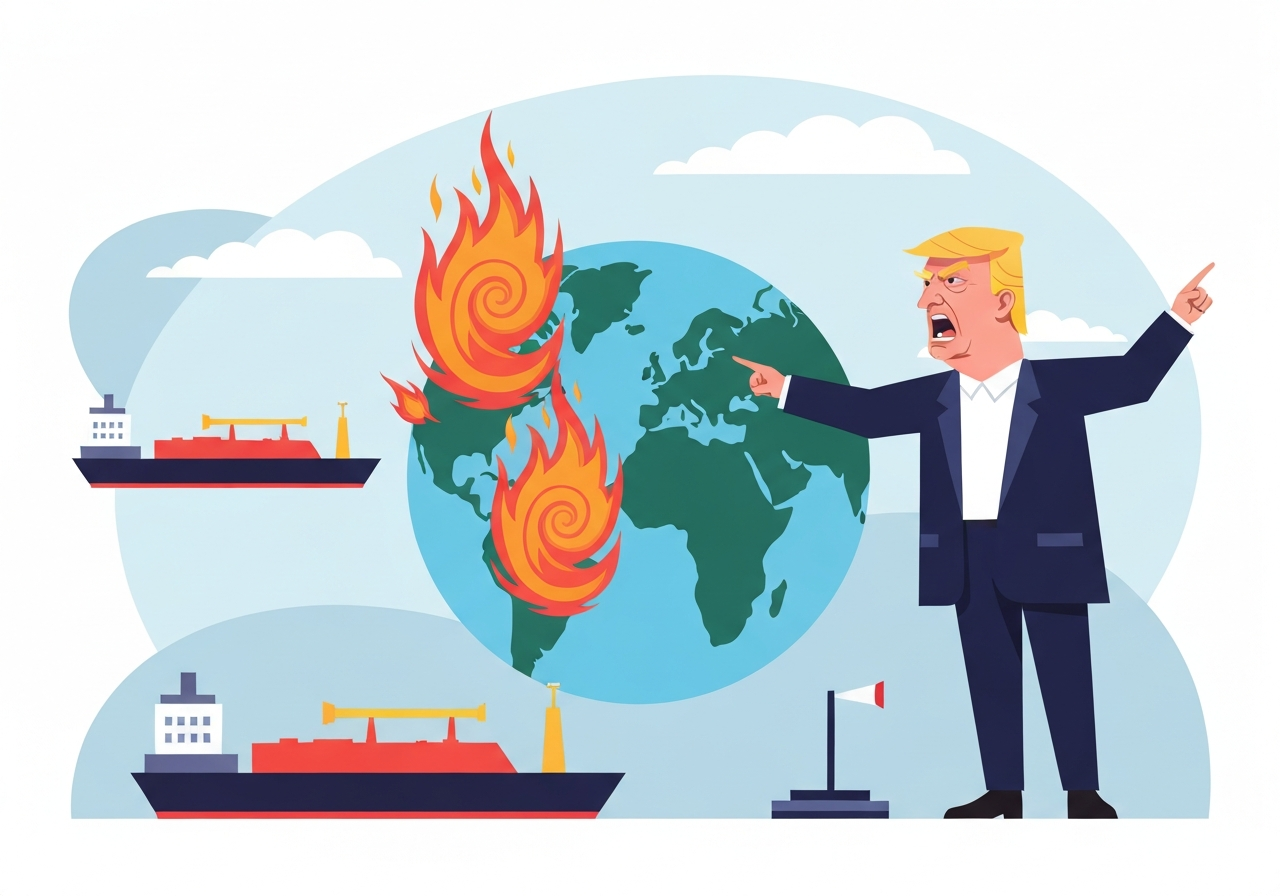
U.S.-Iran hostilities and a fresh round of threats from President Trump on Sunday have kept global oil prices elevated and shipping in the Strait of Hormuz constrained as talks to end the 80-day war remain stalled. U.S. Central Command says American forces have been redirecting commercial traffic and disabling vessels as part of a blockade on Iranian ports that began in mid-April. Market-sensitive moves — including a 30-day extension of a Treasury waiver for Russian at-sea oil — have provided temporary relief even as volatility persists. Diplomacy continues via third-party intermediaries, but both sides signal conditions and mistrust that prevent a rapid deal.
Key takeaways
- CENTCOM reported it has redirected 85 commercial vessels and disabled four others amid a U.S. blockade of Iranian ports that started in mid-April.
- Kpler data shows 55 commodity vessels transited the Strait of Hormuz between May 11–17, up from 19 the previous week and averaging 55 weekly since March 1 (663 total).
- Brent crude spiked as high as $112 per barrel overnight before easing to about $108.75; prices remain far above the roughly $70 seen before the war.
- The U.S. Treasury extended a 30-day sanctions waiver allowing Russian oil already at sea to be delivered to vulnerable buyers, Treasury Secretary Scott Bessent said.
- Lebanon’s health ministry reports 3,020 killed and 9,273 wounded from Israeli strikes since early March; a 45-day extension to a truce was negotiated during talks in Washington.
- Iran and Oman are discussing a mechanism to manage transit in the Strait of Hormuz; Tehran is also forming a Persian Gulf Strait Authority to regulate passage.
- A drone strike caused a fire at the UAE’s Barakah nuclear plant perimeter; there were no radiological releases or injuries and responsibility is unconfirmed.
Background
The conflict entered its 80th day as U.S. and Israeli forces press military operations while diplomatic channels operate intermittently through intermediaries. The U.S. imposed a naval blockade on Iranian ports in mid-April to constrain Tehran’s maritime operations; CENTCOM has repeatedly posted operational updates on redirected and disabled ships. The Strait of Hormuz is a central pressure point — in peacetime it carries about one-fifth of global oil and LNG shipments — and disruptions there have immediate price effects.
Markets have already factored in supply shocks: Brent moved from roughly $70 per barrel in late February to sustained triple-digit levels after the war began. That price shock is now compounded by uncertainty over sanctions policy, including short-term waivers for Russian crude at sea and Iranian claims that the U.S. may temporarily suspend Iran-specific oil restrictions during negotiations. Political actors across Europe, the Middle East and Asia are urging de-escalation even as military warnings and strikes continue.
Main event
Monday saw U.S. Central Command report that operations had redirected 85 commercial vessels and disabled four, an increase from earlier counts reported that same day. CENTCOM reiterated that it is “strictly enforcing the U.S. blockade against Iranian ports,” a posture that has constricted normal maritime flows and prompted rerouting or delays for tankers and bulk carriers. Meanwhile, Kpler’s vessel-tracking shows week-to-week swings in transits through the Strait of Hormuz — 55 crossings in May 11–17, up from a wartime low of 19 the prior week.
On the diplomatic front, Tehran says it has transmitted revised terms to U.S. negotiators via Pakistani intermediaries; Iran’s foreign ministry spokesman Esmaeil Baqaei said talks remain focused on ending the fighting and that nuclear issues are not being discussed at this stage. The U.S. has not publicly confirmed Iranian assertions about specific concessions or offers. Iranian state media also reported that Washington proposed suspending oil sanctions during negotiations — a claim U.S. officials have not verified.
President Trump escalated public pressure with social-media posts warning Iran that the “clock is ticking” for a deal and suggesting renewed military action if Tehran does not move. His comments pushed markets and were followed by an overnight jump in Brent to about $112 a barrel before prices moderated. Separately, the U.S. Treasury announced a 30-day extension to a temporary general license for Russian crude already at sea, a move aimed at stabilizing physical crude flows to energy-vulnerable buyers.
Analysis & implications
Shipping restrictions and naval interdictions in the Gulf translate rapidly into tighter physical crude availability and higher risk premia, especially while major producers and consumers contemplate alternative routing. The Strait of Hormuz remains a chokepoint: even modest declines in weekly transits have outsized effects on forward oil pricing and insurance costs. Traders respond to political signals as much as to physical supply changes; repeated threats from top leaders widen bid-ask ranges and amplify volatility.
Short-term policy moves — like the Treasury’s 30-day waiver for stranded Russian cargoes — can blunt price spikes but do not alter the underlying strategic dynamics. That waiver helps some buyers access cargoes already at sea and reduces incentives for large-scale stockpiling by major buyers, but it expires quickly and therefore leaves continued exposure to renewed supply shocks. If the blockade or Iran’s toll mechanisms persist, operators may shift longer-term trade flows and reroute insurance, raising costs for global energy trade.
Regionally, the Barakah perimeter drone strike and renewed Lebanese-Israeli exchanges increase the risk that localized incidents will cascade into broader confrontations. Germany’s chancellor warned that attacks on nuclear facilities endanger the whole region, underlining how incidents at civilian infrastructure sites elevate international diplomatic urgency. For markets, the main takeaway is that even incremental military escalations will sustain a premium on oil until a durable, verifiable political settlement is reached.
Comparison & data
| Metric | Recent value | Reference period |
|---|---|---|
| Vessels redirected by CENTCOM | 85 (plus 4 disabled) | Midday Monday (update) |
| Strait of Hormuz commodity transits | 55 vessels | May 11–17 |
| Average weekly transits since March 1 | 55 per week (663 total) | March 1–mid May |
| Brent crude price (range) | $70 (pre-war) → $108–112 | Late Feb vs. recent sessions |
The table frames the immediate disruption: vessel redirections and sharp oil-price increases are temporally linked to military and diplomatic developments. While weekly transit counts have recovered from an extreme low of 19, they remain aligned with wartime averages that are well below normal peacetime throughput.
Reactions & quotes
“CENTCOM continues to strictly enforce the U.S. blockade against Iranian ports.”
CENTCOM (official statement on social media)
“This [30-day] extension will provide additional flexibility, and we will work with these nations to provide specific licenses as needed.”
Scott Bessent, U.S. Treasury Secretary
“We are fully prepared for every scenario … in the event of any reckless action we will respond with full strength.”
Esmaeil Baqaei, Iranian Foreign Ministry spokesman
Each quote underlines the competing dynamics: CENTCOM signaling operational control, Treasury aiming to steady markets, and Iran warning of robust responses. These public lines shape expectations among traders, regional governments and neutral intermediaries attempting to keep negotiations alive.
Unconfirmed
- Tasnim’s report that the U.S. offered to temporarily suspend sanctions on Iranian oil during negotiations remains unverified by U.S. officials.
- Attribution of the drone strike that damaged a perimeter generator at the UAE’s Barakah nuclear plant is unconfirmed; authorities have not publicly named an attacker.
- Claims about the specific content of revised Iranian proposals shared via Pakistani intermediaries have not been independently confirmed by U.S. negotiators.
Bottom line
Operational measures in the Gulf, public threats from top leaders and episodic strikes on infrastructure have conspired to keep oil prices substantially above pre-war levels and to sustain market volatility. Short-term administrative fixes — such as a temporary waiver for stranded Russian cargoes — can reduce acute dislocations but do not resolve strategic risks tied to naval control, sanctions policy and mutual mistrust.
For markets and policymakers the priority is clear: a durable, verifiable diplomatic framework that reopens safe, accountable maritime transit and addresses sanctions timelines would remove much of the tail risk that currently supports a premium on energy prices. Until that outcome is credible, traders and governments should expect intermittent price spikes and continued disruption for shipping in the Strait of Hormuz.