
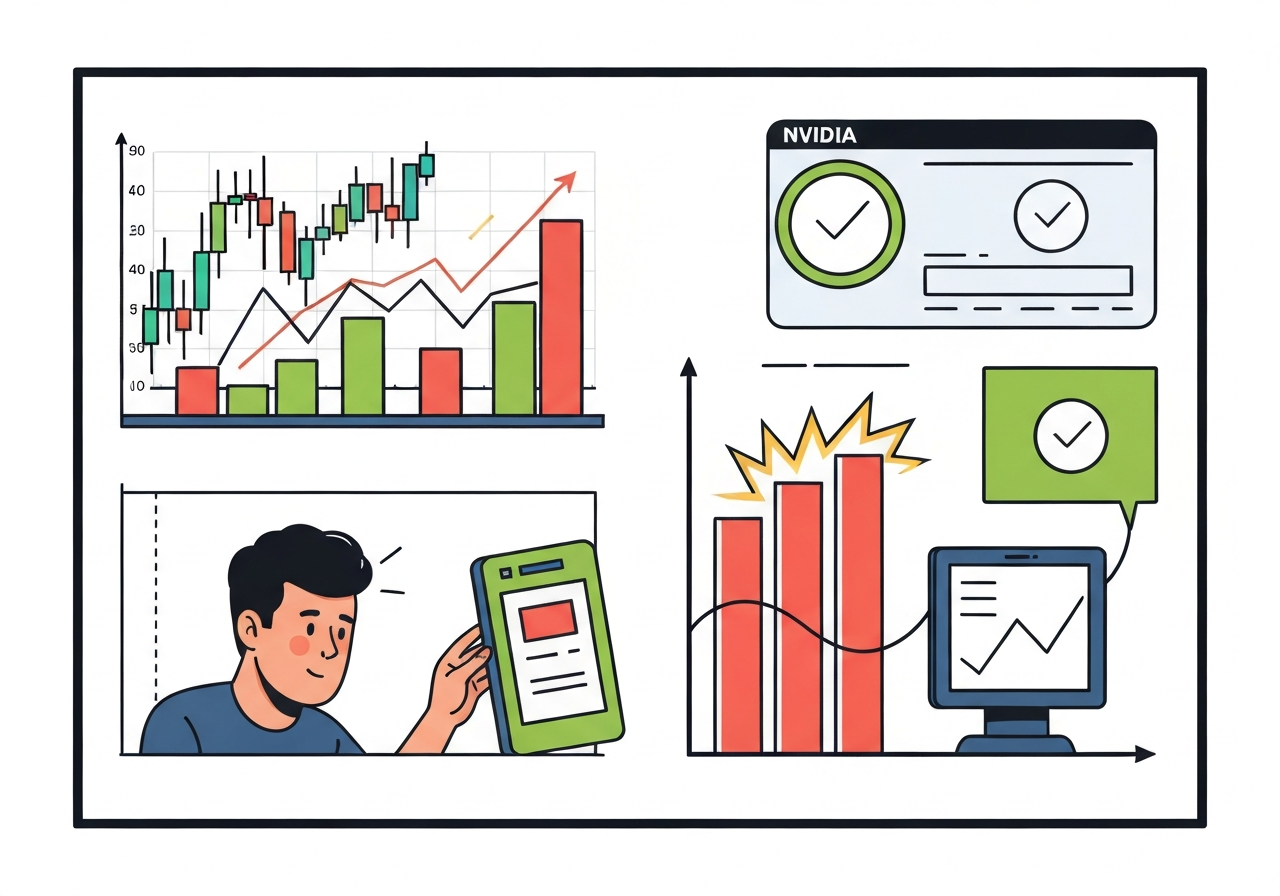
On May 20, 2026, Nvidia Corp. is set to publish quarterly results after the market close, a report that could either validate a months-long surge in chip stocks or intensify investor concern. For much of 2026, semiconductor names have driven market gains, powered by appetite for artificial-intelligence hardware from large cloud and tech companies. Wall Street is watching for not just another strong quarter but guidance that clarifies how durable AI-related demand will be. The report, first filed at 9:11 AM UTC and updated at 1:45 PM UTC on May 20, will be a focal point for traders when markets reopen the next day.
Key Takeaways
- Nvidia reports after the close on Wednesday, May 20, 2026; the print will be interpreted for both current results and forward guidance.
- Chip stocks have led market gains through 2026, fueled largely by spending from Big Tech on AI infrastructure.
- Analysts expect Nvidia to continue showing strong revenue and profit trends, following a recent series of robust earnings across the sector.
- Investors will focus on management commentary about data-center orders, channel inventories and capital-expenditure patterns among major cloud customers.
- A strong beat and raised guidance could extend the sector rally; a softer outlook may spark sharp selling in momentum-driven names.
- Volatility is likely near term as options positioning and passive flows can amplify moves triggered by the print.
Background
The chip sector has outperformed broad markets for much of 2026 as demand for AI accelerators and supporting infrastructure rose sharply. Major cloud providers and large technology firms have committed significant capital to expand AI compute capacity, boosting sales for companies that supply GPUs, networking chips and supporting systems. Nvidia, as a leader in AI-focused semiconductors, is central to investor expectations about the supply chain and the timing of enterprise adoption. Past quarters showed a string of strong results from chipmakers, reinforcing a narrative that a structural shift toward AI compute is underway.
Market participants say the rally has been partly technical: strong earnings, concentrated buy flows and momentum strategies have drawn in asset managers and retail investors alike. That has increased the market’s sensitivity to forward guidance rather than just headline beats, since high valuations make the sector vulnerable to any sign of slowing demand. Regulators and trade dynamics also bear watching; export controls and geopolitical tensions can alter supply chains and reorder competitive advantages. Together, these factors make Nvidia’s cadence of results and management commentary unusually important for near-term price discovery.
Main Event
Nvidia will release results after the close on Wednesday, May 20, 2026, with investors parsing the quarter’s revenue, margins and guidance. Market focus will center on data-center revenue and the durability of demand from hyperscale customers that are building AI infrastructure. Traders will also examine inventory commentary — whether channel stocks have normalized or if end-demand remains robust — and any sign of cadence changes between cloud and enterprise spending.
In recent quarters, Nvidia beat consensus estimates and raised forward targets, which helped sustain a broader chip-stock rally. This quarter’s print will be judged against that backdrop: a repeat pattern could reinforce investor confidence that earnings growth remains intact. Conversely, conservative guidance or signs of lengthening sales cycles might trigger position unwinds in highly rated names and lead to compressed multiples across the sector. Because many investors have concentrated exposures to a handful of leaders, moves in Nvidia shares often ripple through related chips and software stocks.
Execution matters as much as headline numbers. Investors will parse management’s tone on supply constraints, pricing dynamics and product mix shifts toward next-generation accelerators. Commentary about partnerships, software monetization and customer timelines will be used to refine models for both Nvidia and its suppliers. Market liquidity conditions into the print — including options expirations and scheduled macro releases — could amplify the initial market reaction and extend volatility into the following sessions.
Analysis & Implications
If Nvidia posts another strong quarter with upbeat guidance, it would solidify the case that AI-driven capex is a multi-year demand tailwind for semiconductors and related infrastructure plays. That scenario would likely sustain investor rotation into chipmakers, systems vendors and software firms that benefit from enhanced compute spending. Benchmarks tied to semiconductor performance could see further gains, and capital flows might accelerate into thematic funds centered on AI hardware and cloud infrastructure.
On the other hand, if guidance falls short of elevated expectations, the market could quickly reprice that optimism. Given lofty valuations across many AI beneficiaries, even a modest downward revision could prompt sharp de-ratings and sector-wide volatility. The key transmission channels would be margin compression expectations, a reassessment of buildout timelines at hyperscalers, and potential cutbacks in discretionary enterprise projects. Such a shift could also slow hiring and supply-chain investment decisions among suppliers and ecosystem partners.
Beyond near-term price moves, Nvidia’s results carry implications for capital allocation and competition in the AI chip market. Sustained outperformance would reinforce Nvidia’s leadership and make it harder for rivals to close the ecosystem gap, particularly if the company continues to monetize hardware alongside software and developer tools. A softer outcome could embolden competitors and accelerate diversification efforts among large cloud providers to secure multiple supplier sources, altering procurement strategies and long-term vendor relationships.
Comparison & Data
Recent quarters have shown a pattern of strong results across leading chipmakers, but interpretations vary: some investors see a durable structural shift while others warn of cyclical re-acceleration that could fade. Historical precedent from past tech cycles suggests that guidance and forward orders often drive the largest post-earnings moves, especially when a concentrated group of names is responsible for a large share of market gains. Short-term performance tends to be dominated by sentiment and positioning, whereas longer-term outcomes hinge on tangible adoption rates for new technology stacks.
Reactions & Quotes
“Investors will be watching guidance more than the headline beat; execution and visibility matter now,”
Wall Street strategist
“A raised outlook could extend the current leadership, but any hesitation in data-center orders would be read as a warning sign,”
Market analyst
“Retail and institutional positioning are concentrated, so the initial move could be outsized compared with fundamentals,”
Trading desk commentary
Unconfirmed
- Whether hyperscale customers will sustain current AI capex plans beyond the next two quarters remains unclear and depends on internal ROI assessments.
- The precise scale of channel inventory normalization is uncertain until vendors disclose detailed order flows.
- Any immediate regulatory or geopolitical impacts on Nvidia’s supply chain were not reported as of the release time and remain subject to confirmation.
Bottom Line
Nvidia’s May 20, 2026 earnings release is a high-stakes event that may either reinforce a narrative of durable AI-driven demand or expose vulnerabilities in a rally built on concentrated leadership. Market participants should expect volatility and interpret the report through the twin lenses of current results and forward-looking guidance, with particular attention to data-center demand indicators.
For investors, the sensible response is not to chase short-term momentum but to evaluate exposure, concentration risk and the plausibility of multi-year adoption timelines. Traders should be prepared for amplified moves around the print; longer-term investors ought to focus on competitive positioning, customer adoption evidence and consistent monetization of AI ecosystems.