
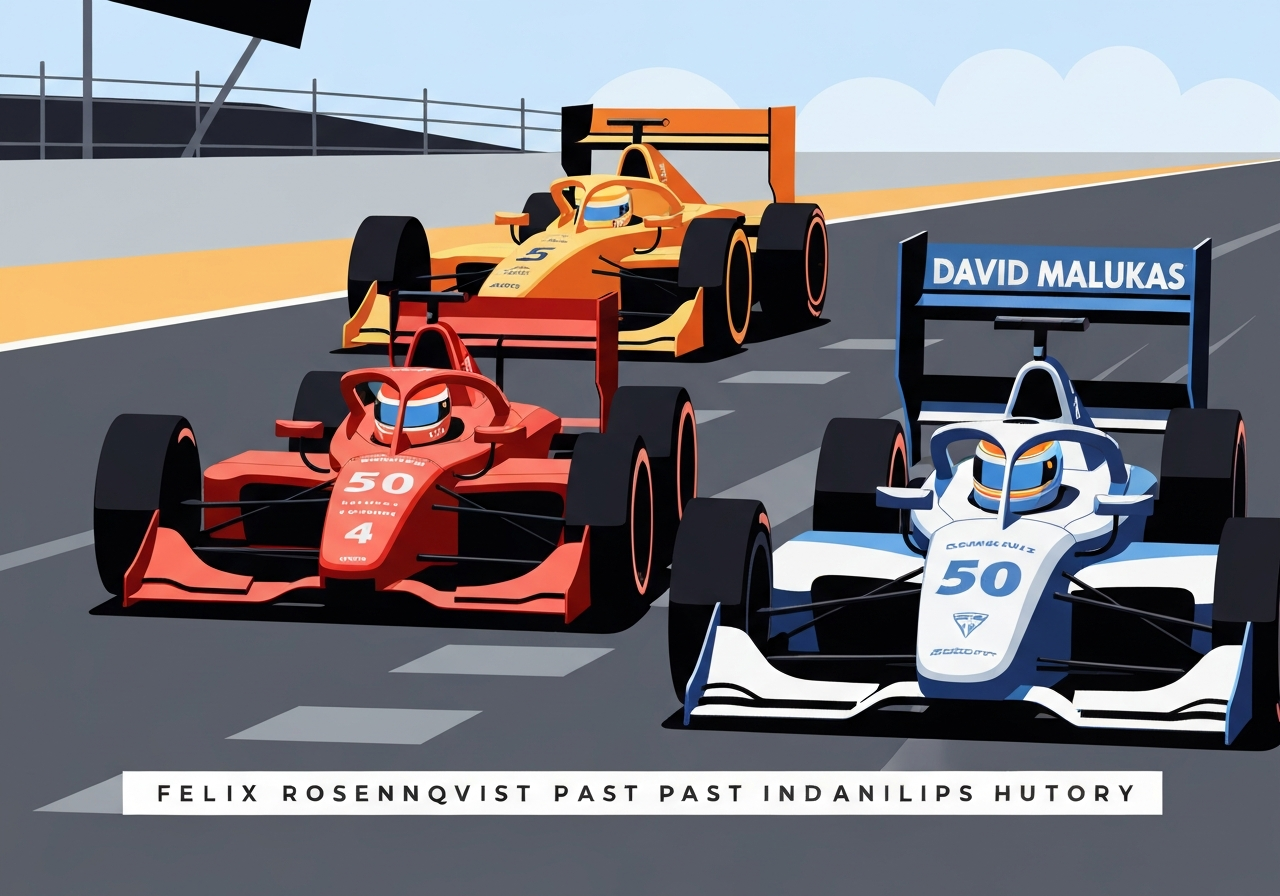
Felix Rosenqvist surged past David Malukas in the closing yards at Indianapolis Motor Speedway on Sunday to claim the closest Indianapolis 500 finish ever, winning by 0.023 seconds. The 34-year-old Swede, celebrating his first child 20 days earlier, executed a daring outside move on the final lap to take the victory for Meyer Shank Racing. The result was Rosenqvist’s second career IndyCar win in 120 starts and his first on an oval, while Malukas finished a heartbreaking runner-up for the second consecutive year. The dramatic finale capped a race marked by rain, two red flags and multiple late-race incidents.
Key Takeaways
- Winning margin: Rosenqvist beat David Malukas by 0.023 seconds, the smallest gap in Indianapolis 500 history.
- Career milestone: The victory was Rosenqvist’s second career IndyCar win (first on an oval) in 120 starts and came 20 days after the birth of his daughter, Stella.
- Team achievement: Meyer Shank Racing earned its second Indianapolis 500 win; team owner Helio Castroneves celebrated his first triumph as an owner.
- Race interruptions: The race featured two red-flag stoppages, including a 12-minute rain delay and a 10-minute halt after Caio Collet hit the wall with eight laps remaining.
- Championship impact: Alex Palou, the pole winner and defending champion, led the most laps (59) and extended his points lead to 37 despite finishing seventh; he was later penalized five points for a post-race technical non-compliance.
- Driver safety and incidents: Several significant incidents affected the closing laps, including Mick Schumacher brushing the wall with 3.5 laps to go and Katherine Legge’s early exit after contact on lap 17.
- Podium and top-fives: Malukas finished second, Scott McLaughlin third, Pato O’Ward fourth and Marcus Armstrong fifth.
Background
Rosenqvist arrived at Indianapolis with a string of near-misses: five straight top-nine qualifying results but no poles and multiple fourth-place finishes in recent years. The Swedish driver had previously won only once in IndyCar, at Road America in July 2020, and had sought a breakthrough at the 2.5-mile oval that crowns the series each May. Meyer Shank Racing, long a competitive outfit, had previously captured one 500 win and entered the weekend aiming to build on that pedigree while Helio Castroneves — a four-time Indy 500 winner as a driver — was establishing his role as a team owner.
The Indianapolis 500 remains the marquee event in IndyCar, combining oval speed, strategic pit stops, and the potential for chaotic late-race restarts that can reshape outcomes in seconds. Recent years have seen tight competition and dramatic finishes, raising the stakes for drivers and teams chasing both race glory and season points. Several drivers in this edition were racing with national profiles to protect and elevate: veterans hunting titles, younger Americans like Malukas seeking breakthrough wins, and international contenders balancing road-course and oval campaigns.
Main Event
The closing sequence began to tilt the race’s outcome after a red flag with seven laps to go, which bunched the field and erased prior gaps. On the restart Malukas emerged as the leader, holding position through the final laps while Rosenqvist and teammate Marcus Armstrong ran side-by-side in a tense battle for track position. With Armstrong giving ground to avoid contact, Rosenqvist slipped into position behind Malukas on the final circuit and committed to an outside pass down Indy’s front straight.
Rosenqvist carried momentum and a crucial tow to complete the pass, touching the iconic yard of bricks half a car-length ahead at the line. The move came after a frenetic race tempo, punctuated by multiple incidents, including Mick Schumacher’s contact with the Turn 2 wall that set up the final one-lap shootout. As Rosenqvist celebrated, Malukas — who led the closing corners — was left to rue a result that again put him on the wrong side of an agonizing near-miss.
Marcus Armstrong, who finished fifth, described the split-second choice on the restart succinctly: he said he elected to lift rather than risk a collision. That decision opened the lane Rosenqvist used to build the momentum that decided the race. For Meyer Shank, the margin vindicated race strategy, pit execution and Rosenqvist’s timing when it mattered most.
Analysis & Implications
The 0.023-second margin rewrites the record book and underscores the razor-thin margins that define modern IndyCar competition on ovals. For Rosenqvist, the win both relieves the burden of previous near-misses and elevates his standing as an oval-capable driver; it may broaden sponsorship and team opportunities and change how rivals prepare for him on similar circuits. For Meyer Shank Racing, a second Indianapolis 500 win enhances the team’s credibility and commercial appeal, particularly with Helio Castroneves translating on-track legacy into ownership success.
Championship ramifications are meaningful but not decisive. Alex Palou extended his points lead to 37 after leading the most laps (59) and recording the most on-track passes (60), yet a five-point post-race penalty reduces that cushion slightly. The penalty — attributed by IndyCar to an assembly error rather than intentional modification — highlights how technical compliance remains a variable that can influence standings after the race checks are complete.
From a sporting perspective, the finish amplifies parity across the field: younger drivers such as Malukas and McLaughlin demonstrated consistent front-running form, while international competitors like Rosenqvist and O’Ward again proved capable at Indianapolis. Race control and safety factors will draw scrutiny given the late-race stoppages and hard impacts, reinforcing ongoing conversations about car behavior in traffic and restart protocols under intense conditions.
Comparison & Data
| Year | Winner | Runner-up | Margin (seconds) |
|---|---|---|---|
| 2026 | Felix Rosenqvist | David Malukas | 0.023 |
| 1992 | Al Unser Jr. | Scott Goodyear | 0.043 |
The 2026 margin (0.023 seconds) cuts the 1992 closest finish by roughly half, setting a new benchmark for tight conclusions at Indianapolis. Rosenqvist’s record now stands at two career wins in 120 starts with one oval victory, while Palou’s tally of laps led (59) and passes (60) this event underline his strong form despite a seventh-place finish. These figures show both the volatility of single races and the consistency required to lead a season campaign.
Reactions & Quotes
Rosenqvist framed the win in personal as well as competitive terms, telling reporters he felt less pressure after becoming a father mere weeks earlier.
“After we had our baby, Stella, I was like I’ve already won the month of May — this was the cherry on top.”
Felix Rosenqvist
David Malukas expressed visible disappointment but acknowledged the narrowness of the outcome and the team’s effort across the event.
“We were driving 150% that whole time. It was ours to win — I just don’t know what else we could have done.”
David Malukas
Marcus Armstrong summarized a key risk decision that helped shape the finish after choosing to lift on the final restart to avoid contact.
“I chose to lift. I don’t know if I could have done anything different.”
Marcus Armstrong
Unconfirmed
- Whether Marcus Armstrong could have held position without lifting on the final restart remains speculative and cannot be confirmed from available race footage or team statements.
- Any long-term effect of Alex Palou’s five-point penalty on contractual or sponsor arrangements has not been disclosed by the team or sanctioning body.
- The exact mechanical cause of Mick Schumacher’s wall contact in the closing laps is under review; data and official incident findings were not fully published at the time of reporting.
Bottom Line
Felix Rosenqvist’s last-lap outside pass for a 0.023-second victory produced the closest finish in Indianapolis 500 history and delivered a career-defining oval win for the 34-year-old. The result rewards Meyer Shank Racing’s strategy and raises Rosenqvist’s profile in the series, while leaving David Malukas to process a second straight agonizing near-miss at the Brickyard.
Beyond the headline, the race illustrated the margins that separate triumph from heartbreak in IndyCar: restarts, tow, pit execution and split-second driver choices all converged in the final moments. With the series moving next to Detroit and championship points still malleable, the sporting and technical lessons from Indianapolis will shape team preparations in the weeks ahead.