
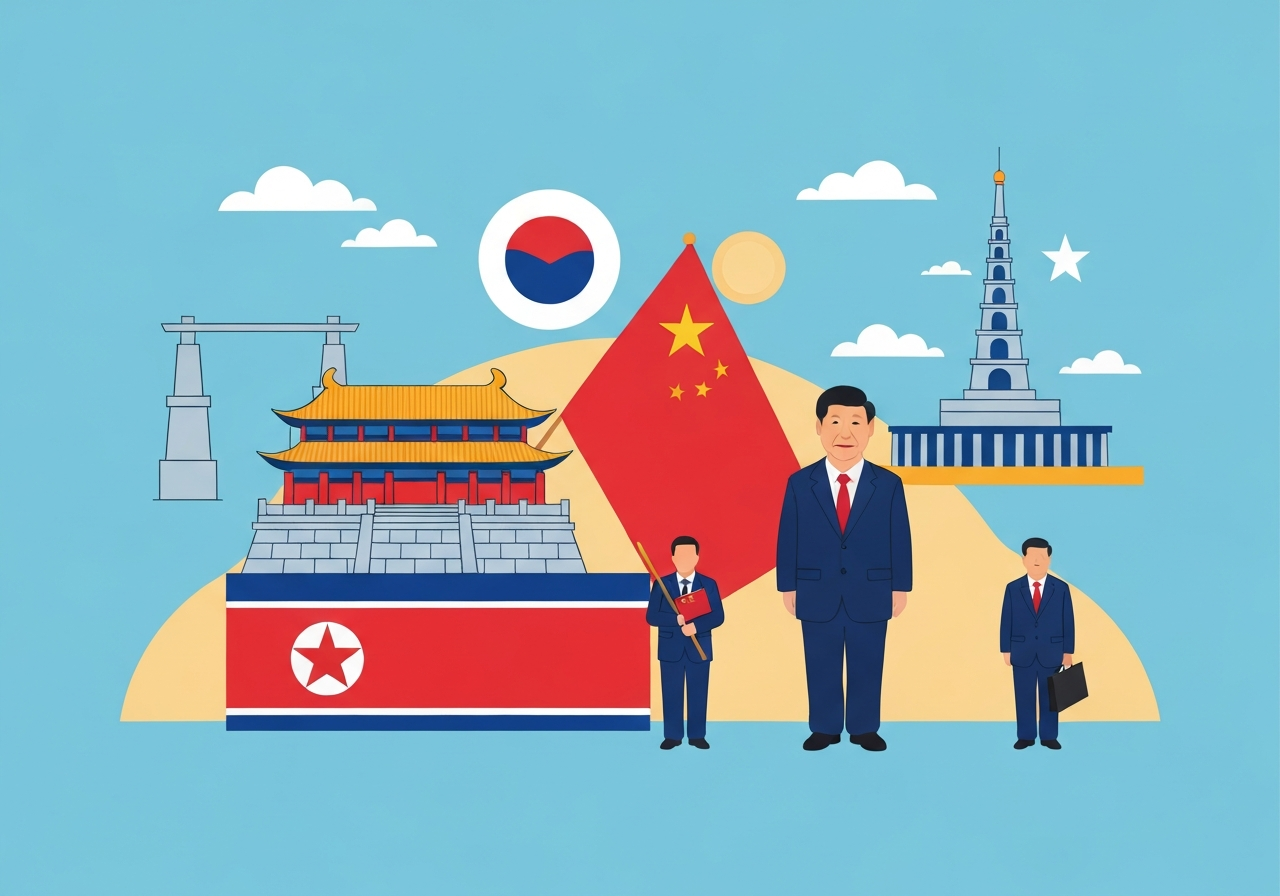
— Chinese President Xi Jinping travelled to Pyongyang on Sunday to meet North Korean leader Kim Jong Un, in a rare outbound trip that Beijing has not made to the North since 2019. The visit occurs amid rising concern in Beijing about Pyongyang’s growing security ties with Moscow, recent weapons tests and new facilities that could expand North Korea’s nuclear output. Xi’s decision to visit in person — after a year of high-level meetings in Beijing and a sharp reduction in his own foreign travel — signals Beijing sees the relationship as urgent and strategically important. The leaders’ talks aimed to manage bilateral ties and to address regional stability ahead of other possible diplomatic moves on the peninsula.
Key Takeaways
- Xi Jinping met Kim Jong Un in Pyongyang on 7 June 2026; it is Xi’s first trip to the North since 2019 and follows a Beijing meeting in 2025 tied to China’s 80th anniversary parade.
- Xi’s overseas travel has slowed: he averaged about 14 trips per year from 2013–2019 but roughly six per year between 2022–2025; in 2020 he made one overseas trip and none in 2021 (Asia Society estimate).
- North Korea’s trade dependence on China has been estimated as high as 95% by a 2022 assessment from the National Committee on North Korea (NGO analysis).
- Since 2023 Russia has reportedly paid North Korea up to $14.4bn for troop deployments and weapons; South Korean researchers say only $580m–$1.5bn appears to have been delivered as observable goods, implying much payment may have been in sensitive military technology or parts (INSS analysis).
- Pyongyang has tested eight missiles so far this year and in May displayed an AI-guided tactical cruise missile; state media also publicised a new factory for weapons-grade nuclear materials (North Korean and USNI reporting).
- Seoul’s foreign ministry welcomed the trip and said it hopes Xi’s visit will help address Korean Peninsula issues, while South Korea’s unification minister floated the possibility of a Kim-Trump meeting later in 2026.
Background
The China–North Korea relationship is rooted in Cold War-era treaties and decades of political and economic support. Beijing and Pyongyang signalled partnership through a mutual defence treaty and dense trade ties; analysts estimated in 2022 that up to 95% of North Korea’s external commerce flowed through China. That dependence, however, has coexisted with Beijing’s longstanding caution about strengthening North Korea’s military capabilities.
The dynamic shifted after Russia invaded Ukraine in 2022. Pyongyang supplied artillery, munitions and manpower that analysts say helped Moscow sustain operations; in return, Moscow reportedly provided substantial payments. Those transactions, and evidence of new North Korean weapons and nuclear infrastructure, have complicated Beijing’s calculations about how to balance its security interests, alliance posture and regional stability.
At the same time, Xi Jinping’s pattern of diplomacy changed after 2019. The Chinese leader moved toward fewer overseas trips while hosting more visits in Beijing, so an outbound trip to Pyongyang is notable not only for policy content but also for its symbolic weight. For Beijing, a personal visit by Xi is a calibrated signal intended to influence Pyongyang’s choices directly.
Main Event
Xi arrived in Pyongyang on 7 June 2026 for meetings with Kim Jong Un that followed a high-profile Beijing summit the previous year. Chinese and North Korean state media described ceremonial welcomes and working-level talks, though full transcripts of the discussions were not released. Observers interpret Xi’s presence as an effort to reassert Beijing’s influence and to convey concerns face-to-face.
Pyongyang highlighted parallel developments: state outlets published images of Kim inspecting a new factory described as producing weapons-grade nuclear materials and unveiled an AI-guided tactical cruise missile in May. Those steps have raised alarm in Beijing about the pace and scope of Pyongyang’s force modernisation.
The summit agenda reportedly covered bilateral ties, economic cooperation and regional security issues, including the implications of North Korea’s growing military ties with Russia. South Korea’s foreign ministry publicly expressed hope the visit would play a constructive role; meanwhile, Seoul’s unification minister said participants may discuss prospects for a meeting between Kim and former US President Donald Trump later this year.
Analysis & Implications
Beijing’s calculus appears to balance two priorities: maintaining strategic leverage over Pyongyang and preventing a military build-up that could destabilise the Korean Peninsula. China benefits from a stable North Korea as a buffer state, but it is wary of an emboldened Pyongyang that acquires sophisticated weapons and deepens military ties with Moscow.
If China judges that Russia is supplying North Korea with advanced systems or technology beyond raw materiel, Beijing may push back diplomatically to prevent a shift in the regional balance of power. Such pressure could take the form of tighter export controls, restrained economic engagement, or private diplomatic coercion rather than public confrontation — options that preserve the bilateral relationship while signalling limits.
Regionally, Xi’s visit complicates alliance management. Seoul and Tokyo have explored deeper security coordination, and the US remains focused on deterrence; Beijing will seek to shape outcomes that avoid a stronger US–Japan–South Korea security architecture that sidelines Chinese interests. Conversely, the visit could open a channel to moderate Pyongyang’s behaviour if Beijing can offer incentives tied to economic relief or diplomatic cover.
Economically, China retains the levers — trade, energy supplies and infrastructure projects — that can influence North Korean decision-making. However, the efficacy of those levers depends on Pyongyang’s appetite for economic engagement versus regime security, and on how much Russia’s support reduces North Korea’s reliance on Beijing.
Comparison & Data
| Metric | Value / Period |
|---|---|
| Xi’s overseas trips | ~14/year (2013–2019); ~6/year (2022–2025); 1 trip in 2020; 0 in 2021 (Asia Society) |
| North Korea missile tests in 2026 | 8 launches reported since start of year (North Korean media/USNI) |
| Estimated Russian payments to North Korea since 2023 | Up to $14.4bn; $580m–$1.5bn possibly in observable goods (INSS) |
| North Korea trade dependence on China | Up to 95% (2022 NCNK estimate) |
These figures illustrate a convergence of trends: reduced Chinese diplomatic mobility, increased North Korean weapons activity and deepening North Korea–Russia ties. Together they help explain why Beijing judged a personal intervention by Xi necessary at this moment. Quantitative estimates vary by source and method, so policymakers must weigh several data streams rather than a single metric.
Reactions & Quotes
South Korea’s government publicly framed the visit as potentially constructive for peninsula diplomacy while urging calm and coordination with allies. Seoul has encouraged China to use its influence to stabilise the situation and to discourage escalatory arms transfers.
“We hope Xi’s visit will play a constructive role in addressing issues related to the Korean Peninsula.”
South Korea Ministry of Foreign Affairs (official statement)
Analysts emphasised the symbolic weight of Xi travelling abroad after a period of limited mobility, interpreting it as a deliberate signal to both Pyongyang and external actors about Beijing’s priorities.
“For Xi to decide to travel to Pyongyang shows the level of significance that China attaches to this trip.”
William Yang, Crisis Group (expert analyst)
North Korean state media stressed sovereign cooperation and new defence capabilities, presenting the visit as a mutual endorsement of ties rather than a public negotiation of limits. Outside capitals, officials are watching for any concrete commitments or shifts in trade and security practices.
Unconfirmed
- Whether Moscow’s payments to Pyongyang were primarily in the form of sensitive military technology rather than cash or conventional goods remains under investigation and is not publicly verified.
- Details of any concessions or concrete economic packages offered by China to North Korea during the summit have not been made public and remain unconfirmed.
- Plans for a Kim–Trump meeting later in 2026 are speculative; discussions have been referenced by officials but no confirmed date or venue has been announced.
Bottom Line
Xi Jinping’s trip to Pyongyang on 7 June 2026 is best read as a calibrated, high-stakes effort by Beijing to manage an increasingly complex triangle of China, North Korea and Russia. The visit underscores Beijing’s concern about Pyongyang’s weapons development and expanding ties with Moscow, and represents an attempt to preserve Chinese leverage at a critical moment.
How Beijing converts that leverage into policy — whether through diplomacy, economic incentives or discrete pressure — will shape stability on the Korean Peninsula and influence broader regional alignments. Observers should watch for any follow-on announcements about sanctions compliance, security assurances or concrete economic arrangements that could alter Pyongyang’s strategic choices.
Sources
- Al Jazeera — international news organisation (original reporting)
- Asia Society — policy analysis (Xi travel statistics)
- National Committee on North Korea (NCNK) — NGO research (trade dependence estimate)
- U.S. Naval Institute (USNI) — defence reporting (missile and weapons reporting)
- Institute for National Security Strategy (INSS) — South Korean government-funded research (report on Russia–North Korea transactions)