
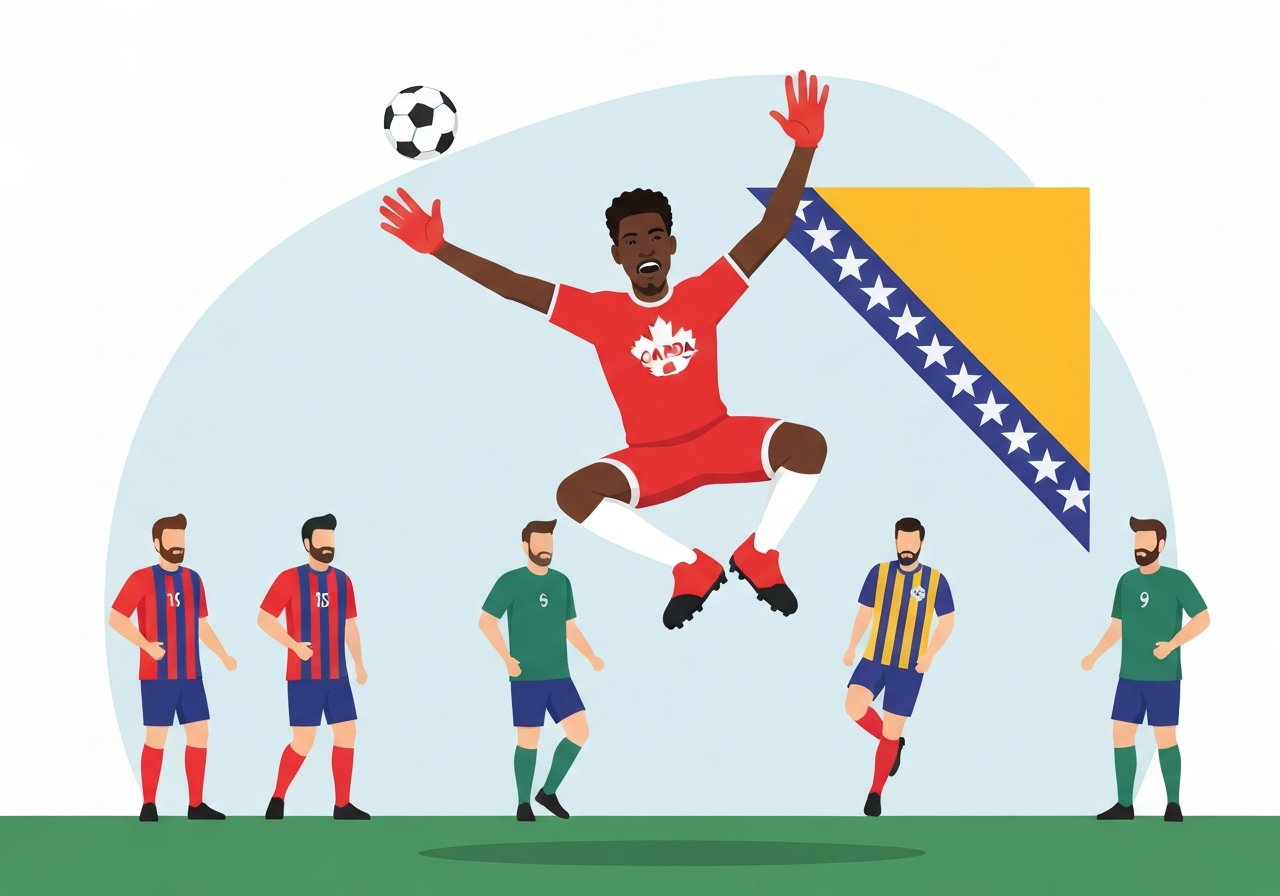
In Vancouver on 12 June 2026, Cyle Larin came off the bench and equalised seconds after entering to salvage a 1-1 draw for Canada against Bosnia and Herzegovina in their Group B opener, earning the hosts their first-ever World Cup point. Jovo Lukic had given Bosnia the lead with a first-half header on his first competitive start and first international goal. Larin replaced Tani Oluwaseyi in the 76th minute and struck with his first touch 121 seconds later, converting a chance created by Jonathan David. The result ends the memory of Canada’s scoreless campaign in Qatar four years earlier and leaves Jesse Marsch’s side to regroup ahead of Thursday’s meeting with Qatar in Vancouver.
- Match finished 1-1: Jovo Lukic (Bosnia) and Cyle Larin (Canada) scored; Larin entered in the 76th minute and scored 121 seconds later.
- Canada earned their first point at a World Cup, after losing all three group matches in 2022 (Qatar).
- Lukic’s goal came from a corner routine; it was his first competitive start and his first international goal.
- Jonathan David missed a key first-half chance (around the 17th minute) and Nikša Katić/Sead Kolasinac produced important defensive interventions, including a Kolasinac clearance that hit the crossbar early in the second half.
- About 7,000 temporary seats were installed in the south stand; many were filled by Bosnia supporters whose celebrations followed Lukic’s goal.
- High-profile attendees included Ryan Reynolds (who celebrated Larin’s goal with fans), Connor McDavid and other celebrities; pre-match entertainment featured Michael Bublé and Alanis Morissette and a Snowbirds flypast.
- Marsch praised the crowd’s impact and said the team must improve quickly ahead of the next fixture against Qatar on Thursday.
Background
Canada entered the 2026 World Cup as one of the co-hosts and with heightened expectations after qualifying automatically as host nation. The match against Bosnia and Herzegovina was their Group B opener and marked the first time Canada had played a World Cup match on home soil. The team’s previous World Cup appearance in 2022 ended with three defeats and zero points, so there was added pressure on Jesse Marsch’s squad to deliver a credible performance for the home crowd.
Bosnia arrived with momentum built around a frontline featuring Ermedin Demirovic and Jovo Lukic, the latter given his first competitive start and rewarded with a goal. The match took place in a largely pro-Canada atmosphere—organisers added roughly 7,000 temporary seats in the south stand—yet Bosnia’s travelling supporters were vocal and their early goal intensified the noise. Both teams faced selection and fitness questions: Canada adjusted without Alphonso Davies available in the starting lineup, while Edin Dzeko was short of full fitness and began the match on the bench.
Main Event
Canada started energetically and created early openings, but Bosnia threatened on the counter. Amar Memic, partnering Demirovic up front, missed a chance inside the opening minutes, and Jonathan David squandered a clear opportunity on around 17 minutes that would have given the hosts the lead. Moments later Bosnia took a surprise lead: Ivan Basic’s corner was flicked on and Jovo Lukic glanced a header past the Canadian defence into the net.
The Bosnian goal sent their supporters into raptures in the temporary south stand seating. Canada pressed for an equaliser throughout the first half and into the second, with Richie Laryea and Tani Oluwaseyi among those probing. An extraordinary Sead Kolasinac intervention diverted a Laryea effort onto the crossbar about eight minutes into the second half, preventing an immediate leveller. Canada continued to apply pressure, seeing chances cleared off the line and blocked by resolute Bosnian defending.
Marsch made multiple attacking changes after the hour mark in search of a breakthrough. A triple substitution refreshed Canada’s frontline and Ismaël Koné’s interplay with Jonathan David helped fashion the decisive move. David supplied a first-time flick into the path of Cyle Larin; Larin eluded his tight marker, Tarik Muharemovic, and volleyed low past goalkeeper Nikola Vasilj, the ball grazing Nikola Katic en route to the net.
Analysis & Implications
The equaliser has immediate sporting and symbolic significance. On the field it gives Canada a tangible result to build on and removes the psychological baggage of a goalless, point-free World Cup return. For Jesse Marsch, the draw both rewards managerial adjustments and highlights remaining deficiencies in finishing and game management that will require attention before facing Qatar on Thursday.
Strategically, Bosnia showed that organised set-piece routines can punish even a home side with momentum, underscoring the importance of defensive concentration. Lukic’s goal from a practiced corner will prompt Canada’s coaches to review marking responsibilities and zonal coverage. Conversely, Canada’s persistent attacking waves and late substitution impact indicate the squad depth can change games—Larin’s finish underlines the value of experienced attacking options off the bench.
Economically and socially, the match illustrated the commercial and cultural buzz of a World Cup on Canadian soil: celebrity attendance, high-profile musical acts and a Snowbirds flypast all contributed to a large-scale event atmosphere. That public engagement matters for host-city stakeholders and sponsors, while also raising stakes for team performance given heightened local expectations.
Comparison & Data
| Tournament | Group-stage results | Points |
|---|---|---|
| World Cup 2022 (Qatar) | 3 matches, 3 defeats | 0 |
| World Cup 2026 (to 12 June) | Group B opener: 1 draw | 1 |
Canada’s single point from the opening Group B match marks a measurable improvement from 2022, when they exited without any points. The data underline how a single substitution and a swift impact can alter a team’s tournament trajectory: Larin’s 121-second equaliser changed Canada’s group-stage standing instantly and may affect tiebreaker scenarios if results elsewhere follow similar margins.
Reactions & Quotes
Jesse Marsch praised the crowd and highlighted the importance of the substitute impact while acknowledging improvements were needed for the next match.
“How awesome was it to see all of the red jerseys, the sea of red? In a difficult moment, we responded.”
Jesse Marsch, Canada head coach (post-match)
Bosnia head coach Sergej Barbarez emphasised his players’ resilience under pressure in a largely pro-Canada stadium and welcomed the result’s message for his squad.
“We were playing against a host, their opening match, a full stadium… it was a huge pressure and a huge compliment that my team did not succumb.”
Sergej Barbarez, Bosnia and Herzegovina head coach
Fan reaction in the stands was exuberant after Larin’s strike; celebrities in attendance, including Ryan Reynolds, joined supporters in celebration, and players’ substitutes poured onto the pitch in a spontaneous outpouring of national relief and joy.
Unconfirmed
- Some reports linked Larin’s selection issues to Southampton’s alleged expulsion from the playoffs and a possible lost Premier League opportunity; that connection requires further confirmation from club or league statements.
- Accounts describing Michael Bublé being “smuggled” into the centre circle among flag bearers are based on eyewitness reporting; formal confirmation from event organisers about the method of his entry is not yet available.
Bottom Line
Cyle Larin’s 121-second cameo transformed Canada’s Group B outlook, producing not just a point but a psychological lift for a host nation still shaping expectations at its first home World Cup. The match exposed defensive vulnerabilities from set pieces and finishing issues that Canada must address quickly. Bosnia demonstrated clinical efficiency from a corner routine and resilience on the road, gaining a valuable result that keeps them competitive in the group.
Looking ahead, Canada’s immediate task is to refine finishing and defensive coordination before facing Qatar on Thursday, while Bosnia will aim to build on the confidence from Lukic’s breakthrough. For fans and stakeholders, the game was a reminder that single moments—substitutions, set plays, individual finishes—can pivot tournament narratives overnight.