
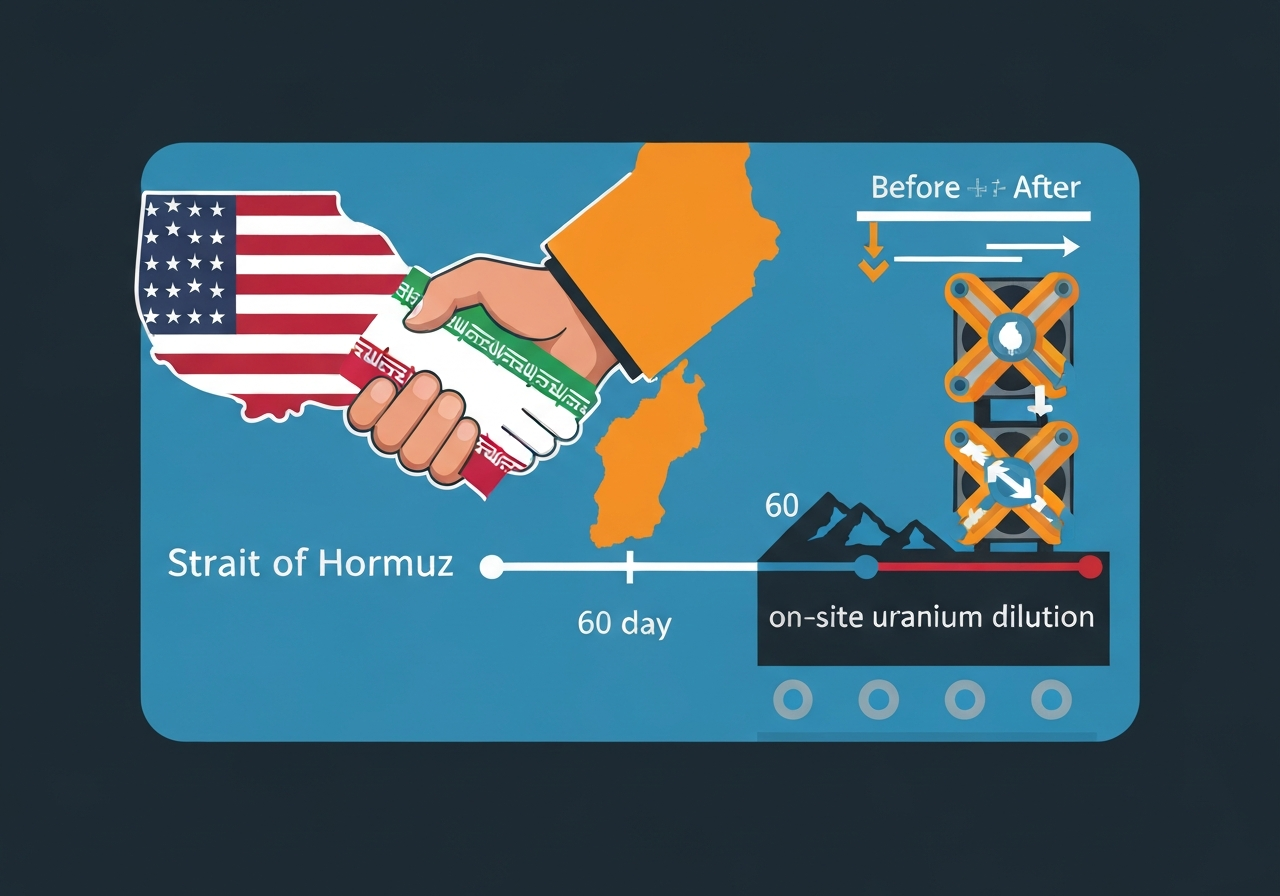
Lead: U.S. officials said a draft memorandum between Washington and Tehran would require Iran to downgrade its stockpile of highly enriched uranium on site and would pause — but not fully lift — many sanctions. The interim text would also reopen the Strait of Hormuz toll‑free for 60 days and include a pledge to protect Lebanon’s territorial integrity amid Israel’s campaign against Hezbollah. The memorandum, circulated to reporters on June 17, 2026, was later echoed by Iranian state media. Senior U.S. sources spoke to journalists on condition of anonymity because details remain sensitive.
Key Takeaways
- The draft calls for Iran to downgrade its highly enriched uranium on site as a minimum step and to agree not to pursue nuclear weapons, according to U.S. officials.
- The accord would grant immediate waivers to U.S. sanctions that allow Iran to resume oil sales for the 60‑day negotiation window.
- The Strait of Hormuz would be reopened toll‑free for 60 days; the memorandum does not rule out fees after that period.
- The document affirms a commitment to Lebanon’s territorial integrity and states that military operations in Lebanon must cease upon signing.
- The U.S. would not permanently remove sanctions at signing; some sanctions relief would be phased and linked to further talks.
- Officials described a potential reconstruction package of at least $300 billion for Iran, conditioned on later agreements and external investment pledges.
- Iran’s 2024 oil export revenue exceeded $46 billion, underlining the economic stakes tied to any waivers.
Background
The memorandum is an interim attempt to halt the fighting that began on Feb. 28, 2026, and to create time for broader negotiations over Iran’s nuclear program and regional behavior. Diplomatic ties between the United States and Iran have been severed since 1980 following the U.S. Embassy hostage crisis in Tehran; a signed ceremony between the two presidents would mark an historic thaw if it occurs. The 2015 framework that the Trump administration abandoned in his first term similarly traded restrictions on enrichment for sanctions relief; this draft departs from that model by offering immediate waivers to some sanctions during a short negotiation window.
The wider regional context includes Israel’s military operations in Lebanon against Hezbollah and repeated maritime attacks in the Persian Gulf that had disrupted global energy flows. Gulf Arab states, some of which were mediators, have signaled reluctance to finance Iranian reconstruction after cross‑border hostilities damaged regional infrastructure. Tehran maintains its nuclear program is peaceful, while Washington and Israel have cited the program and proxy networks as central security concerns.
Main Event
U.S. officials briefed journalists on June 17, 2026, describing draft language that would require Iran to downgrade its highly enriched uranium on site as an initial verification step. The text, as summarized by officials, includes an explicit Iranian commitment not to develop or procure nuclear weapons and sets a 60‑day window for further negotiation. Iranian state television later published a version of the draft that tracked many of the points the U.S. sources described.
In exchange for the initial commitments, the U.S. would issue waivers enabling Iran to export oil freely for the duration of the talks; comprehensive sanctions relief would be negotiated later and would not be automatic. The memorandum also stipulates an immediate cessation of military operations in Lebanon once the document is signed, a clause Israel has publicly resisted. The draft would reopen the Strait of Hormuz to toll‑free passage for 60 days, with an acknowledgement that future fees or arrangements could be discussed.
The agreement contemplates a phased process for lifting broader sanctions, including those tied to weapons proliferation and human rights, but sets no definitive timetable in the interim text. Officials said the memorandum envisages external investment to support Iranian reconstruction, with Gulf partners mentioned as potential contributors; U.S. leaders, including President Donald Trump, stated Washington would not itself finance the $300 billion reconstruction figure outlined in reports. Trump described the memorandum ambiguously during a G7 summit, saying the document was “very strong” but reserving the right to abandon the deal.
Analysis & Implications
If implemented, the interim pact would immediately reduce regional kinetic risk by halting direct hostilities and by reopening a central maritime chokepoint. Reopening the Strait of Hormuz for 60 days would ease acute pressure on global energy markets that had surged after sea lanes were disrupted, but the short duration limits long‑term market reassurance. Granting oil waivers at the outset removes a key lever the U.S. had used to influence Tehran, potentially weakening Washington’s bargaining position in the subsequent nuclear talks.
Politically, the agreement creates tensions domestically for leaders in Washington and Jerusalem. In the U.S., members of Congress and policy hawks are likely to criticize waivers and any early concessions; in Israel, Prime Minister Benjamin Netanyahu has already faced pushback as the deal would constrain Israeli operations in Lebanon. Regionally, the prospect of large‑scale reconstruction funds and removed economic pressure could shift calculations inside Iran and among proximate states, affecting incentives for de‑escalation or renewed competition.
On verification and enforcement, downgrading highly enriched uranium on site introduces technical and inspection challenges, requiring trusted multinational monitoring to ensure compliance. The memorandum’s ambiguity on the sequencing and permanence of sanctions relief raises the risk of future disputes if parties interpret conditional language differently. Finally, the $300 billion reconstruction figure — substantial on its face — is contingent on external investment and political willingness among Gulf states and other partners to engage economically with Tehran.
Comparison & Data
| Item | 2015 JCPOA | 2026 Draft Memorandum |
|---|---|---|
| Immediate sanctions relief | Phased, conditional (oil sanctions lifted later) | Waivers to allow oil sales during 60‑day window |
| Uranium restrictions | Significant reduction in enrichment and stockpile | On‑site downgrading of highly enriched uranium as minimum |
| Strait of Hormuz | Not addressed | Reopened toll‑free for 60 days |
| Reconstruction funds | Not envisaged | At least $300 billion proposed (conditional) |
The table highlights how the draft memorandum diverges from the 2015 arrangement by front‑loading economic relief and introducing an explicit, time‑limited maritime reopening. Analysts say the immediate waivers could undercut leverage that was central to earlier diplomacy, while proponents argue a short ceasefire and rapid de‑escalation are necessary to prevent further regional destabilization.
Reactions & Quotes
U.S. and Iranian responses were mixed and cautious. Below are representative reactions and contextual notes.
“You never know with deals, do you? But you’re going to find out pretty soon.”
President Donald Trump (public remark)
Trump described the memorandum as strong while also warning he could abandon the agreement if dissatisfied; his remarks underscore the political fragility of the interim deal.
Authorities released draft text that largely mirrored the U.S. summary, signaling Tehran’s tentative acceptance of the framework.
Iranian state television (state broadcaster)
State media publication of the draft suggests Tehran is prepared to present the draft domestically, though the exact terms and endorsements by Iran’s political leadership remained unclear.
“Stopping the fighting is necessary, but verification and sequencing of sanctions relief are critical to ensure compliance.”
Regional security analyst (independent expert)
Analysts warned that implementation will hinge on inspection access, clarity on which sanctions are waived or lifted, and whether external investors follow through on reconstruction commitments.
Unconfirmed
- Whether Presidents Donald Trump and Masoud Pezeshkian will sign a joint ceremony remains unconfirmed; officials have suggested the possibility but no schedule was published.
- The precise mechanics and timetable for delivering the reported $300 billion in reconstruction funds are not verified; sources say the money is conditional and may depend on Gulf investment pledges.
- Details on which specific sanctions would be permanently lifted at the end of negotiations and the exact verification steps for uranium downgrades have not been finalized publicly.
Bottom Line
The draft memorandum represents a pragmatic, if imperfect, pause: it seeks an immediate end to active hostilities, a short window to restart nuclear negotiations, and temporary economic relief that could reduce acute regional pressures. However, by granting early waivers for oil exports and proposing large reconstruction funds, the interim text trades immediate incentives for Iran at the potential cost of U.S. bargaining leverage in later talks.
Implementation will depend on verification arrangements, the willingness of external investors to follow through, and political backing in Washington and allied capitals. Absent clear, enforceable sequencing and international monitoring, the memorandum could stabilize the region only briefly or create new points of contention as parties dispute compliance and timelines.
Sources
- Associated Press — news reporting (original article summarizing U.S. officials and Iranian state media)