
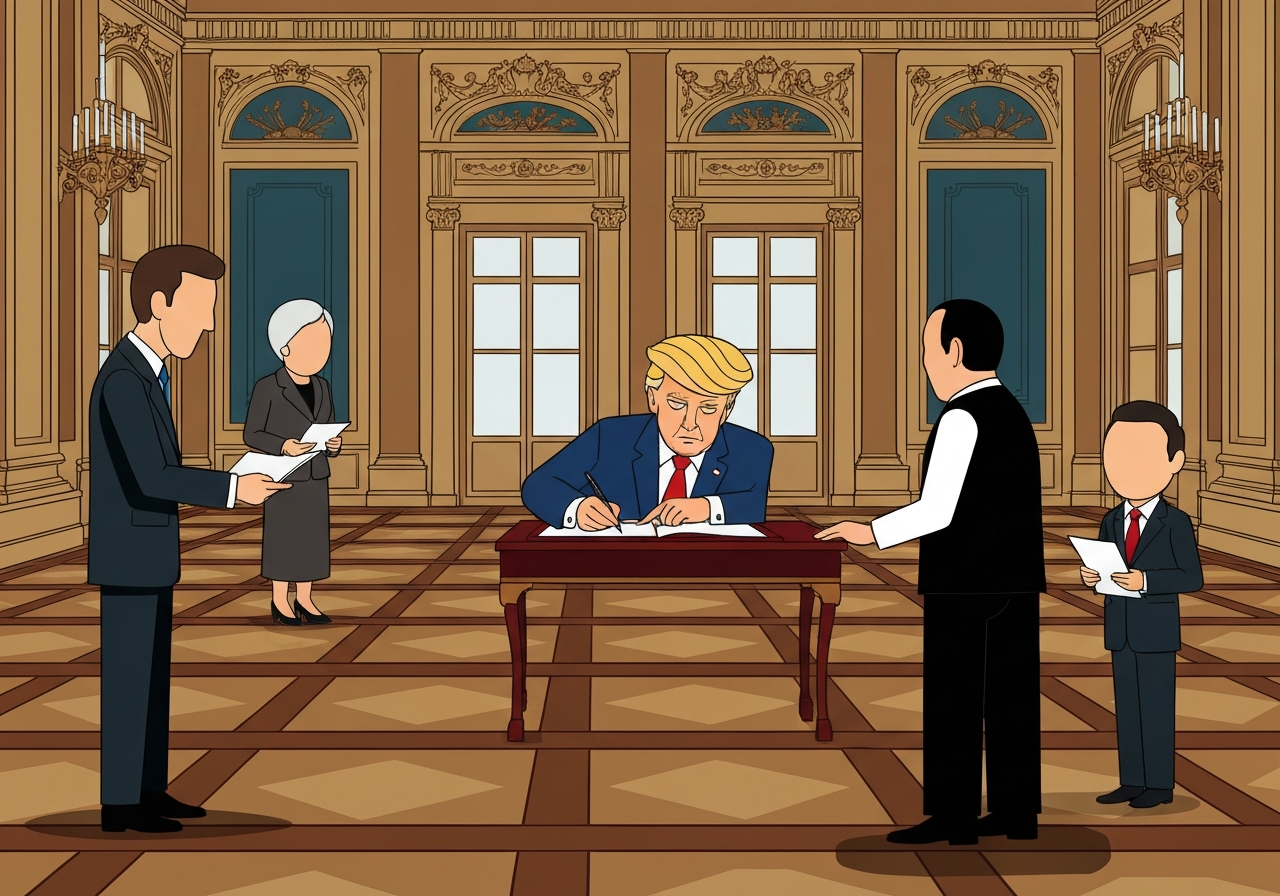
Lead: On June 17, 2026, at the Palace of Versailles in France, President Donald Trump signed a hard copy of a 14-point memorandum of understanding with Iran, an accord both sides say is intended to expand a ceasefire and reopen the Strait of Hormuz. Iran’s President Masoud Pezeshkian also signed, and officials say the document commits the United States and regional partners to waivers for Iranian oil exports and a $300 billion reconstruction fund. The memorandum launches a 60-day window for negotiators to outline final, technical terms; reactions from international capitals and US lawmakers were swift and mixed.
Key Takeaways
- On June 17, 2026, President Donald Trump signed a hard copy of a 14-point, ~800-word memorandum with Iran at the Palace of Versailles; Iran’s President Masoud Pezeshkian has also signed, according to Iranian state media.
- The text pledges that Iran will not procure or develop nuclear weapons and sets a “minimum methodology” for down‑blending enriched uranium under IAEA supervision.
- The agreement includes US waivers to allow Iranian oil exports and specific provisions for re‑opening and managing transit through the Strait of Hormuz.
- It commits the US and regional partners to establish a $300 billion reconstruction fund for Iran, to be implemented in the next negotiation phase.
- Signing triggers a formal 60‑day technical negotiation window; some US officials described that period as flexible, while the MOU defines it as the time to draft final terms.
- Pakistan and Qatar, which acted as mediators, said the memorandum is effective immediately and will host a ceremony and technical talks this week.
- Domestic US lawmakers — including Senate Minority Leader Chuck Schumer, Sen. Elizabeth Warren and Sen. Adam Schiff — criticized the deal as favorable to Iran and insufficiently protective of US interests.
- International responses ranged from praise by China’s foreign ministry to cautious welcome by European leaders; observers flagged verification and monitoring as central challenges.
Background
The memorandum arrives after months of mediated contacts that accelerated following intensified hostilities in the region over the past year. The United States and Iran had clashed directly and via proxies, disrupting commercial traffic in the Gulf and prompting international concern over energy security. Pakistan and Qatar played visible facilitation roles in shuttle diplomacy and helped broker the language now presented in the 14-point document.
Negotiators deliberately framed the text as a memorandum of understanding rather than a full treaty: officials describe it as a framework to halt active hostilities, restore maritime commerce through the Strait of Hormuz, and open a bounded negotiation window for technical details. The decision to produce both English and Farsi versions — and to sign both languages — was driven by Tehran’s insistence on transparency and legal symmetry, according to Iran’s Foreign Ministry statements.
Main Event
On the evening of June 17, President Trump attended a private dinner hosted by French President Emmanuel Macron at the Palace of Versailles during the G7 wrap-up and signed a printed copy of the memorandum with Secretary of State Marco Rubio reportedly present and White House staff documenting the moment. French officials posted a short video of the signing and Macron described the plan as paving the way for lasting peace.
Iranian state media IRNA published photos showing President Masoud Pezeshkian with a Farsi copy bearing signatures that Iranian officials say correspond to the English version. US officials said the White House transmitted a photograph of the signed page to Iran after the Versailles signing; Tehran and Washington characterize the document as now formally finalized.
The agreement’s operative provisions include immediate measures to expand the ceasefire across conflict fronts — explicitly citing Lebanon among the affected theatres — operational steps for re‑establishing transit through the Strait of Hormuz, and a commitment to allow monitored down‑blending of near‑weapons‑grade uranium under International Atomic Energy Agency oversight. The memorandum also sets out economic measures, including the construction fund pegged at $300 billion to support reconstruction if technical terms are fulfilled.
Analysis & Implications
Diplomatically, the memorandum represents a tactical de‑escalation: it aims to stop active hostilities while creating a structured period for negotiators to solve complex verification and sanctions issues. If implemented, waivers for oil exports and reopening the Hormuz could ease global energy market pressures and reduce freight risk premiums that spiked during the conflict.
Security experts stress the agreement’s durability will hinge on verification. The text’s acceptance of a down‑blending procedure, rather than full removal of enriched stocks, places heavy emphasis on continuous, high‑quality monitoring by the IAEA to detect diversion or clandestine enrichment activities. Analysts warn that Iran’s increased enrichment expertise since 2018 reduces the margin for error compared with earlier decades.
Politically within the United States, the memorandum sharpens partisan divides. Critics argue the deal delivers concessions without enforceable guarantees; supporters point to the immediate cessation of open warfare and the creation of a predictable negotiation timeline. Regionally, the memorandum could reshape alliances by tying reconstruction incentives to compliance, but it also raises the risk that parties marginalized from talks will seek asymmetric methods to influence outcomes.
Comparison & Data
| Item | Detail |
|---|---|
| Document length | ~800 words, 14 points |
| Reconstruction fund | $300 billion pledged by US and partners |
| Negotiation window | 60 days for technical terms |
| Verification | IAEA-supervised down‑blending minimum methodology |
The table summarizes the memorandum’s principal quantitative commitments. Observers note that the $300 billion figure is an initial pledge; the composition of funding sources and disbursement conditions remain to be negotiated during the 60‑day technical phase.
Reactions & Quotes
World leaders and regional actors responded swiftly; official statements highlight divergent priorities and interpretations.
“It’s signed.”
President Donald Trump — Remarks at Palace of Versailles (June 17, 2026)
Trump’s brief comment accompanied video released by France showing the signing. US officials later clarified that a photograph of the signed document was transmitted to Iranian counterparts.
“The 14‑point plan paves the way for lasting peace.”
President Emmanuel Macron — Social media post
Macron framed the memorandum as a diplomatic opening and suggested the deal could ease energy prices. French officials hosted the event where the hard‑copy signing occurred.
“The dawn of peace has arrived.”
Wang Yi — China’s top diplomat, phone call reported by Xinhua
China’s foreign ministry characterized the memorandum as a positive step and urged faithful implementation by all parties to prevent distractions from the next phase.
Unconfirmed
- Whether a formal signing ceremony in Geneva on Friday will proceed with Vice President J.D. Vance attending — Iranian officials said no additional ceremony would be held, while some US officials described one as planned.
- Precise composition and sources of the pledged $300 billion reconstruction fund — the memorandum sets the total but does not publish detailed funding commitments.
- Operational timelines for reopening the Strait of Hormuz and the exact fees or navigation mechanisms referenced by Iranian parliamentary leaders remain to be published and verified.
Bottom Line
The Versailles signing of a 14‑point memorandum between the United States and Iran marks a significant diplomatic step toward pausing open hostilities and restoring maritime commerce. The text couples security measures — including IAEA‑supervised down‑blending — with major economic incentives, notably a $300 billion reconstruction pledge intended to bind Iran to compliance.
But the memorandum is a framework, not a final deal. Its success depends on swift, transparent technical negotiations during the 60‑day window, robust third‑party verification, and concrete funding commitments that align incentives with enforceable safeguards. Expect intense diplomatic activity, detailed monitoring proposals from the IAEA, and heated domestic political debate in Washington over the coming days.