
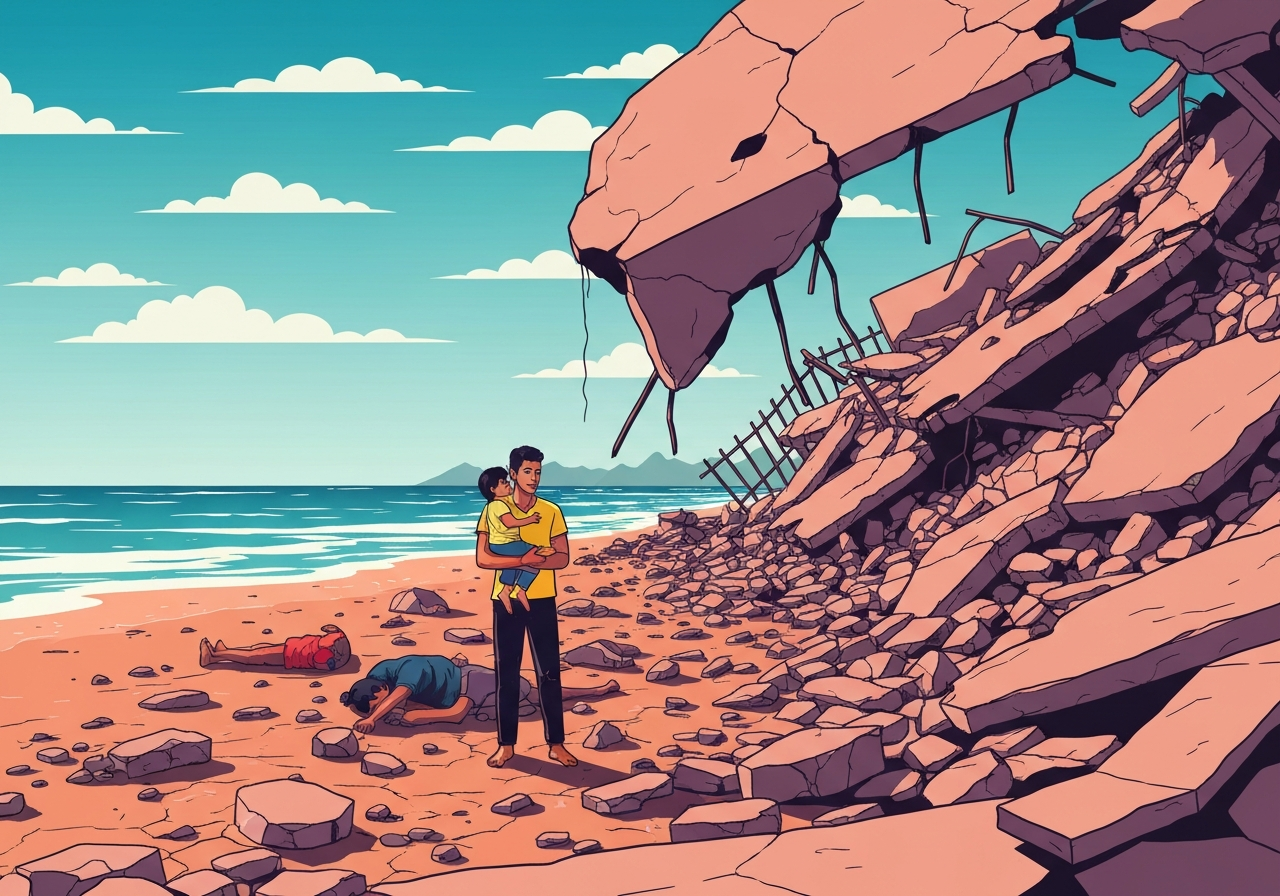
On June 24, 2026, two powerful earthquakes struck Venezuela’s northern coast within a minute of each other, the stronger registering magnitude 7.5 and the earlier foreshock 7.2. The quakes—centered roughly 23 km southeast of Yumare and felt across Caracas and surrounding states—collapsed buildings, closed Simon Bolivar International Airport and left communities scrambling. Acting President Delcy Rodríguez declared a state of emergency as rescue teams and international aid offers began arriving. Officials reported at least 32 fatalities and about 700 people injured; authorities warned those figures may rise as search operations continue.
Key takeaways
- Two large quakes struck within 40 seconds: a 7.2 foreshock followed by a 7.5 mainshock, both on the evening of June 24, 2026, near Venezuela’s northern coast.
- Official counts list at least 32 dead and roughly 700 injured so far; the acting president said the toll is expected to increase as assessments in La Guaira continue.
- La Guaira state saw the heaviest damage and has been declared a disaster zone; multiple multi-story buildings and a waterfront hotel in Macuto partially or fully collapsed.
- Caracas neighborhoods including San Bernardino, Baruta, Chacao and Altamira reported building collapses and widespread structural damage; more than 500 emergency workers were dispatched to Chacao alone.
- Simon Bolivar International Airport (Maiquetía) was closed because of structural and interior damage, disrupting travel and logistics during the emergency.
- International assistance offers came quickly: the United States, Dominican Republic, El Salvador, Mexico, Qatar and others pledged rescue teams or humanitarian support.
- Initial reports indicate Venezuela’s oil fields and major installations were not immediately hit, though power outages and infrastructure damage could affect output regionally.
Background
Venezuela sits near active plate boundaries along its northern margin and has a history of damaging coastal earthquakes. The country’s largest recorded tremor was a magnitude 7.7 event in 1900, also off the northern coast and within a few hundred kilometers of this week’s epicenters. Caracas experienced a major quake in 1967; many residents and engineers say large urban areas have not seen shaking on this scale for decades.
Decades of economic crisis, underinvestment and uneven enforcement of building standards have left parts of Venezuela with older masonry structures and limited retrofitting. Since the 1970s, newer codes—such as international concrete and seismic standards—have improved resilience for more recent construction, but many neighborhoods still contain vulnerable stock. Those construction patterns help explain why quakes centered near populated areas can cause extensive collapse and high casualties.
Main event
At 6:04 p.m. ET on June 24, a magnitude 7.2 tremor struck near San Felipe; about 40 seconds later a larger magnitude 7.5 quake struck roughly 23 kilometers southeast of Yumare. The rapid pair of shocks produced violent shaking that residents described as longer and stronger than previous events, sending people into the streets and toppling older buildings in coastal towns and Caracas neighborhoods.
La Guaira state was particularly hard hit, with acting President Delcy Rodríguez calling the situation there a “true tragedy.” Video and eyewitness accounts show collapsed residential towers, a partly destroyed eight-floor hotel in Macuto and heavy rubble in Catia La Mar. Local authorities declared La Guaira a disaster zone and prioritized search-and-rescue operations in the most damaged sectors.
In Caracas, municipal officials reported collapses and major structural damage in Baruta, San Bernardino, Chacao and Altamira. Mayors and local emergency coordinators described hundreds of rescuers working overnight; gas lines were shut off in many areas and power failures were widespread. Hospitals and clinics have been treating the injured, and some victims were pulled alive from the rubble in initial rescue efforts.
National response measures included a state of emergency, suspension of school classes for a week, and temporary halting of rail services and non-essential activities. Authorities said international search-and-rescue teams and humanitarian aid were being accepted from several countries, and coordination was underway to prioritize life-saving assistance.
Analysis & implications
Engineering and seismological experts say the timing, shallow depth and proximity of the quakes to populated coastal zones amplify destructive potential. Shallow earthquakes transmit stronger ground motion to structures; when older, unreinforced masonry buildings are common, the risk of collapse—and therefore fatalities—rises substantially. Venezuela’s mix of pre-code buildings and newer, better-designed structures helps explain why damage has been concentrated in older districts and coastal towns.
The humanitarian impact will depend on how quickly rescue teams can access collapsed buildings and how medical facilities cope with hundreds of injured. Power outages and damaged roads slow emergency response and complicate logistics for equipment, shelter and medical supplies. Suspension of airport operations at Simon Bolivar International Airport further constrains rapid international aid arrival and evacuation options until safety inspections are completed.
Economically, the quakes risk an additional blow to an already fragile Venezuelan economy. Although early reporting suggests major oil facilities were not directly struck, prolonged power losses and coastal infrastructure damage could disrupt refining and export operations temporarily. Reconstruction of housing and critical services will require substantial funds and coordination, and the existing sanctions and political complexities could influence speed and scale of international support.
Comparison & data
| Date | Location (approx.) | Magnitude | Relative rank |
|---|---|---|---|
| 1900 | Off northern coast (historic) | 7.7 | Largest on record |
| 2026-06-24 | 23 km SE of Yumare | 7.5 | Largest since 1900 |
| 2026-06-24 | Near San Felipe | 7.2 | Foreshock; among largest recent events |
The table places Wednesday’s sequence in historical context: the 7.5 event is the strongest recorded in more than a century, while the 7.2 foreshock ranks among Venezuela’s most powerful modern quakes. Seismologists note that doublet events—two large quakes close in time and space—can complicate rescue and damage assessments because aftershocks and the second shock increase collapse risk for already weakened structures.
Reactions & quotes
Government and international responses were rapid and focused on rescue and solidarity. Below are succinct official and eyewitness statements with context.
“We will not leave here until we rescue the last person we can save alive.”
Mayor of Chacao Municipality
The Chacao mayor used this remark to convey the intensity of overnight search-and-rescue work and to reassure families that municipal teams remained on-scene despite difficult conditions.
“The United States is immediately deploying search and rescue teams, medical resources, and humanitarian assistance to Venezuela.”
U.S. Secretary of State (statement)
This declaration signaled a quick offer of assistance; operational details about the number, timing and locations of U.S. teams were being coordinated with Venezuelan authorities at the time of reporting.
“Dozens of buildings have collapsed, and we are currently engaged in arduous rescue operations to save as many lives as God allows.”
Acting President Delcy Rodríguez
Rodríguez’s statement framed the scale of damage—particularly in La Guaira—and announced measures including a disaster declaration and suspension of classes to free resources for the emergency response.
Unconfirmed
- Exact final death toll and injury totals remain provisional and may change as officials complete searches and hospital reports are consolidated.
- Full inventory of collapsed or structurally compromised buildings across affected states is incomplete; additional structural failures may be reported as evaluations continue.
- Detailed, verified assessments of impacts to oil production and refining capacity are not yet available; initial accounts indicate major facilities were spared but power outages could disrupt operations.
Bottom line
Wednesday’s back-to-back 7.2 and 7.5 earthquakes represent the strongest shaking in Venezuela in over a century and have produced significant loss of life, injuries and structural damage concentrated along the northern coast and in Caracas suburbs. Immediate priorities are search-and-rescue, medical care for the injured and stabilizing damaged structures to prevent further collapse and casualties.
The broader recovery will hinge on rapid damage assessment, the arrival and coordination of international aid, restoration of electricity and transport links, and resources for rebuilding. Given pre-existing economic fragility and underinvestment in some infrastructure, reconstruction will be challenging and could shape Venezuela’s humanitarian and political landscape for months to come.
Sources
- CNN (live reporting and summary) — news
- U.S. Geological Survey (event and seismic data) — scientific agency
- Reuters (initial reporting on infrastructure and oil sector) — news agency
- Associated Press (casualty and official statements) — news agency