
Lead
On Wednesday evening, two powerful earthquakes struck Venezuela’s northern coast within a minute of each other, killing at least 32 people and injuring about 700. A magnitude 7.2 foreshock hit near San Felipe just after 6:04 p.m. ET and was followed 40 seconds later by a 7.5 mainshock roughly 23 km southeast of Yumare. The coastal state of La Guaira has been declared a disaster zone as rescue teams search collapsed buildings and affected infrastructure. Authorities and foreign partners are mobilizing search-and-rescue operations while connectivity and essential services remain disrupted.
Key Takeaways
- The sequence: A 7.2 quake struck near San Felipe just after 6:04 p.m. ET, followed 40 seconds later by a 7.5 quake about 23 km southeast of Yumare.
- Casualties and injuries: Acting President Delcy Rodríguez reported at least 32 dead and roughly 700 injured; officials warn the toll may rise as searches continue.
- Worst-hit area: La Guaira suffered the most damage, with dozens of buildings collapsed, including a waterfront hotel in Macuto; Simon Bolívar International Airport has been closed for severe damage.
- International assistance: Search-and-rescue teams are being sent from the United States, Dominican Republic, El Salvador, Mexico and Qatar; China, Brazil and several Caribbean states have offered humanitarian support.
- Infrastructure hit: Power and telecoms saw major disruptions; NetBlocks reported connectivity fell to 59% before recovering to about 77%.
- Economic outlook: Early USGS modeling places potential losses between $10 billion and $100 billion.
- Context: The quakes arrive amid Venezuela’s deep political and economic crisis following the January capture of Nicolás Maduro and ongoing sanctions and fiscal collapse.
Background
Venezuela sits along complex tectonic boundaries off the northern coast of South America, where occasional large earthquakes have caused significant damage historically. The June 24, 2026 events — a 7.2 foreshock followed 40 seconds later by a 7.5 mainshock — are among the strongest to hit the country in more than a century. Many affected areas, including the capital Caracas and the coastal state of La Guaira, contain older buildings and mixed construction standards that raise vulnerability to strong shaking.
The country entered the disaster already deep in political and economic disarray. Following the reported capture of former President Nicolás Maduro earlier this year, an interim administration led by acting President Delcy Rodríguez has been attempting to stabilize foreign relations and invite investment while coping with years of sanctions, hyperinflation and a collapsed public health system. Those pre-existing strains reduce state capacity to respond and exacerbate humanitarian needs after a major quake.
Main Event
The first shakes began just after 6:04 p.m. ET with a 7.2 tremor near San Felipe, capital of Yaracuy state. Forty seconds later a larger 7.5 shock occurred about 23 kilometers southeast of Yumare, producing extensive shaking along the northern coastal corridor. The two shocks were felt across Venezuela and in neighboring Colombia; the US Tsunami Warning Centers said there was no continuing tsunami threat.
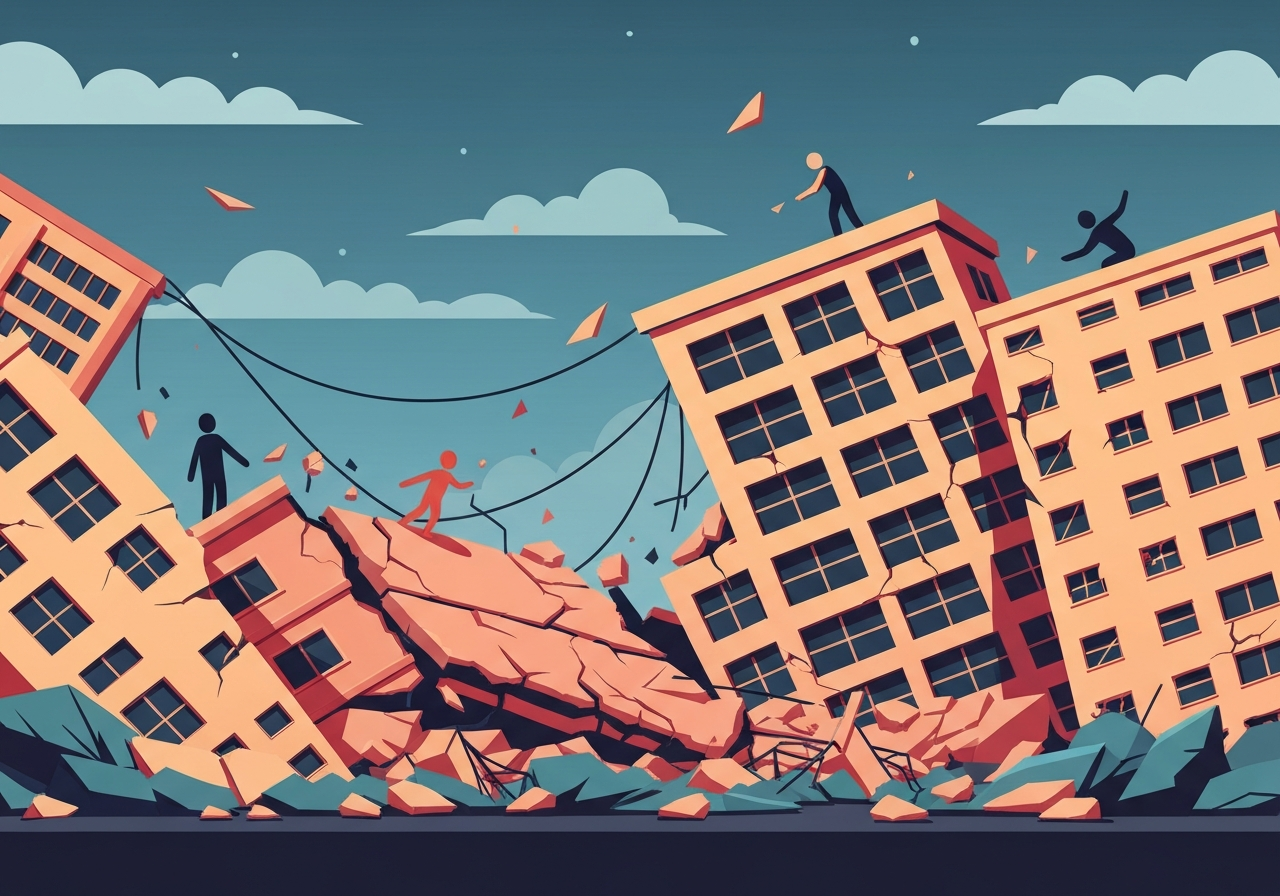
La Guaira experienced the worst damage. Acting President Rodríguez declared the state a disaster zone and described dozens of collapsed structures, including part of an eight-floor waterfront hotel in Macuto reduced to rubble. Simon Bolívar International Airport, serving Caracas, reported severe internal and structural damage and was temporarily closed as rescue teams cleared debris.
In Caracas several districts reported total or partial collapses. Local officials and videos geolocated by media teams show rescue workers removing survivors from rubble in San Bernardino and other neighborhoods. Residents described panicked evacuations, nighttime streets crowded with people avoiding aftershocks, and prolonged disruptions to power and gas services in many municipalities.
Analysis & Implications
The twin shocks’ timing and proximity to populated coastal zones help explain the high casualty and damage reports. The 40-second interval between foreshock and mainshock provided virtually no time for organized evacuation; many people were at home because the quake occurred on a public holiday evening. Older multi‑story residential buildings, often constructed with limited seismic retrofitting, amplified the risk of collapse in affected neighborhoods.
Emergency response faces multiple constraints. Years of economic contraction — GDP down roughly 80% since 2013 — have weakened public services, hospitals and logistics. Fuel, medical supplies and trained urban search-and-rescue capacity are all limited compared with typical needs after major seismic events, raising the urgency of incoming international assistance while complicating distribution and coordination.
The broader political context will shape the aid footprint and reconstruction path. Caracas’ international realignment since January, including closer ties with the United States and China, means offers of assistance now have diplomatic as well as humanitarian implications. Rapid, well-coordinated relief could ease immediate suffering and influence future foreign investment and reconstruction contracts; conversely, delays or politicized aid could deepen hardship and domestic tensions.
Comparison & Data
| Metric | Reported figure |
|---|---|
| Primary magnitudes | 7.2 (foreshock), 7.5 (mainshock) |
| Distance from Yumare | ~23 km southeast |
| Reported casualties | 32 dead, ~700 injured (reported) |
| Connectivity (NetBlocks) | Low 59% → recovered to 77% |
| USGS economic loss model | $10 billion–$100 billion |
The US Geological Survey’s early economic modeling uses exposure and shaking intensity to estimate a wide loss range ($10B–$100B), reflecting both uncertainty in damage penetration and the uneven distribution of vulnerable assets along the coast. Connectivity drops recorded by NetBlocks indicate impaired communications that can slow situational awareness and hamper rescue coordination in the critical first 48–72 hours.
Reactions & Quotes
“We extend our deepest condolences and are immediately sending search-and-rescue teams, medical resources and humanitarian aid to Venezuela,”
U.S. Secretary of State Marco Rubio (statement)
Rubio announced rapid deployment of American rescue teams and equipment at the direction of President Trump; U.S. teams were expected to arrive early Thursday to assist local operations.
“Dozens of buildings have collapsed in La Guaira — the situation is a true tragedy and we are engaged in arduous rescue operations,”
Acting President Delcy Rodríguez (official statement)
Rodríguez described the scope of damage in La Guaira, the closure of Simon Bolívar International Airport and the creation of a high-level task force to coordinate search-and-rescue efforts.
“We will not leave here until we rescue the last person we can save alive,”
Mayor of Chacao Municipality (local official)
The Chacao mayor said rescuers could still hear people under rubble overnight and committed municipal emergency services to continued operations amid power and gas shutdowns.
Unconfirmed
- Exact final death toll: authorities say the number will rise but a consolidated nationwide total has not yet been published.
- Reports that four buildings collapsed in Caracas (attributed to Nicolás Maduro Guerra) are being evaluated by local engineering teams and are not yet independently verified.
- Attribution of collapses to construction quality versus shaking intensity remains under assessment; formal structural surveys are pending.
Bottom Line
Two near‑simultaneous large earthquakes have produced a fast-moving humanitarian crisis in Venezuela’s northern coastal states, with La Guaira hardest hit and major infrastructure including the international airport damaged. Immediate priorities are search and rescue, emergency medical care, temporary shelter, water and sanitation, and restoring communications to coordinate relief.
Beyond the immediate emergency, the disaster will test Venezuela’s constrained public services and reshape diplomatic and economic calculations: international aid offers are arriving quickly but will require careful coordination in a politically fraught environment. For residents and responders, the next 72 hours are decisive for survival and for establishing a transparent, effective relief operation.