
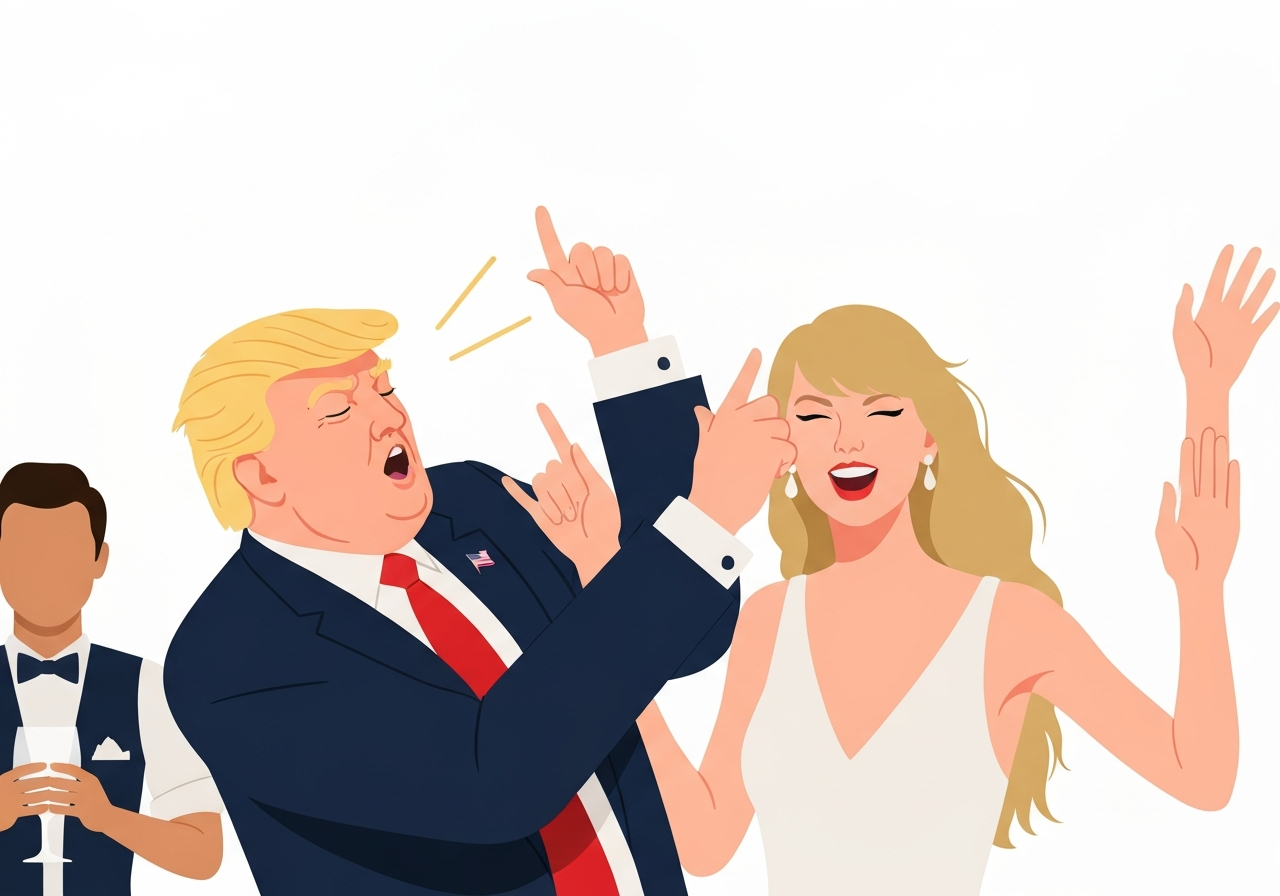
On Friday evening the White House posted a meme that appropriated the purple Madison Square Garden wedding imagery of Taylor Swift and Travis Kelce, replacing the couple’s celebratory billboard with a message about Donald Trump. The move followed another collage-style post the night before that reworked Swift’s Eras Tour poster into a patriotic motif featuring the former president. The social-media push landed alongside Swift’s large July 4 weekend celebration at Madison Square Garden, but the singer continued her event and high-profile performances undeterred. The exchange underscored a rare moment where presidential messaging crossed directly into a celebrity wedding night with limited immediate political fallout.
Key Takeaways
- The White House posted an Instagram meme on Friday evening parodying the Madison Square Garden “JUST MARRIED” display, swapping in the phrase “Trump Is Your President” and the line “It’s happened!”
- A related White House collage on Thursday repurposed imagery from Swift’s 2023 Eras Tour poster and echoed a line from that promotional campaign.
- The wedding at Madison Square Garden took place over the July 4 weekend and reportedly hosted about 1,000 guests with arena-stage musical performances by major artists.
- Top performers slated to appear included Stevie Nicks and Paul McCartney, and the event featured Adam Sandler as host on the Garden stage.
- This episode follows a 2024 incident in which an AI deepfake of Swift was posted online; Swift publicly denied endorsing Trump at the time.
- Trump has publicly alternated between jibes at Swift and a muted congratulatory tone — a tactical balance given her popularity in some swing-state electorates.
- Separately, a proposed Trump-backed Freedom 250 concert around the same holiday drew fallout as several musicians withdrew from the lineup.
Background
Taylor Swift has become an influential cultural and political figure in recent years, particularly after high-profile public statements in 2020 that criticized the then-president’s handling of racial justice issues. Her 2023 Eras Tour was a commercial behemoth whose promotional imagery is widely recognized, making it a frequent target for parody and political repurposing. Donald Trump and his communications team have repeatedly used celebrity-focused content to energize supporters, and social posts that lampoon well-known entertainers are a recurring tactic.
The choice of Madison Square Garden as the wedding venue added symbolic weight. The arena is an iconic New York stage familiar to millions, and the timing over the July 4 weekend overlapped with the former president’s own plans for large-scale patriotic events. A number of artists who had been linked to the Freedom 250 celebration reportedly backed away from that partisan concert, an episode that highlighted the fraught intersection of entertainment and political alignment.
Main Event
The White House Instagram post on Friday evening visually reworked the Garden’s purple billboard of Swift and Travis Kelce, replacing the “JUST MARRIED” signage with pro-Trump messaging. The post arrived after a Thursday collage that stitched together emblematic American moments alongside an image of Trump, labeled in a way that echoed Swift’s Eras Tour marketing. Both posts were circulated on platforms where they could quickly be captured and reshared.
Officials also shared short montage videos to X (formerly Twitter) that paired historical American footage with repurposed Swift imagery, using taglines such as “Next in America’s Eras Tour” and “America’s greatest hits, one era at a time.” Compared with other recent online attacks—like a 2024 AI-created video showing Trump as a doctor mocking Hollywood figures—these items were relatively mild in tone but deliberately tethered to pop-culture visuals.
At Madison Square Garden, the wedding proceeded with large-scale musical elements and an audience that included prominent entertainers commonly associated with progressive causes. Adam Sandler served as a host figure on the arena stage, and headline performers like Stevie Nicks and Paul McCartney were reported to be part of the weekend’s lineup. Observers noted the contrast between a celebrity-led celebration and the White House’s decision to insert political messaging into that same visual space.
Analysis & Implications
The White House’s appropriation of Swift imagery illustrates a strategic choice: to leverage widely recognized pop-culture assets for political messaging. Such moves can energize a core political base while also risking counterproductive attention from swing voters who admire the targeted celebrity. In this case, the administration appears to have calibrated its tone—provocative enough to be noticed, but not so escalatory as to provoke a high-profile backlash.
Trump’s ambivalence toward Swift is politically rational. Campaign advisers understand that Swift holds sway among young and suburban voters in several battleground states. A sustained public feud could mobilize constituents against him, so alternating mockery with perfunctory well-wishing reduces the chance of turning cultural affection into electoral mobilization. This balancing act echoes a broader pattern in which politicians engage pop culture selectively, measuring potential gains against reputational or turnout costs.
There are broader implications for the boundaries between politics and entertainment. The episode underscores how social platforms flatten contexts: a wedding sign, a concert poster and a political ad can be reshaped into a single meme in minutes. That speed intensifies pressures on public figures and institutions to respond, counter, or ignore — decisions that now carry both cultural and electoral consequences.
Comparison & Data
| Timeframe | Target | Platform | Notable Element |
|---|---|---|---|
| Thursday (this week) | Taylor Swift imagery | Instagram (collage) | Parody of Eras Tour poster |
| Friday (this week) | Swift/Kelce wedding display | Instagram (image) | Replaced MSG “JUST MARRIED” with pro-Trump message |
| 2024 | Taylor Swift | X / AI video | Deepfake endorsement later denied by Swift |
The table above summarizes the recent posts that tied presidential messaging to Swift’s public imagery. Each item relied on recognizable visuals—tour posters, venue billboards, or manipulated video—to increase shareability. That reuse of cultural signifiers is central to how political messaging now attempts to expand reach beyond traditional channels.
Reactions & Quotes
The posts prompted immediate online attention but no large-scale public confrontation between the parties involved. Observers on social platforms debated whether the posts were clever satire or an unnecessary provocation that risked energizing Swift’s supporters. Below are the principal public lines that framed the exchange.
Trump Is Your President — It’s happened!
White House Instagram (official post)
I HATE TAYLOR SWIFT!
Donald J. Trump (public post)
Unconfirmed
- Whether the White House’s timing was intended to target the wedding specifically or to capitalize on broader holiday attention remains unconfirmed.
- Motivations of individual musicians who withdrew from the Freedom 250 lineup have been described publicly, but the extent to which politics alone drove those decisions is not fully verified.
- Any internal deliberations at the White House about the expected political payoff or backlash from the Swift posts have not been disclosed.
Bottom Line
The episode is less a new escalation than a reminder that political operatives will use culturally potent imagery when it suits their messaging goals. In this instance, the White House repurposed instantly recognizable Swift visuals to stoke attention without provoking an intense public rupture. For Swift, the event highlighted how celebrity milestones can become political theater almost by accident.
Going forward, watch two things: whether future political posts escalate beyond parody into targeted disinformation, and whether celebrities or their teams respond in ways that translate cultural influence into organized civic action. Both paths could alter the calculus for politicians who weigh the benefits of attention against the risks of alienating voters in competitive districts.