
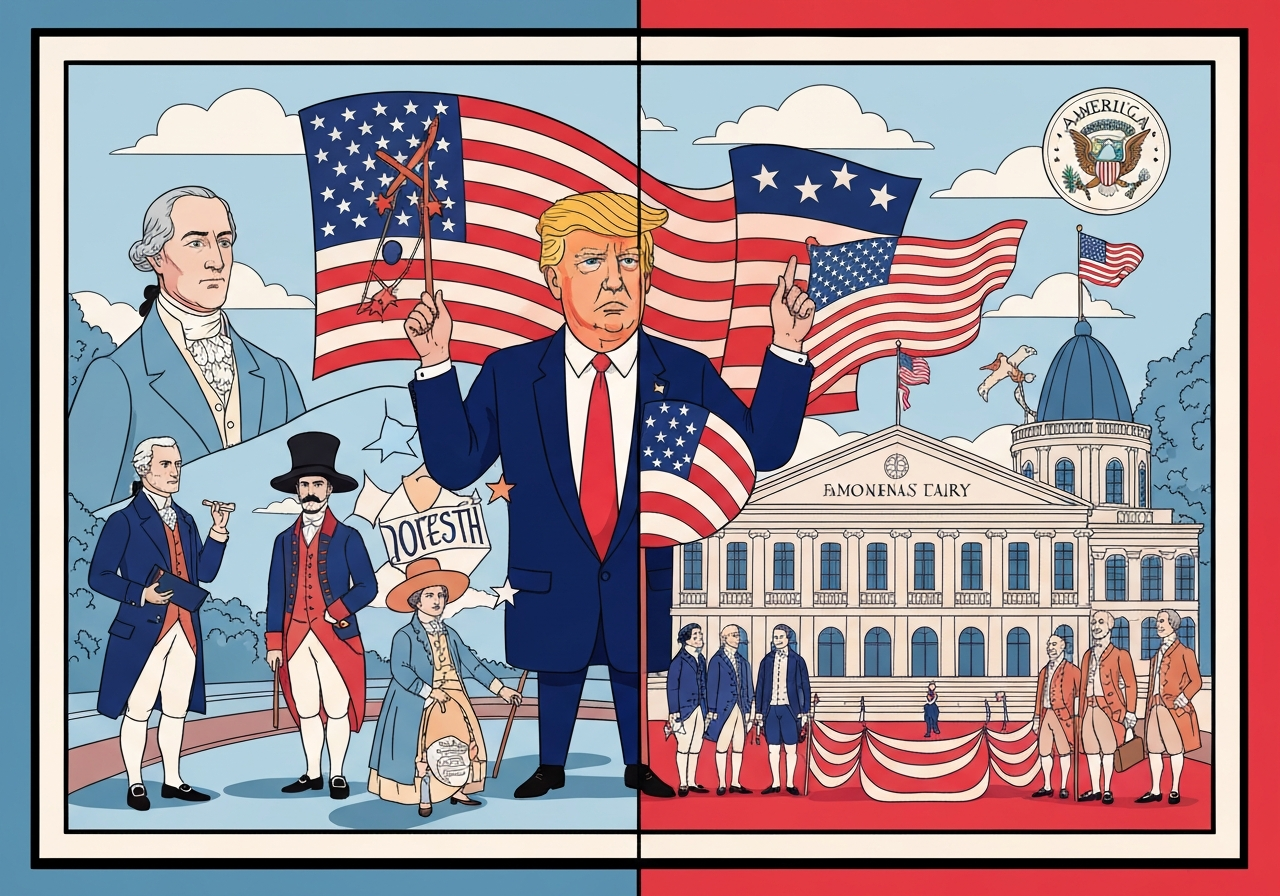
President Donald Trump combined ceremonial honors and pointed partisan appeals on Saturday as he marked the 250th anniversary of American independence in Washington. The program, staged on the National Mall and briefly interrupted by severe storms that prompted roughly a two-hour evacuation, honored veterans and displayed historic flags while also including calls for the SAVE America Act and renewed endorsements of the Second Amendment. The president framed the milestone as an unparalleled national triumph but interwove political messaging more typical of campaign rallies than traditional July 4 addresses. Large-scale celebrations around the country were shaped by extreme heat and localized weather disruptions that altered or canceled events from New England to the mid-Atlantic.
Key Takeaways
- Trump commemorated the 250th anniversary on the National Mall, combining veteran tributes with partisan appeals and policy plugs, including support for the SAVE America Act.
- Severe weather forced a roughly two-hour evacuation of the Mall; a Great American State Fair alert went up shortly after 7 p.m. ET, sending crowds to shelters and transit hubs.
- Veterans honored included World War II servicemembers and one of the first Black officers to lead a Special Forces team in Vietnam; historic flags on display ranged from the flag draped over Abraham Lincoln’s casket to the Wright Brothers’ plane flag.
- Event programming featured performers frequently seen at Trump rallies, including Lee Greenwood, and was organized largely by groups aligned with the White House rather than the bipartisan congressional initiative created a decade ago.
- Heat and storms affected nationwide festivities: Hartford, Harrisburg and Wilkes-Barre canceled, Boston and Philadelphia briefly sheltered attendees, and New York and Pittsburgh adjusted fireworks timing.
- New York’s maritime parade included 43 tall ships followed by military aircraft flyovers, and Mount Vernon hosted naturalization ceremonies where new citizens took the Oath of Allegiance.
Background
The 250th observance of American independence has been the focal point of yearlong planning by federal, state and private groups seeking to present a range of commemorations — from civic pageantry to historic reflections. Traditionally, Independence Day addresses emphasize national unity and common civic values; presidents across parties have used the holiday to speak to shared history rather than campaign specifics. This year, organizers and the White House shaped programming that mixed ceremonial elements with political symbols and performers linked to the president’s rallies.
Weather and climate conditions altered many planned events. Much of the East Coast experienced heat near or above triple digits in places, prompting public-health and safety responses that included event cancellations and rescheduling. Local governments and event producers adjusted fireworks, parades and public gatherings to reduce risks to attendees, while some national-scale programming went ahead under modified conditions.
Main Event
On the National Mall, the ceremony honored veterans and displayed historic artifacts while Mr. Trump delivered remarks that combined laudatory history with partisan appeals. Storms earlier in the evening triggered an evacuation that lasted about two hours; signage at the nearby Great American State Fair advised people to leave shortly after 7 p.m. ET. Attendees sought shelter in museums, subway stations and federal buildings, with some waiting in the air-conditioned spaces of the Ronald Reagan Building and International Trade Center.
Trump used the platform to praise military service, noting veterans from World War II and a Black Special Forces officer who led troops in Vietnam. He offered declarative lines about American preeminence — including the line, “We will always be on top” — and injected his familiar rhetorical beats about strength and national destiny. He also made lighter asides, referencing a possible third presidential term and calling World War II’s veterans “the greatest generation.”
Unlike customary nonpartisan July 4 remarks, the address included advocacy for the SAVE America Act, a pending elections measure facing resistance in some Republican circles, and firm support for the Second Amendment. Performers with long associations to Trump events, such as Lee Greenwood, helped shape the program’s political tone. Organizing groups were largely aligned with the White House rather than the bipartisan initiative that Congress launched a decade ago to coordinate national Independence Day activities.
Elsewhere, local and regional commemorations had mixed experiences: in New York, 43 tall ships paraded past the Statue of Liberty and military jets, including a stealth bomber and the Blue Angels, flew overhead; in Philadelphia, crowds gathered near Independence Hall even as midday fireworks and stadium events coincided with a World Cup match; and at Mount Vernon, naturalization ceremonies granted new citizens the Oath of Allegiance.
Analysis & Implications
Trump’s decision to fuse celebration with explicit policy advocacy marks a departure from the customary presidential use of Independence Day as a unifying observance. By promoting the SAVE America Act and foregrounding partisan cultural themes, the speech served both commemorative and campaign functions ahead of the November midterms. That blending may rally supporters but risks alienating independents and Republicans who prefer neutral national messaging on a holiday that traditionally emphasizes civic cohesion.
The prominence of veterans and historic flags reinforced a narrative of continuity and sacrifice that political leaders across the spectrum typically highlight. Displaying artifacts tied to Lincoln and early aviation linked the present-day administration to long-standing American milestones; such visual cues can strengthen patriotic sentiment while also allowing political actors to claim stewardship of national heritage.
Weather-driven disruptions underscore how climate and extreme-heat events are reshaping public rituals. Cancellations and evacuations in multiple cities reflect growing operational challenges for large, outdoor civic gatherings during summer months. Event planners and municipalities may increasingly incorporate contingency planning for extreme heat and storms, altering the experience and scale of national celebrations.
Comparison & Data
| City/Region | Impact on Celebrations |
|---|---|
| Washington, D.C. | National Mall evacuated ~2 hours; Great American State Fair alert ~7 p.m. ET |
| Hartford, CT | Major public events canceled |
| Harrisburg & Wilkes-Barre, PA | Planned celebrations canceled |
| Boston, MA | Fireworks/concert briefly paused; attendees sheltered |
| Philadelphia, PA | Evacuation ordered; midday fireworks still observed near Independence Hall |
| New York, NY | 43 tall ships procession; aerial displays proceeded |
These entries summarize reported local outcomes and show a pattern of weather-related adjustment rather than uniform cancellation. While some cities postponed or canceled high-profile events, others adapted schedules to prioritize safety and preserve portions of their programs.
Reactions & Quotes
“We will always be on top. We will never let our country fall. We will always be the best.”
President Donald Trump
This line was delivered as part of the president’s broader rhetoric of American exceptionalism, positioned amid ceremonial honors and political appeals.
“If that doesn’t make you proud to be an American,”
Tina Hale, attendee from Cohoes, N.Y.
Hale’s remark followed a military flyover and captured the reaction of onlookers who attended despite heat and weather warnings. Others described attending to be part of the historic anniversary or to combine the holiday with unrelated events like sporting matches.
“Just to be a part of the 250 years (anniversary) is an amazing thing.”
David Koshko, Marine Corps reserve veteran
Koshko framed participation as a civic and personal milestone after spending hours outdoors in high temperatures.
Unconfirmed
- Extent to which the SAVE America Act language used in the speech will alter Republican support in Congress remains unclear and is subject to further legislative developments.
- Reports do not indicate widespread injuries related to the National Mall evacuation; official health or incident tallies were not reported in the immediate coverage.
Bottom Line
The 250th anniversary observances combined pageantry and political signaling: ceremonial elements honored service and history, while the president used the platform to press partisan priorities. That approach may energize core supporters but diminishes the long-standing convention of nonpartisan July 4 messages aimed at national unity.
Weather and heat shaped many local and national events, illustrating how climate volatility is already altering civic rituals. Organizers and public officials will likely reassess planning and safety protocols for future large-scale commemorations as extreme weather becomes a recurrent factor.
Sources
- Associated Press (news report summarizing events and remarks on the 250th anniversary)