
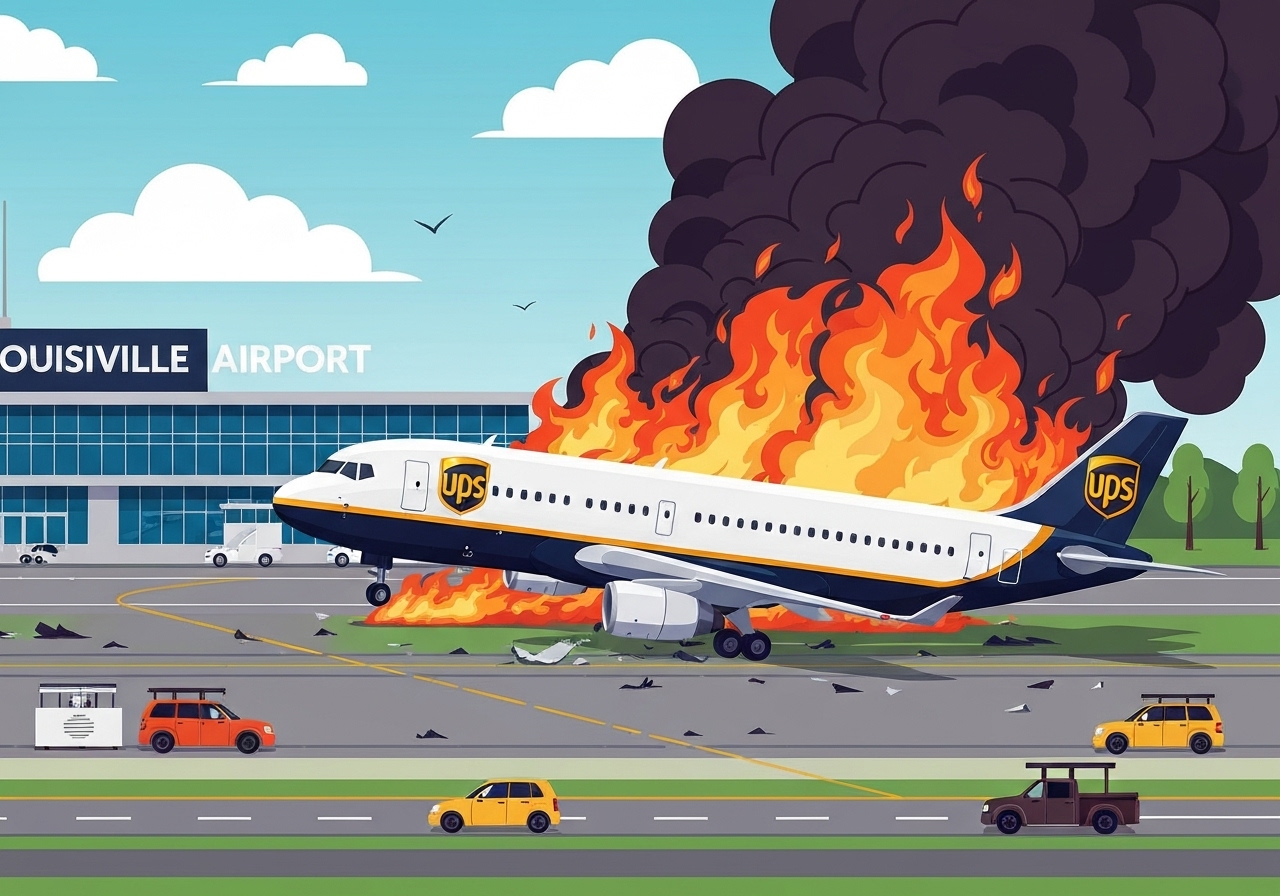
This week, new video surfaced showing a UPS cargo jet erupting into a massive fireball after takeoff near Louisville Muhammad Ali International Airport, Kentucky, killing at least 12 people including the three crew members aboard. The crash occurred on Tuesday south of the airport and reduced multiple buildings to rubble while scattering debris over more than half a mile. Officials reported the aircraft’s left engine caught fire and separated shortly after liftoff; investigators recovered the plane’s cockpit voice and flight data recorders and have sent them to Washington for analysis. State and federal authorities are continuing rescue and recovery operations while the National Transportation Safety Board leads a technical probe with FBI forensic support.
Key Takeaways
- At least 12 fatalities were reported, including the three pilots on UPS Flight 2976; officials say the death toll could rise.
- The crash occurred on Tuesday just south of Louisville Muhammad Ali International Airport; satellite imagery shows a debris field extending more than a half-mile.
- Authorities reported the aircraft carried about 38,000 gallons of fuel at the time of the accident.
- Officials said the left engine caught fire and detached during or immediately after takeoff.
- The NTSB recovered the plane’s black boxes and transported them to Washington for analysis; investigators are reviewing the aircraft’s maintenance history.
- FBI forensic investigators are assisting the NTSB; officials said FBI involvement is standard and does not imply suspicion of terrorism.
- Kentucky Gov. Andy Beshear said a young child is believed to be among the dead and that some people remain unaccounted for.
- UPS employs more than 25,000 people in the Louisville area and operates roughly 400 daily flights through the airport, which the company calls the centerpiece of its global air network.
Background
UPS Flight 2976 was bound for Honolulu when it crashed shortly after departure on Tuesday. Louisville has long been a central hub for UPS’s air operations; the company’s Worldport and related facilities make the airport a key node in overnight cargo logistics. The concentration of personnel and aircraft traffic around the field increases the scale and potential local consequences of any major accident. Past commercial and cargo aircraft accidents in the U.S. have prompted lengthy NTSB probes focused on mechanical failure, maintenance records and crew procedures, setting a familiar template for the current investigation.
Aviation safety investigations typically examine maintenance history, parts condition, crew communications and wreckage distribution to reconstruct the sequence of events. The presence of large quantities of jet fuel complicates on-scene recovery and can produce extensive fire damage, which in turn makes physical evidence harder to interpret. Federal agencies including the NTSB, FAA and sometimes the FBI coordinate technical, regulatory and forensic resources to ensure a comprehensive review. Local emergency services and corporate response teams also play a central role in search, rescue and community support following crashes near populated areas.
Main Event
According to officials, the left engine of the UPS aircraft ignited and separated shortly after the plane became airborne on Tuesday, which witnesses and newly shared social media video appear to confirm. The jet then descended into a cluster of buildings south of the airport, triggering a large conflagration that consumed structures and left a trail of debris across the neighborhood. Satellite images released after the crash show wreckage and scorched earth spanning more than a half-mile, consistent with a high-energy breakup and post-impact fire.
Rescue crews arrived on scene to find widespread damage and casualties; state officials reported at least 12 dead, including the three-member flight crew, and said some residents remain unaccounted for. Kentucky Gov. Andy Beshear briefed reporters on Wednesday, labeling the situation fluid and warning that the fatality count could rise as teams continue searches. Local hospitals and emergency response units were mobilized to treat survivors and support families affected by the disaster.
The NTSB confirmed recovery of the aircraft’s flight data recorder and cockpit voice recorder and said they were sent to Washington for forensic analysis. Agency officials have said investigators will examine maintenance logs, component records and performance data, and will work to integrate witness accounts and video evidence into the formal reconstruction of events. UPS has cooperated with investigators and activated employee support resources at its Louisville campus.
Analysis & Implications
The apparent in-flight engine failure and separation is a critical focus because it could point to a catastrophic mechanical malfunction or an inflight structural event. If investigators confirm an engine detached while the aircraft was under thrust, they will probe component lifecycles, recent maintenance actions and any recorded anomalies in engine monitoring data. Such findings can trigger airworthiness directives, grounding actions or broader inspections across fleets if a systemic defect is identified.
The scale of human and property loss near a major cargo hub underscores wider community and economic consequences: UPS is the largest employer in Louisville with more than 25,000 local staff, and damage to infrastructure or workforce can disrupt logistics flow and local livelihoods. Operational interruptions at a 24/7 cargo hub can ripple through supply chains, affecting shipments, delivery times and downstream commercial partners, particularly during high-demand periods for freight.
Regulatory and legal outcomes may follow the technical findings. If maintenance or procedural lapses are implicated, there could be enforcement action by the FAA and civil litigation by affected residents and families. Conversely, if a rare manufacturing defect is found, the response would focus on mitigation and corrective actions by the manufacturer and carriers. Either scenario will likely prompt industry-wide reviews of inspection intervals, training and emergency response planning in cargo operations.
Comparison & Data
| Item | This Crash | Typical Large Cargo Jet |
|---|---|---|
| Reported fatalities | 12 (including 3 crew) | Varies; most cargo accidents have lower passenger counts |
| Fuel onboard | ~38,000 gallons | Ranges widely by route; long-haul flights often carry tens of thousands of gallons |
| Debris field | More than 0.5 mile | Dependent on breakup altitude and speed |
The table provides a quick contextual snapshot: the large fuel load and extensive debris field are consistent with a high-energy accident involving a heavy freighter on long-range routing. These factors complicate firefighting and evidence preservation, which can lengthen the operational timeline for recovery and analysis.
Reactions & Quotes
UPS issued a message to staff and the public expressing condolences and gratitude to employees and responders. The company emphasized support for affected families and the local community as rescue and recovery continued.
“Our hearts continue to be with all who have been impacted.”
Carol Tomé, UPS CEO
The NTSB offered procedural details about the investigation and the status of evidence recovery, noting the black boxes were intact enough to be analyzed.
“The recorders were recovered and have been sent to Washington for evaluation; they appear to be in good condition.”
Todd Inman, NTSB member
Governor Beshear provided an on-the-record situational update about casualties and ongoing searches, situating state resources in support of local responders and families.
“We are still searching for a handful of people and assessing the full scope of the damage.”
Gov. Andy Beshear (Kentucky)
Unconfirmed
- Early social media clips show the fire and descent, but the exact timing and cause of the engine separation remain subject to formal forensic confirmation.
- Reports of the precise number of injured or unaccounted-for residents may change as search teams complete door-to-door checks and identify victims.
- Any suggestion that the FBI’s participation implies nonstandard criminal inquiry is unverified; officials say FBI forensic support is routine in complex accident scenes.
Bottom Line
The newly surfaced video gives the public a stark visual of a catastrophic in-flight event that quickly became a large urban disaster, killing at least 12 people and damaging a residential and industrial area near a major cargo hub. Technical evidence recovered so far—especially the flight data and cockpit voice recorders—will be central to determining the mechanical, human or systemic factors that led to the left engine fire and separation.
Investigators face the twin challenges of interpreting heavily fire-damaged wreckage and tracing maintenance and parts histories for components subject to extreme stress. While initial statements clarify steps already taken, definitive conclusions will depend on laboratory analysis and reconstructed timelines that can take weeks or months. In the interim, local recovery, support for victims’ families and operational continuity at a global logistics node will be pressing priorities.
Sources
- NBC News (national news report)
- National Transportation Safety Board (NTSB) (federal investigative agency)
- UPS Corporate Website (company statement and corporate information)
- Office of the Governor of Kentucky (official state statements)