
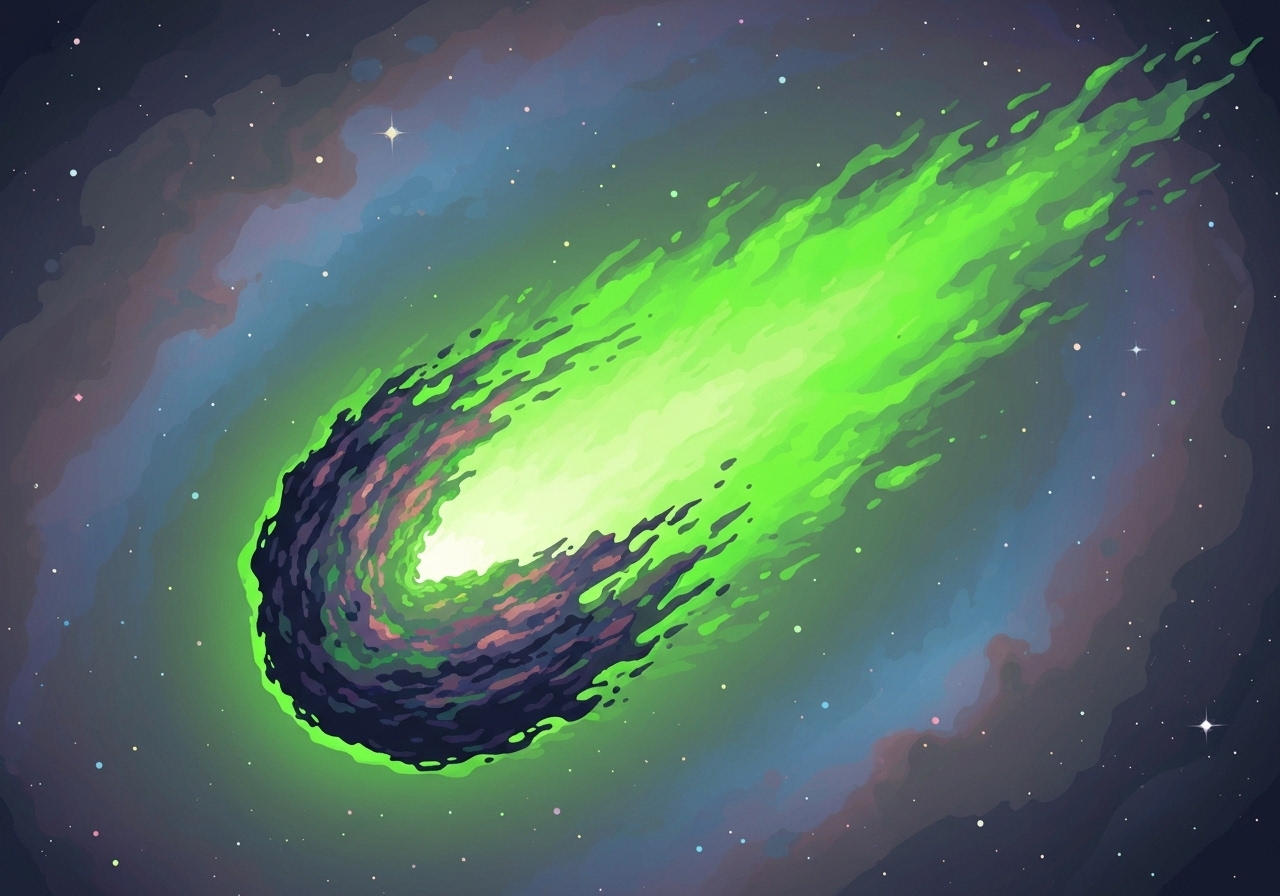
Lead: A new post‑perihelion image captured by Qicheng Zhang at Lowell Observatory shows interstellar comet 3I/ATLAS glowing green from diatomic carbon emissions while its dust tail appears largely concealed by viewing geometry. The observation was made immediately after the comet reached perihelion on Oct. 29 and was photographed from Earth during morning twilight on Oct. 31. Although the tail looks faint in the frame, Zhang and other observers say it remains present but viewed nearly head‑on. The dataset opens a crucial observational window as astronomers probe the comet’s composition and the effects of long‑term space irradiation.
Key Takeaways
- Observation: Qicheng Zhang used the Lowell Discovery Telescope on Oct. 31 for an optical, post‑perihelion look at 3I/ATLAS; the comet reached perihelion on Oct. 29.
- Green glow: A green filter sensitive to diatomic carbon (C2) highlighted strong C2 emissions, a common cause of green cometary comae.
- Tail geometry: The dust tail is present but largely hidden because observers are viewing it nearly head‑on; subtle asymmetric brightness betrays the tail’s position.
- Interstellar status: 3I/ATLAS is the third confirmed interstellar visitor recorded and was discovered in July 2023.
- Irradiation hypothesis: Preliminary research suggests prolonged space radiation may have produced an irradiated crust on the nucleus, potentially masking pristine interior material.
- Color and activity: Preprint results posted Oct. 28 indicate rapid brightening ahead of perihelion and a spectrum that appeared bluer than the Sun in some filters.
- Accessibility: After perihelion the comet rose higher above the horizon and is now observable with large professional telescopes and modest amateur instruments (roughly 6‑inch/15 cm aperture or larger).
Background
Comets develop an extended coma and, often, a tail as solar heating drives sublimation of ices and the release of dust and gases. Sunlight and ultraviolet (UV) radiation break apart larger molecules—particularly hydrocarbons—producing photochemical fragments such as diatomic carbon (C2) that fluoresce in the green portion of the spectrum. Observers commonly use narrowband filters tuned to these emissions to isolate molecular species and map active regions on a comet.
3I/ATLAS was discovered in July and quickly drew attention because it is only the third confirmed interstellar object to pass through the inner solar system. Its interstellar origin makes it scientifically valuable: in principle it can carry information about a different stellar environment. However, a suggested irradiated crust — produced by long exposure to cosmic rays and solar wind in interstellar space — could complicate efforts to read pristine material from the nucleus.
Main Event
On Oct. 31, during morning twilight, Zhang photographed 3I/ATLAS with multiple filters using the Lowell Discovery Telescope. The C2‑sensitive green filter produced a striking image in which the coma appears vividly green. Zhang also posted a similar diatomic carbon image to his Cometary blog, noting the visual impression of what the comet might look like to human eyes if our vision were sensitive to those emissions.
Although the frame lacks an obvious broad dust tail, Zhang pointed out a subtle left‑side brightness enhancement that indicates the tail is present just behind the nucleus and curving slightly leftward. That asymmetric glow is consistent with a tail viewed almost directly along its axis, which shortens its apparent extent on the sky. In short, the apparent lack of a tail is a perspective effect rather than a disappearance of dust.
Separate imaging from July at Gemini South in Chile provided earlier views of the comet when it was farther from perihelion, while the post‑perihelion window is now allowing spectroscopy and narrowband imaging that emphasize gaseous emissions. Zhang and collaborators reported on Oct. 28 via a preprint that the comet brightened rapidly ahead of perihelion and showed a relatively bluer signal in some filters compared with the Sun.
Analysis & Implications
The strong C2 signal means hydrocarbon parent molecules are abundant in 3I/ATLAS and that UV photodissociation is actively producing detectable molecular fragments. That pattern is common among active comets that approach the Sun, but its prominence here helps confirm that the comet’s near‑surface chemistry is responsive to solar irradiation despite its interstellar origin.
If an irradiated, processed crust blankets the nucleus, remote measurements will largely sample altered material rather than pristine interior samples that retain a record of the comet’s birth environment. That would reduce the diagnostic power of spectroscopy for tracing the comet’s system of origin, although gas and dust released during outbursts or from deeper vents might still yield informative signatures.
The reported rapid brightening near perihelion and the comet’s bluer relative color in some filters suggest increased activity and a composition richer in species with shorter‑wavelength fluorescence. Practically, those factors make the comet easier to follow and study in the weeks after perihelion, when gas production peaks and multiple observatories can obtain complementary datasets.
Comparison & Data
| Date | Telescope/Facility | Noted Feature |
|---|---|---|
| July 2023 | Gemini South (NOIRLab) | Early images of 3I/ATLAS at greater solar distance |
| Oct. 28, 2023 | arXiv preprint | Reported rapid brightening and relatively bluer colors ahead of perihelion |
| Oct. 29, 2023 | Orbital milestone | Perihelion (closest approach to the Sun) |
| Oct. 31, 2023 | Lowell Discovery Telescope | Post‑perihelion optical imaging showing strong C2 (green) emissions |
The table places recent observations in context: early southern‑hemisphere images captured structure before perihelion, an arXiv preprint described brightening immediately prior to perihelion, and Lowell’s post‑perihelion imaging emphasized gaseous emissions. Together these datasets create a timeline of changing activity and provide multiple wavelengths for cross‑comparison.
Reactions & Quotes
Zhang has offered accessible explanations tying molecular photodissociation to familiar analogies and describing observational choices.
“It’s sort of for the same reason that if we stay out in the sun too long without sunscreen, we get sunburnt,”
Qicheng Zhang / Lowell Observatory (observer)
The comment summarized how UV light breaks apart large organic molecules on the comet to produce detectable fragments such as diatomic carbon.
“It’s brightest in the bluest filter that we have,”
Qicheng Zhang / Lowell Observatory (observer)
Zhang used that phrasing to explain why the comet appears significantly brighter in shorter‑wavelength (blue/green) filters than in redder bands during these observations.
Unconfirmed
- The hypothesis that 3I/ATLAS carries an extensively irradiated crust that fully masks its natal composition remains provisional and requires additional spectroscopic and possibly resolved imaging evidence.
- The estimate that the comet may be roughly 3 billion years older than the solar system comes from an early study and is not yet corroborated by independent age diagnostics.
- Any suggestion that 3I/ATLAS is an artificial object or spacecraft has been widely dismissed by the astronomical community and lacks supporting evidence.
Bottom Line
Post‑perihelion imaging of 3I/ATLAS confirms active gaseous chemistry dominated by hydrocarbon breakdown products such as diatomic carbon, producing a vivid green coma when viewed through appropriate filters. The apparent absence of a dust tail in some frames is explained by viewing geometry rather than an intrinsic lack of dust.
Because 3I/ATLAS is an interstellar visitor and only the third confirmed example, continued multiwavelength observations over the coming months are especially valuable. Spectroscopy, time‑series imaging, and coordinated amateur–professional campaigns will be needed to test the irradiated‑crust hypothesis and to maximize what can be learned about the comet’s origin and history.