
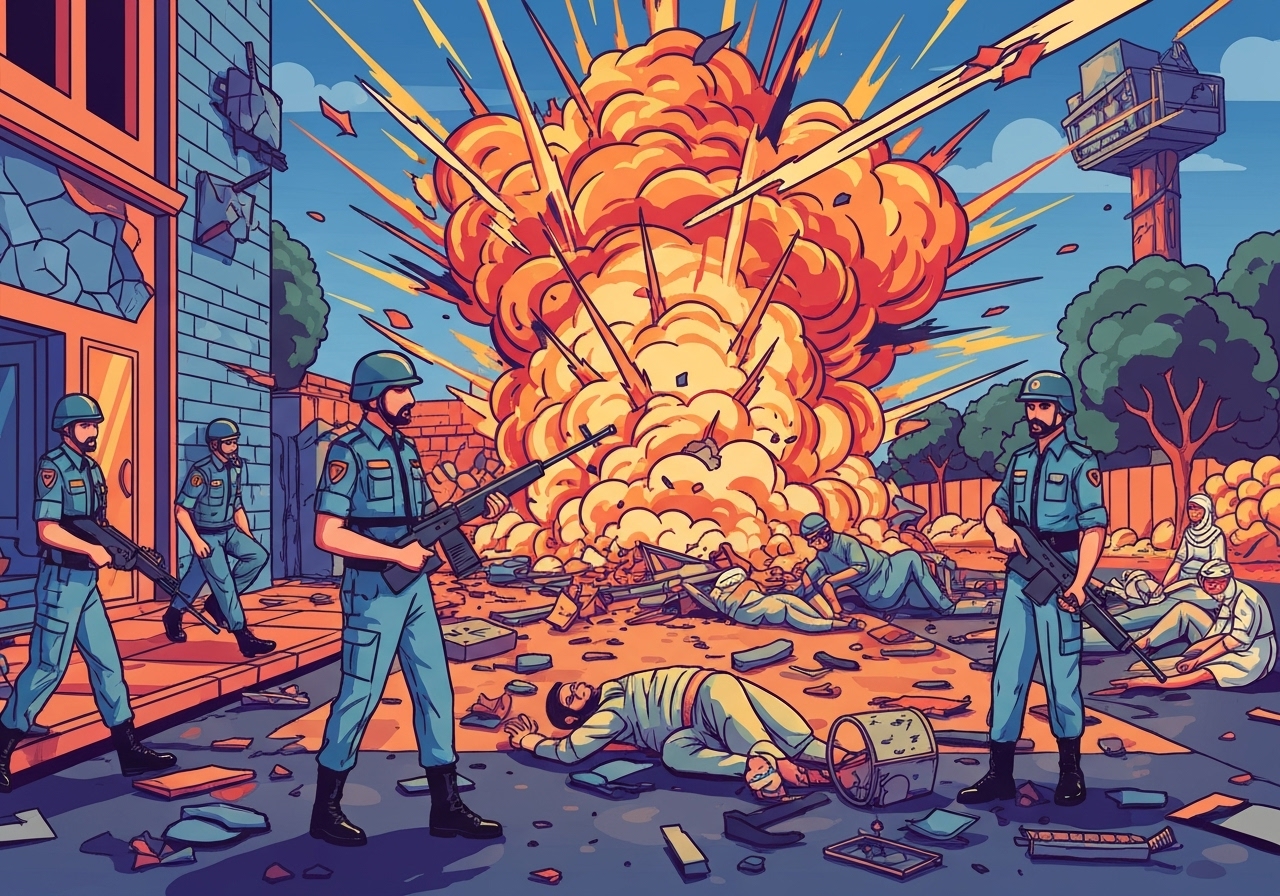
Lead: On 11 November 2025 a suicide bomber detonated at about 12:30pm (07:30 GMT) at the entrance of the District Judicial Complex on Srinagar Highway in Islamabad, killing at least 12 people and wounding more than 30, with five in critical condition. Prime Minister Shehbaz Sharif accused Indian-backed actors of orchestrating the assault; a breakaway TTP faction, Jamaa‑ul‑Ahrar, later claimed responsibility while the TTP denied involvement. The blast came as security forces were conducting large-scale operations after an earlier assault on Cadet College Wana and amid other violent incidents in the region.
Key takeaways
- Time and place: The suicide explosion hit the District Judicial Complex on Srinagar Highway in Islamabad at about 12:30pm (07:30 GMT) on 11 November 2025.
- Casualties: Authorities say at least 12 people were killed and hospitals reported more than 30 injured, including at least five in critical condition.
- Claim of responsibility: Jamaa‑ul‑Ahrar, a splinter of Tehreek‑e‑Taliban Pakistan (TTP), claimed the attack; the TTP officially denied involvement.
- Political allegation: Prime Minister Shehbaz Sharif publicly blamed ‘India proxies’ for the bombing but presented no evidence to verify external involvement.
- Regional context: The attack coincided with an ongoing rescue operation after a car-bomb and attack on Cadet College Wana and came days after a deadly car blast in New Delhi.
- Simultaneous incidents: Security forces also reported an earlier assault in Wana and a separate bomb in Dera Ismail Khan that injured at least 14 security personnel.
Background
Pakistan has faced repeated attacks from the TTP and allied groups since the insurgency intensified in the late 2000s. The TTP and its factions have targeted security forces and civilian sites, leading Islamabad to repeatedly warn that hostile actors are exploiting safe havens across the border in Afghanistan.
Diplomatic ties in the region have shifted through 2025: Pakistan’s once-close relationship with the Afghan Taliban has frayed amid mutual accusations, while India has increased engagement with Kabul. Islamabad has frequently alleged New Delhi’s support for Pakistan-based insurgent activity — claims India rejects — and tensions have been heightened by recent cross-border clashes and failed talks mediated in Doha and Istanbul.
Main event
The explosion occurred at the main entrance used by litigants at the District Judicial Complex, a busy court that opened three years ago and handles thousands of daily visitors, including many lawyers. Witnesses described a chaotic scene with hundreds attempting to flee; one legal professional estimated roughly 2,000 people were on site when the device detonated.
Interior Minister Mohsin Naqvi released casualty figures that were subsequently confirmed by hospital authorities: at least 12 dead and more than 30 wounded, among them at least five in critical condition. Emergency services evacuated the injured to nearby hospitals and authorities sealed off sections of the highway while investigators searched the scene.
Separately, Pakistani forces were engaged in operations in South Waziristan after an explosives-laden vehicle breached the entrance to Cadet College Wana a day earlier. Officials said around 300 cadets had been rescued and operations to free the remaining hostages were ongoing. A separate blast in Dera Ismail Khan injured at least 14 security officers on the same day.
The Jamaa‑ul‑Ahrar faction issued a claim of responsibility through channels monitored by analysts, while the larger TTP denied involvement. Islamabad’s leaders, including Prime Minister Shehbaz Sharif, portrayed the attack as part of a wider campaign and directly accused Indian proxies, a charge New Delhi rejects and which has not been substantiated publicly by independent evidence.
Analysis & implications
The incident represents a sharp escalation in security threats inside Pakistan’s capital, a city that has been relatively calm compared with restive border provinces. An attack at a high‑profile judicial complex is likely intended to undermine public confidence in state institutions and to grab maximum media attention.
If Jamaa‑ul‑Ahrar’s claim is genuine, it underscores the persistence of factional networks able to strike urban targets. Pakistan’s immediate public attribution to external actors — specifically ‘India proxies’ — raises the risk of further diplomatic friction and complicates efforts to de‑escalate with neighbouring states and non‑state actors.
Domestically, the government faces pressure to strengthen urban security and to explain apparent intelligence or perimeter failures at a major courthouse. Internationally, the attack puts renewed focus on cross‑border dynamics: Islamabad blames sanctuary and support for militants in Afghanistan, while Kabul denies harbouring groups targeting Pakistan.
The timing — concurrent with the Wana siege and a separate deadly blast in New Delhi — could provoke reciprocal rhetoric or security measures that steer the region toward sharper polarisation. Analysts warn the cycle of accusation and counter‑accusation risks spillover violence and could hamper humanitarian or diplomatic channels already strained by recent clashes.
Comparison & data
| Incident | Date | Reported deaths | Reported injuries |
|---|---|---|---|
| Islamabad district court suicide bombing | 11 Nov 2025 | 12 | 30+ |
| Cadet College Wana assault (car bomb then attack) | 10–11 Nov 2025 | — (hostage situation; casualties reported in operations) | Rescued ~300 cadets so far |
| New Delhi car explosion | 10 Nov 2025 | 13 | — |
| Dera Ismail Khan bomb | 11 Nov 2025 | 0 (reported) | 14 security personnel injured |
The table places the Islamabad blast in the context of a cluster of violent incidents across the subcontinent over the same 48‑hour period. Data remain provisional and subject to revision as official investigations proceed.
Reactions & quotes
Government leaders immediately framed the blast within a broader security challenge. Below are representative statements and their context.
This attack shows that the conflict now threatens the heart of Pakistan, not only border regions.
Khawaja Asif, Pakistan Defence Minister
Defence Minister Asif used forceful language to characterise the incident as part of a larger campaign against the state, framing it as a nationwide security emergency rather than an isolated strike.
These strikes are the worst examples of state‑backed terrorism in the region, and should be condemned internationally.
Shehbaz Sharif, Prime Minister of Pakistan
The prime minister explicitly accused external proxies linked to India; his statement escalates the diplomatic stakes but did not include publicly shared evidence linking specific Indian entities to the attack.
We are treating the scene as a terrorist attack and coordinating medical and investigative resources accordingly.
Mohsin Naqvi, Interior Minister
Interior Ministry briefings focused on casualty management and the ongoing forensic and security response at the court complex.
Unconfirmed
- Direct state involvement: Islamabad’s claim that ‘India proxies’ orchestrated the attack has not been supported by public forensic or intelligence evidence available to independent media.
- Claim verification: Jamaa‑ul‑Ahrar’s responsibility claim has been circulated but independent authentication of the group’s operational role and the bomber’s identity remains pending.
Bottom line
The November 11 suicide blast at Islamabad’s district judicial complex is a stark indicator that militants or violent networks retain the capacity to strike high‑profile urban targets. With at least 12 dead and dozens wounded, the attack heightens internal security pressures and raises the diplomatic temperature across South Asia.
Key things to watch: official investigative findings on the bomber and any external links; the outcome of operations in Wana and further security incidents across Pakistan; and how Islamabad and New Delhi manage their public attributions, which could either inflame or, if handled cautiously, help stabilise a tense regional environment.
Sources
- Al Jazeera — international news outlet reporting on the Islamabad blast and regional context