
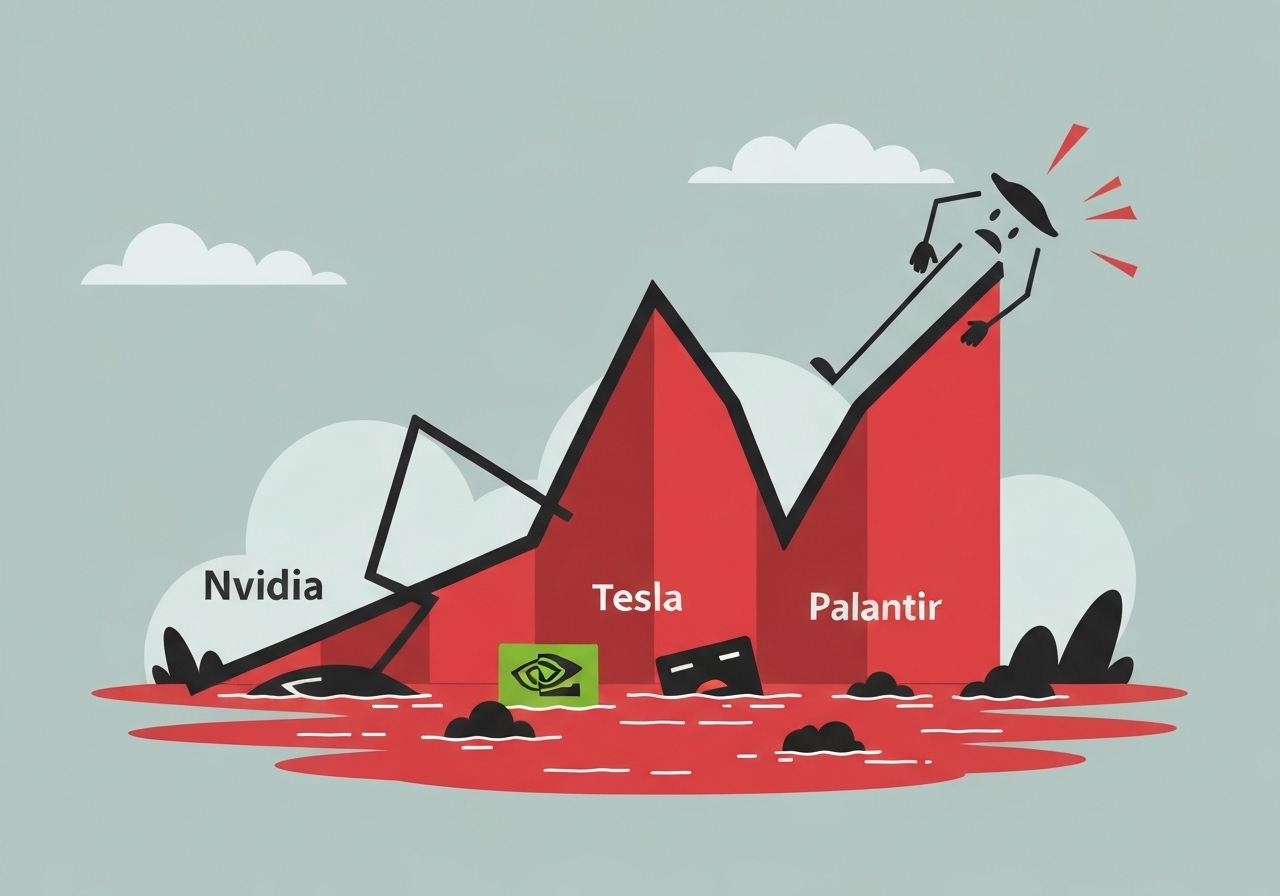
Lead: U.S. equity futures moved modestly higher after hours on Thursday even as the cash market suffered a sharp pullback, with the S&P 500, Nasdaq and Russell 2000 breaching key technical levels. The retreat was led by major growth names including Tesla, Nvidia and Palantir, while late reports from Applied Materials and Nu Holdings added to overnight headlines. Investors.com posted a scheduled maintenance notice from 10:00 PM ET to 2:00 AM ET and apologized for any temporary feature outages. Market participants described the session as a rapid, breadth-light correction that left large-cap leadership under pressure.
Key Takeaways
- Dow Jones futures ticked up slightly in after-hours trading following a volatile cash session on Thursday.
- The S&P 500, Nasdaq and Russell 2000 undercut important technical levels during the session, prompting stop-loss cascades in some names.
- Tilt toward growth equities: Tesla, Nvidia and Palantir were among the most heavily sold, amplifying headline volatility.
- Applied Materials (AMAT) and Nu Holdings (NU) reported late Thursday, adding earnings-related moves to the market mix.
- Smaller-cap pressure was visible as the Russell 2000 lagged, signaling a narrower rally before the sell-off.
- Investors.com scheduled maintenance from 10:00 PM ET to 2:00 AM ET could temporarily limit access to some site features.
Background
The market entered Thursday following a period of concentrated gains led by large-cap technology and AI-exposed stocks. That leadership had pushed indexes to elevated levels, making the market more sensitive to profit-taking and headline risk. Liquidity dynamics—tight breadth, high options positioning and sizable passive inflows—have in recent weeks increased the potential for abrupt moves when a cluster of names begins to adjust.
Thursday’s sell-off reflected that vulnerability: a handful of megacap names accounted for outsized market moves, while many other sectors showed smaller net changes. Historically, rallies driven by a narrow set of leaders can experience sharp reversals when traders reassess valuations or reposition ahead of earnings and macro events. Market structure—overnight futures, program trading and stop orders—can accentuate these swings.
Main Event
The trading day saw heavy selling in several high-profile growth stocks, with Tesla, Nvidia and Palantir among the most notable decliners. The losses were broad enough, however, to push the S&P 500, Nasdaq and the small-cap Russell 2000 beneath chart support that many technical traders watch for risk management. That intraday breakdown pressured momentum-related strategies and produced faster-than-normal declines in affected tickers.
Applied Materials and Nu Holdings released reports late Thursday, and their after-hours activity contributed to headline volatility; some market participants interpreted the releases as incremental reasons to reduce exposure to semiconductor-related and fintech-linked positions. After the cash close, Dow futures and broader index futures showed modest recovery, suggesting some traders used the pullback as a short-term entry point.
Liquidity conditions amplified the move: with concentrated gains in a handful of names, derivative positions and algorithmic flows can create feedback loops when those names sell off. The session was notable more for its speed and narrow leadership than for a broad-based sell-off across all sectors.
Analysis & Implications
In the near term, the market faces a period of higher volatility as investors parse earnings, economic data and central bank outlooks. When core leadership stocks retrench, it tends to weigh on investor sentiment quickly because market indices are heavily influenced by a small number of mega-cap constituents. A pullback that removes froth from stretched valuations could be constructive if it leads to broader participation later, but it complicates immediate risk-on positioning.
The underperformance of the Russell 2000 relative to large caps highlights a disconnect between small-cap fundamentals and large-cap speculative momentum. If smaller stocks continue to lag, investors may interpret that as a signal to favor defensive positioning or quality cyclicals until breadth improves. Conversely, a quick rebound among leadership names would likely restore confidence and draw flows back into growth sectors.
From a macro perspective, the episode underscores sensitivity to event risk—earnings releases, guidance changes and platform-specific headlines can trigger outsized moves in an environment where liquidity is uneven. Portfolio managers will monitor whether the selling is concentrated and technical, or whether it spreads to economically sensitive areas that could presage slower growth.
Comparison & Data
| Index / Instrument | Session Note |
|---|---|
| Dow Jones futures | Modest after-hours recovery following cash-market pullback |
| S&P 500 | Undercut key technical levels during Thursday session |
| Nasdaq | Largely led lower by megacap tech names |
| Russell 2000 | Weaker relative performance, indicating narrow rally erosion |
The table summarizes tactical moves observed during the session; exact index point moves and intraday percentages varied across exchanges and data vendors. Market breadth measures—advance/decline ratios and new highs versus lows—were notably weaker than during the prior consolidation, reflecting concentrated selling pressure.
Reactions & Quotes
Market participants and platforms offered immediate reactions as the session unfolded, highlighting both the technical nature of the sell-off and operational notes for users.
We apologize for any inconvenience. Scheduled maintenance will take place from 10:00 PM ET to 2:00 AM ET and some features may be unavailable.
Investors.com (site notice)
Investors are recalibrating positions after a narrow rally, leading to a rapid pullback in several headline names.
Market strategist (industry commentary)
Unconfirmed
- Whether specific earnings items at Applied Materials or Nu Holdings were the primary cause of the broad sell-off remains unconfirmed.
- Reports that a single algorithmic strategy triggered cascading stops across multiple megacaps have not been independently verified.
- Any claims about large institutional reallocations as the sole driver of the decline are not confirmed and lack direct disclosure.
Bottom Line
Thursday’s session was a reminder that narrow leadership can mask market fragility: when a few large stocks pull back, index-level damage can occur quickly even if broader economic indicators remain unchanged. The after-hours bump in Dow futures suggests some participants view the move as corrective rather than the start of a sustained bear phase, but the loss of technical support in major indexes raises the bar for near-term optimism.
Investors should watch breadth measures, upcoming earnings reports and macro releases to determine whether this is a transient shakeout or the start of a deeper reassessment. Risk management—position sizing, stop levels and liquidity planning—will be especially important while volatility remains elevated.