
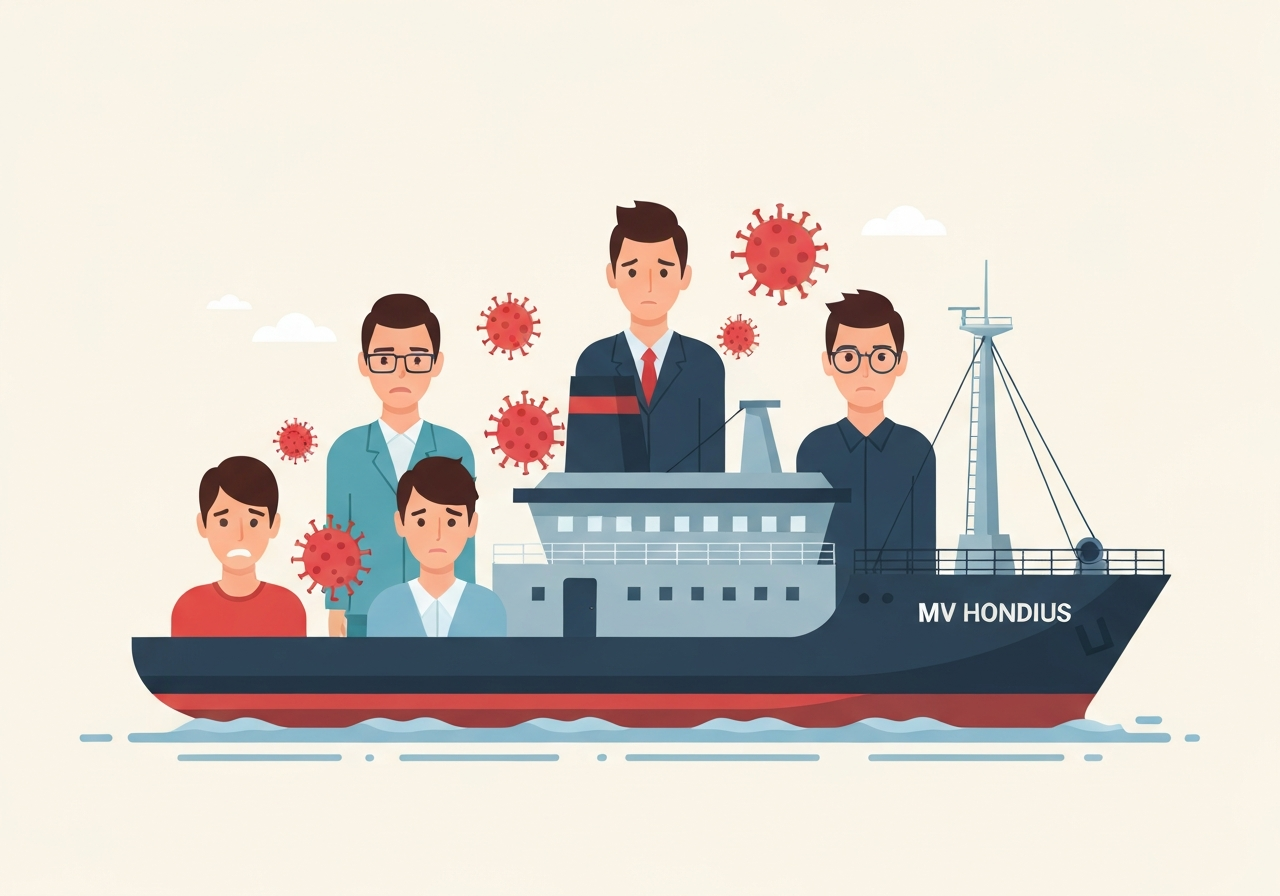
Lead: The World Health Organization said on Wednesday that five confirmed hantavirus infections are linked to a cluster aboard the Dutch-operated cruise ship MV Hondius, which has been at sea since leaving Ushuaia, Argentina. Three passengers have died after illnesses traced to the voyage; investigators say eight people in total are reported as infected or suspected. Health authorities in several countries — including the United States — are tracing and monitoring passengers who disembarked earlier. The ship has resumed sailing toward the Canary Islands while officials work to screen, treat and repatriate those affected.
Key takeaways
- WHO confirmed five laboratory-confirmed hantavirus cases as of Wednesday, May 7, 2026, with three additional suspected infections, bringing the reported cluster total to eight.
- Three passengers have died in connection with the onboard outbreak: a Dutch couple and a German national; attribution of all three deaths specifically to hantavirus is not fully clarified.
- At least 29 passengers disembarked at St. Helena on April 24 after the first onboard fatality; Dutch officials have said roughly 40 people may have left there, and many remain untraced.
- About 150 people remained aboard under precautionary measures while the MV Hondius sailed from Cape Verde to Tenerife; Oceanwide Expeditions operates the vessel.
- U.S. public health authorities said the risk to the wider U.S. population is extremely low; travelers from California, Georgia and Arizona were being monitored for symptoms but showed no illness.
- Three patients — including the ship’s doctor among them — were evacuated to the Netherlands for treatment; two evacuated patients tested positive for the Andes strain and one evacuee was asymptomatic but closely linked to a fatal case.
- The Andes hantavirus strain, detected in some patients, is notable because person-to-person transmission has been documented in South America, though such spread remains uncommon.
Background
Hantaviruses are a family of rodent-borne viruses that can cause severe respiratory disease in humans. Most human infections occur after inhalation of aerosolized virus from rodent urine, droppings or saliva; the Andes strain has been associated with rare human-to-human transmission in close-contact settings in South America. Incubation periods commonly range from 2 to 4 weeks, complicating contact tracing for travelers who mixed with others after disembarking.
The MV Hondius departed Ushuaia approximately a month before the cluster was publicly reported and made stops that included St. Helena and Cape Verde. The pattern of illness — multiple cases emerging in a confined, shared environment — prompted public-health agencies and the ship operator to initiate a coordinated response, including evacuation of severely ill patients and intensified passenger tracing.
Main event
The sequence of events began with an onboard death that prompted a group of passengers to disembark on April 24 at St. Helena; Oceanwide Expeditions later confirmed 29 people were offloaded that day and said it is attempting to contact a total of 30 individuals it believes left the ship at various points. Dutch authorities told investigators the number could be closer to 40, creating an urgent tracing task.
Subsequent illnesses and two more deaths were reported: a Dutch woman who left the ship and later died after flying to Johannesburg, and a German woman who died on May 2 while the ship was near Cape Verde. The body of the German passenger remained on board pending formal processes. Official statements say three people were later evacuated to the Netherlands for specialized care.
The WHO announced the number of lab-confirmed cases had risen to five on Wednesday and said three of the reported cases are linked to the Andes strain in preliminary testing. Oceanwide resumed the voyage from Cape Verde toward the Canary Islands; Spanish authorities and the ship operator arranged plans for docking in Tenerife so passengers could undergo medical checks and be repatriated.
Analysis & implications
Public-health officials stress that the overall risk to the general public remains low, but the incident highlights gaps that can appear when a mobile population mixes across international borders. The discrepancy in passenger counts who disembarked in St. Helena — 29 according to the operator, about 40 according to Dutch officials — complicates timely contact tracing and increases the window for potential symptom development elsewhere.
The identification of the Andes strain in some cases elevates concern because that strain has been linked to rare person-to-person spread in South America. However, most hantavirus infections continue to stem from rodent exposure. Response strategies therefore balance containment of possible person-to-person transmission with broader surveillance and traveler guidance to limit rodent exposure in endemic areas.
The outbreak also raises questions about port authority decisions, cruise operations and passenger information practices. Several ports initially refused entry or imposed restrictions; Spanish officials later confirmed the ship will dock at Tenerife despite local opposition. Clear operational guidance for safe disembarkation and onward travel is now a priority for WHO and national health agencies.
Comparison & data
| Metric | Count / note |
|---|---|
| Reported cases (total) | 8 (5 confirmed, 3 suspected) |
| Confirmed hantavirus cases | 5 (WHO, May 7, 2026) |
| Deaths linked to outbreak | 3 passengers (two Dutch, one German) |
| Evacuated for treatment | 3 patients sent to the Netherlands |
| Passengers remaining aboard (approx.) | ~150 under precautionary measures |
| Passengers disembarked at St. Helena | 29 (operator) – ~40 (Dutch officials) |
The small table above summarizes the key counts public agencies and the operator have given. Discrepancies in disembark numbers and cause-of-death attribution are documented and noted in the Unconfirmed section below; these differences are important because they directly affect contact-tracing scope and risk assessments.
Reactions & quotes
WHO and regional officials have sought to temper alarm while urging robust public-health measures for those exposed. Their comments frame the incident as containable if procedures are followed and contacts are monitored.
“We believe this will be a limited outbreak if public health measures are implemented.”
Dr. Abdi Mahamud, WHO Western Pacific Incident Manager
This statement accompanied WHO guidance urging step-by-step operational plans for disembarkation and onward travel for the remaining passengers. WHO Director-General Dr. Tedros also said the agency was supporting member states with technical advice.
“This is not COVID — it spreads very, very differently.”
Maria Van Kerkhove, infectious disease epidemiologist, WHO
Van Kerkhove’s comment was intended to clarify that hantavirus transmission dynamics do not mirror those of pandemic respiratory viruses, reinforcing targeted containment rather than broad travel bans. Regional WHO leadership added that there is no need for panic or blanket travel restrictions.
“There is no need for panic or travel restrictions.”
Hans Kluge, WHO Regional Director for Europe
Unconfirmed
- Whether all three passenger deaths aboard the MV Hondius were directly caused by hantavirus remains unresolved; official attribution differs between statements.
- The exact number of passengers who disembarked at St. Helena before the outbreak was made public is inconsistent (operator: 29; Dutch officials: about 40) and remains under verification.
- The precise point and timing of primary exposure (rodent source versus contact transmission aboard) have not been conclusively established and are under investigation.
Bottom line
The MV Hondius outbreak illustrates how a rare but serious pathogen can create international public-health challenges when cases occur on mobile, multinational platforms such as cruise ships. WHO’s public statements that the risk to the general public is low are grounded in current evidence, but the presence of the Andes strain and gaps in passenger tracing justify heightened surveillance and targeted actions.
For travelers and ports, the immediate priorities are timely contact tracing, transparent communication about who disembarked when, and coordinated medical evaluations for symptomatic individuals. Over the medium term, the incident should prompt review of cruise-line protocols for early detection, passenger notification and cross-border coordination to shorten the time between an index event and public-health action.
Sources
- Yahoo News live blog — news compilation and live reporting.
- World Health Organization — international public-health agency (official statements and technical guidance).
- U.S. Centers for Disease Control and Prevention (CDC) — national public-health authority (advisories and traveler monitoring updates).
- Oceanwide Expeditions — operator of MV Hondius (official passenger and operational statements).
- Reuters — international news agency (reporting on tracing and national responses).
- The New York Times — national news outlet (reporting on traveler monitoring and case follow-up).