
Lead
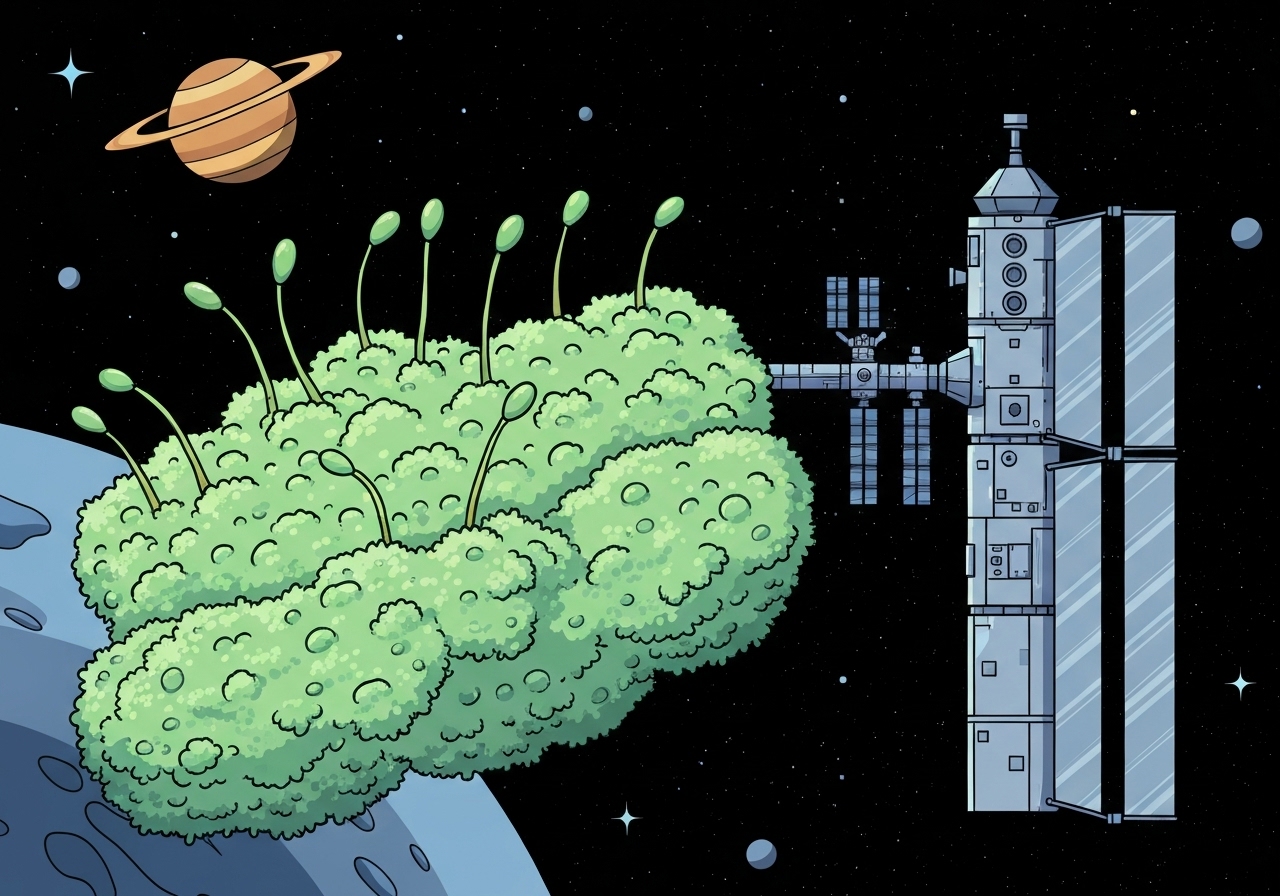
Researchers report that spores of the moss Physcomitrella patens survived at least nine months attached to the exterior of the International Space Station (ISS) and germinated after return to Earth. The samples were mounted on the Cygnus NG-17 spacecraft and exposed to ultraviolet radiation, vacuum and temperature extremes before retrieval. Space-exposed spores showed an 86% germination rate versus 97% for Earth-kept controls, though some chlorophyll degradation was detected. Authors suggest moss resilience could inform future life-support and in-situ soil-formation strategies for long-duration missions.
Key Takeaways
- Research published in the journal iScience found Physcomitrella patens spores remained viable after nine months outside the ISS attached to Cygnus NG-17.
- Space-exposed, encased spores germinated at 86% on return; Earth-control spores germinated at 97% under the same lab conditions.
- Encasement within a sporangium conferred high resistance to UVC doses exceeding 100,000 J/m2, vacuum, deep-freezing and thermal cycling.
- Chlorophyll in space-exposed samples showed measurable degradation, indicating some biomolecular damage despite high germination rates.
- Lead author Dr Tomomichi Fujita (Hokkaido University) highlights potential uses in oxygen generation, humidity regulation and initial soil formation for extraterrestrial habitats.
- Independent scientist Dr Agata Zupanska (SETI Institute) cautions that ISS exterior conditions do not fully replicate deep-space, lunar or Martian environments.
- Previous Earth-based work shows other mosses such as Syntrichia caninervis withstand simulated Mars-like conditions, supporting broader resilience across species.
Background
Mosses are recognized as pioneering terrestrial plants that colonize bare substrates and initiate soil-building processes. Physcomitrella patens (also called spreading earthmoss) is a model species in plant science because of its simple lifecycle and durable spores. Interest in hardy, low-maintenance organisms for space stems from their potential role in closed ecological systems: they need little substrate, can tolerate desiccation, and may assist with air and water regulation.
Previous experiments have sent seeds, spores and microbial samples to low Earth orbit and measured survival after exposure to vacuum, extreme temperatures and radiation. Desert moss species such as Syntrichia caninervis have survived Mars-analog tests on Earth, which helped motivate the present ISS exterior exposure. The new study aimed specifically to compare three moss structures and identify which preparations best withstand the combined stressors of the orbital environment.
Main Event
The team led by Dr Tomomichi Fujita first tested three moss preparations on Earth under simulated space stressors, including UVC radiation, vacuum and temperature extremes. They observed that spores encased in their natural sporangium were the most resilient, tolerating UVC exposure above 100,000 joules per square metre and maintaining the ability to germinate. Following these laboratory trials, researchers mounted encased spores in sample holders with varied filter configurations and sent them to the ISS aboard the Cygnus NG-17 resupply vehicle.
Holders were attached to the station’s exterior and remained exposed for nine months while the ISS orbited at approximately 400 kilometres altitude. On return, the samples were transported to laboratory conditions on Earth and rehydrated and warmed to trigger germination. All returned samples showed high germination rates; fully exposed specimens achieved an 86% germination rate compared with 97% for ground controls kept in parallel.
Although viability was high, spectral and biochemical assays detected degradation of one chlorophyll form in the space-exposed samples, a sign of molecular damage from the orbital environment. The authors note that while encasement protects spores from immediate lethality, subcellular damage may accumulate and could affect long-term growth or photosynthetic efficiency if plants were to be cultivated off Earth.
Analysis & Implications
The demonstration that moss spores can survive prolonged exposure on the ISS exterior and still germinate narrows the gap between laboratory simulations and real orbital conditions. For mission planners, durable propagules such as encased spores offer a compact payload option for transporting biological material between planetary bodies. Their low mass and dormancy capability make spores attractive candidates for early-stage biological payloads on sample-return or cargo missions.
However, survival during transport is only one requirement for off-world cultivation. Successful germination on Earth does not guarantee growth under different gravity, atmospheric composition or radiation regimes found on the Moon or Mars. The observed chlorophyll degradation signals that while spores revive, physiological performance may be impaired; any plan to use mosses for oxygen production or soil formation would need follow-up tests in controlled regolith simulants and under altered gravity.
There are also planetary protection and contamination considerations. Transporting terrestrial organisms to other worlds carries legal and ethical obligations under the Outer Space Treaty and planetary protection guidelines. Researchers and mission designers must balance the potential benefits of pioneering species for habitat support against the risk of contaminating pristine extraterrestrial environments and compromising future science.
Comparison & Data
| Condition | Germination Rate | Notes |
|---|---|---|
| Earth control (laboratory) | 97% | Baseline germination after storage/rehydration |
| ISS exterior (fully exposed) | 86% | 9 months on Cygnus NG-17; UV-exposed; some chlorophyll degradation |
| Laboratory UVC test (>100,000 J/m2) | Encased spores survived | Sporangium provided strong protection versus naked cells |
The table summarizes the core quantitative outcomes: high viability despite orbital exposure, with a measurable drop in germination and biochemical indicators of damage. These data suggest encasement is a key variable for survival; further comparative tests across species and protective matrices are needed to quantify trade-offs between viability and functional performance.
Reactions & Quotes
Lead author Tomomichi Fujita framed the results as an early proof of concept for biological resilience in space and potential utility for life-support strategies.
“While moss may not be on the menu, its resilience offers insights into developing sustainable life-support systems in space.”
Dr Tomomichi Fujita, Hokkaido University (lead author)
Independent commentary stressed the limits of extrapolating ISS-exterior survival to active off-world cultivation.
“Dormant, desiccated forms show far greater resistance than hydrated tissues, but exterior ISS exposure is not equivalent to lunar or Martian conditions.”
Dr Agata Zupanska, SETI Institute (external expert)
Both perspectives underline consensus that spore survival is a meaningful but incomplete milestone toward using plants in extraterrestrial habitats.
Unconfirmed
- Whether spores that revive after orbital exposure can establish sustained, photosynthetically productive growth under Martian or lunar gravity and atmosphere is untested.
- The long-term effects of the detected chlorophyll degradation on plant fitness and reproductive success off Earth remain unknown.
- Performance of other moss species or engineered strains in comparable conditions is still to be demonstrated.
Bottom Line
This study establishes that Physcomitrella patens spores, especially when encased in a sporangium, can survive nine months outside the ISS and still germinate on return to Earth. The finding advances our understanding of biological durability in low Earth orbit and highlights spores as compact, low-maintenance candidates for transporting living material between locations.
Nevertheless, survival is only the first hurdle. Demonstrating active growth, ecological function and safety under extraterrestrial gravity, atmosphere and planetary-protection rules will require targeted habitat trials, regolith interaction studies and rigorous contamination mitigation. For mission designers, the result is promising but preliminary: spores may be part of future bio-regenerative systems, but substantial follow-up work is essential.
Sources
- The Guardian — Moss spores survive nine-month ride outside ISS (news coverage)
- iScience (peer-reviewed journal; study published by Fujita et al.)
- SETI Institute (research institute; expert commentary from Dr Agata Zupanska)