
Lead
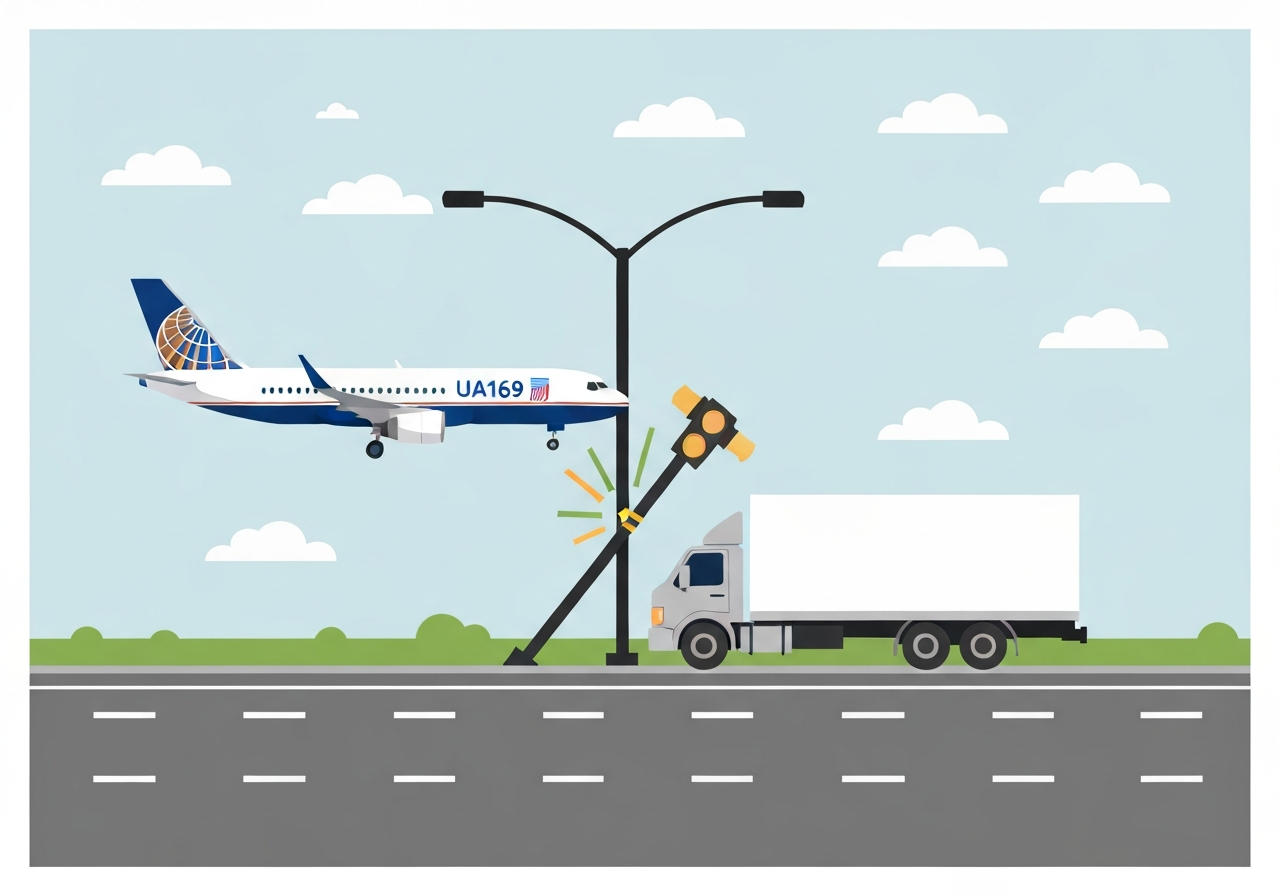
On May 3, 2026, United Airlines Flight UA169, a Boeing 767 carrying 221 passengers and 10 crew, contacted a light pole and a tractor-trailer on the New Jersey Turnpike as it approached Newark Liberty International Airport. The aircraft landed, taxied to the gate and evacuated no injured passengers; the truck driver received minor injuries and was treated and released. Dash-cam video captured debris and what appears to be landing-gear components near the truck cab just after 2 p.m. Local and federal agencies have opened investigations into how the jet came in low enough to strike roadside structures.
Key Takeaways
- Flight UA169 originated in Venice, Italy, and was on final approach to Newark Liberty International Airport when the incident occurred on May 3, 2026, just after 2:00 p.m.
- The aircraft was a Boeing 767 with 221 passengers and 10 crew; it landed safely and there were no passenger or crew injuries reported.
- State police say a tire from the landing gear and the plane’s underside struck a light pole and a tractor-trailer; the pole then hit a nearby Jeep.
- The tractor-trailer driver, identified as Warren Boardley by his employer, was taken to hospital with glass-related injuries to his arm and hand and later released.
- Runway 29 — the runway in use — is 6,725 feet long; the flight was vectored there because of windy conditions instead of the airport’s longer runways of roughly 11,000 and 9,999 feet.
- The FAA and the National Transportation Safety Board have launched probes; New Jersey State Police and the Port Authority conducted on-scene inspections and cleared the runway for normal operations.
- Dash-cam frames show what appears to be a wheel or tire component outside the truck driver’s window, prompting questions about how landing gear contacted roadside structures.
Background
Newark Liberty International Airport sits adjacent to the New Jersey Turnpike, where several highway lanes run close to approach paths for some runways. Over the years regulators and airport authorities have balanced runway use, wind conditions and approach procedures to limit overflight of highways, but shorter runways inherently leave less margin for error on final approach. On May 3, strong and shifting winds prompted air-traffic controllers to vector UA169 to Runway 29, the airport’s shortest runway, rather than the longer 11,000- and 9,999-foot runways the flight usually uses.
Modern large jets such as the 767 have published landing distance requirements that depend on weight, configuration and weather; for the 767-400 variant the recommended minimum runway distance commonly cited is just over 6,000 feet. While a 6,725-foot runway meets that minimum on paper, it reduces the safety buffer compared with longer runways and can complicate approaches that require maneuvering to align with the strip. Airports that abut highways have in the past been sites of rare but high-profile close calls, which is why investigators will examine approach profiles, runway selection, and communications between the cockpit and controllers.
Main Event
According to authorities, UA169 was on final approach to Runway 29 when its landing gear and underside struck a light pole alongside the New Jersey Turnpike. Dash-cam footage from a southbound tractor-trailer shows a sudden impact that sends glass and debris into the truck cab; frame-by-frame review appears to show a wheel or tire component just outside the driver’s window. The truck, bound for a bakery depot in Newark, was about to exit the turnpike when struck.
Port Authority and New Jersey State Police crews inspected the runway and adjacent highways for debris and structural damage; they reported runway inspections were completed and normal airport operations resumed later Sunday. The Port Authority said the aircraft taxied to the gate and passengers deplaned without injury. The truck driver, identified by his employer as Warren Boardley, was taken to hospital with cuts from glass and released after treatment, Port Authority officials said.
The airline issued a brief statement confirming UA169 made contact with a light pole on final approach, that its maintenance team was assessing aircraft damage, and that it was investigating the circumstances. Federal authorities — including the FAA — and the National Transportation Safety Board have opened formal inquiries to determine the sequence of events and contributing factors. Local law enforcement continues to work with investigators to document roadway and infrastructure damage caused by the pole strike.
Analysis & Implications
Investigators will focus on why the airliner was at an unusually low altitude over the turnpike. Potential lines of inquiry include wind and weather conditions at the time, whether the approach involved circling or vectoring that left less margin for error, and cockpit situational awareness. The dash-cam imagery showing landing-gear components near the truck makes the precise geometry of the strike key to understanding whether the landing gear itself or tire debris caused secondary damage.
Runway choice matters: Runway 29 at Newark is 6,725 feet long and lies closer to ground-level highway infrastructure than the airport’s two longer runways. While available performance numbers indicate a 767-400 can operate safely on a runway just over 6,000 feet under appropriate conditions, that leaves a smaller safety envelope for deviations in speed, glideslope or touchdown point. Pilots and controllers work within standardized landing minima, but margins shrink when weather or crosswinds require nonstandard vectors or shorter runways.
The incident will also prompt scrutiny of air traffic control instructions and whether communications and approach monitoring adhered to procedures. On the ground side, it may accelerate conversations about protective barriers, pole placement and roadway clear zones where airport approaches run close to highways. Regulators and airport operators could review whether additional mitigations — such as revised approach paths, infrastructure relocation, or supplemental visual guidance systems — are warranted to reduce the risk of future collisions.
Comparison & Data
| Runway | Length (feet) | Context |
|---|---|---|
| Runway 11 (typical) | 11,000 | One of the airport’s longer primary runways |
| Runway (other typical) | 9,999 | Commonly used for long-haul arrivals |
| Runway 29 (used on May 3) | 6,725 | Shortest runway; closest to turnpike |
| Recommended 767-400 minimum | ~6,000+ | Published performance minima depend on weight and conditions |
The table shows Runway 29’s noticeably shorter length compared with the airport’s other primary runways. That gap helps explain why pilots and controllers face different constraints when using Runway 29: performance margins tighten and approach geometry may be more complex. Investigators will compare the flight’s actual touchdown point and approach profile against the expected parameters for a fully compliant landing on that runway under the day’s weather.
Reactions & Quotes
Officials, aviation experts and travelers reacted with relief that the incident did not lead to serious injuries, but with questions about how a large jet contacted roadside infrastructure during a routine arrival.
“The question investigators are going to want to understand is, how did that happen? Why was the plane too low?”
Kris Van Cleave, CBS News senior transportation correspondent
Van Cleave emphasized the investigative focus on approach profile and contributing environmental or human factors. Experts noted that a shorter runway increases the need for precise touchdown and alignment, particularly in windy conditions.
“I would consider this runway to be relatively short,”
Robert Sumwalt, former NTSB chair, retired captain
Sumwalt described the approach as challenging and said pilots would be motivated to avoid landing long on a shorter strip, which can increase pilot workload during final descent. Local officials also expressed relief that no passengers were hurt.
“I’m grateful the aircraft landed safely, and all passengers and crew are unharmed,”
Gov. Mikie Sherrill (statement)
Unconfirmed
- Whether crosswind or gusting conditions directly caused the aircraft to fly lower than the published glideslope has not been confirmed by investigators.
- Precise identification of the struck component (tire, wheel assembly, or part of the gear bay) remains unverified pending technical inspection of the aircraft and debris.
- Any potential role of air-traffic control instructions or radar vectoring in the aircraft’s path is under review but not yet established.
Bottom Line
The May 3, 2026 incident involving United Flight UA169 is an uncommon but serious reminder of how airport layout, runway selection and weather can compress safety margins. That a large jet made contact with a light pole and a roadway vehicle without fatalities underscores both the element of luck and the robustness of aircraft structural survivability and emergency procedures. Investigations by the NTSB, FAA, New Jersey State Police and the Port Authority will aim to establish a clear chain of events — from weather and ATC decisions to pilot technique and any mechanical factors.
Depending on findings, the case could lead to operational changes at Newark Liberty and similar airports: revised routing, additional visual guidance, infrastructure adjustments or updated pilot procedures for short-runway approaches. For travelers and policymakers, the key near-term priority is transparent investigative reporting and targeted mitigations that lower the likelihood of any repeat occurrence.