
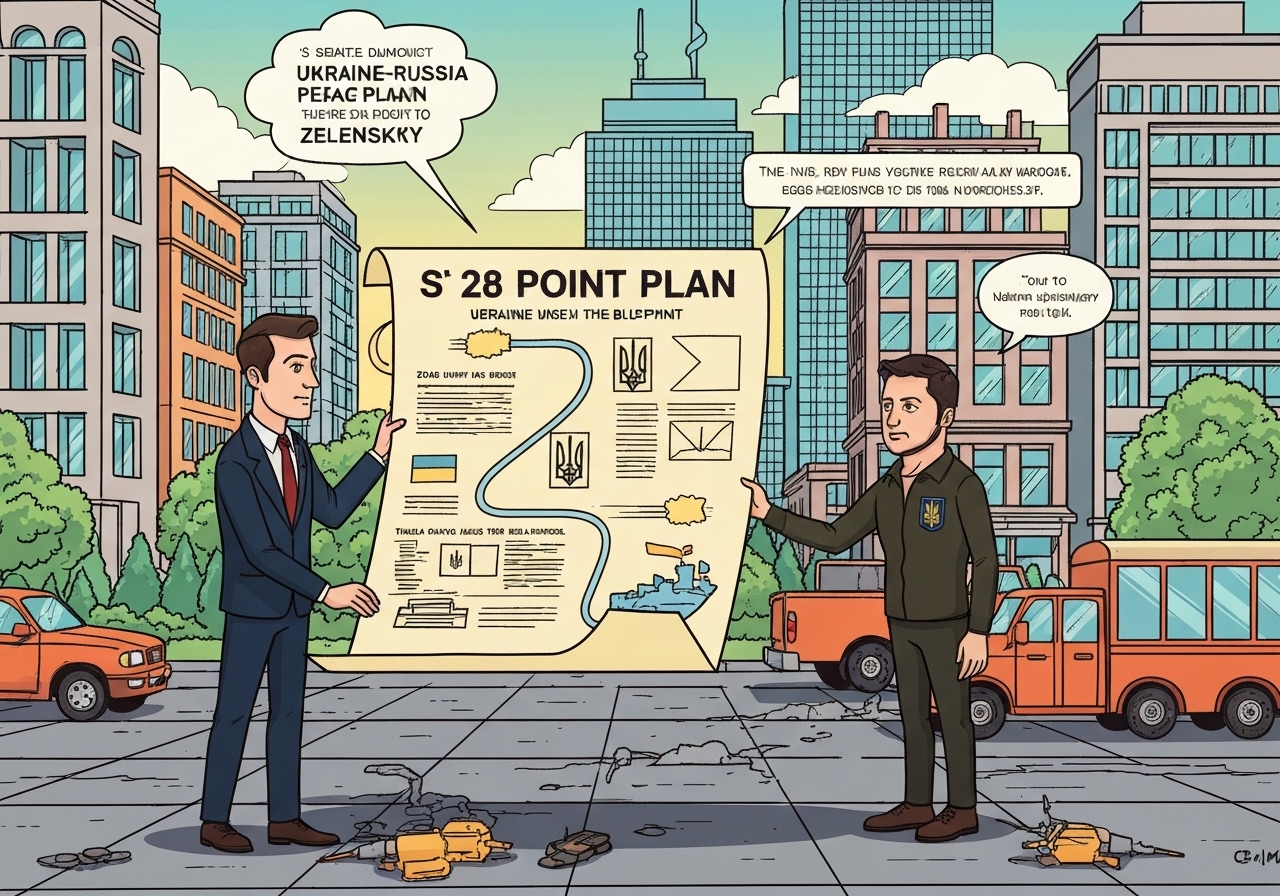
Lead: The Trump administration presented a 28-point draft peace proposal to Ukrainian President Volodymyr Zelenskyy in Kyiv on Thursday that would require substantial concessions from Kyiv while offering NATO-style security guarantees, a senior U.S. official told ABC News. The draft, created by special envoy Steve Witkoff with input from Secretary of State Marco Rubio and White House advisers, remains subject to change. Kyiv was presented with a package that ties territory and military limits to legal guarantees, reconstruction funding and staged reintegration of Russia into the global economy.
Key Takeaways
- The draft contains 28 numbered provisions and was presented to President Zelenskyy in Kyiv on Thursday; it is still a working draft and could be revised.
- The plan would cap the Ukrainian Armed Forces at 600,000 personnel and require constitutional language barring future NATO membership (provisions 6–7).
- It proposes NATO-style security guarantees: the U.S. and European allies would treat a future attack on Ukraine as an attack on the transatlantic community (provision 5 and related articles).
- Territorial clauses include de facto recognition of Crimea, Luhansk and Donetsk as Russian and a frozen line for Kherson and Zaporizhzhia (provision 21).
- An economic package would use $100 billion of frozen Russian assets for Ukraine reconstruction; the U.S. would allegedly receive 50% of profits from a U.S.-led investment vehicle (provision 14).
- Sanctions and recognition clauses are conditional: global sanctions would be reinstated and recognition revoked if Russia violates the deal; guarantees could be voided if Ukraine attacks Russia without cause (provision 10).
- The draft calls for Ukraine to hold elections in 100 days and for full amnesty for wartime actions, enforced by a Peace Council to be headed by President Donald J. Trump (provisions 25–27).
Background
The proposal arrives against a decade-long struggle over Ukraine’s sovereignty that escalated dramatically after Russia’s full-scale invasion. Ukrainian leaders, led by President Zelenskyy, have repeatedly sought long-term collective defense guarantees from NATO and partners; those requests shape Kyiv’s response to any settlement that limits NATO prospects. Previous attempts to resolve parts of the conflict—most notably diplomatic accords and ceasefires—have left unresolved territorial, security and political questions that this draft explicitly attempts to settle.
The U.S. role in drafting and brokering a settlement has been politically prominent; the plan cited was prepared by Steve Witkoff with input from senior U.S. officials, including Secretary of State Marco Rubio, according to U.S. sources. The document mixes security guarantees, territorial arrangements, economic incentives and institutional mechanisms—aiming to tie immediate ceasefire steps to long-term reconstruction and reintegration frameworks for Russia.
Main Event
U.S. officials presented the 28-point draft to Zelenskyy’s team in Kyiv on Thursday after consultations with senior Ukrainian officials, including Rustem Umerov, a senior member of Zelenskyy’s administration who reportedly negotiated modifications before the presentation. U.S. officials describe the plan as a package that trades territorial and military concessions for binding security guarantees and a comprehensive reconstruction program.
Key security features in the text would cap Ukraine’s armed forces at 600,000 personnel and enshrine in Ukraine’s constitution a pledge not to join NATO, while NATO would include a reciprocal statutory or procedural provision barring future admission. The draft also states NATO would not station troops in Ukraine, although it envisions European fighter jets being based in Poland.
On economy and reconstruction, the draft assigns $100 billion of frozen Russian assets to U.S.-led rebuilding efforts in Ukraine, with Europe contributing an additional $100 billion; it further proposes staged unfreezing of other funds and joint U.S.-Russian investment vehicles. The package also specifies staged lifting of sanctions on Russia and an invitation to rejoin the G8 contingent on implementation.
Territorial items are explicit: Crimea, Luhansk and Donetsk would be treated as de facto Russian; Kherson and Zaporizhzhia would be frozen along current contact lines; and a demilitarized withdrawal zone in parts of Donetsk would be recognized as Russian territory. Humanitarian provisions include an “all for all” prisoner exchange and an obligation to return civilian detainees and children.
Analysis & Implications
If adopted in anything like its current form, the draft would represent a major recalibration of the international security order in Europe. A constitutional bar on NATO membership and formalized territorial concessions would close avenues Kyiv has long pursued for collective defense and Western integration. For Ukraine, those trade-offs raise immediate sovereignty and democratic-accountability questions: constitutional changes and territorial settlements typically require broad domestic consensus, which may be difficult to secure under duress or amid occupation.
The NATO-style guarantee described—framed as treating an attack on Ukraine as an attack on the transatlantic community—aims to provide deterrence without full NATO accession. However, translating that language into reliable, rapid military assistance will depend on legally binding commitments, political will among Western capitals, and clear triggers for action. The draft’s clauses that void guarantees if Ukraine acts offensively (or if its forces cross certain thresholds) create enforcement asymmetries that could constrain Kyiv’s defensive options.
Economically, the proposed use of frozen Russian assets to fund reconstruction and the staged reintegration of Russia into major international forums (including a return to the G8) are designed to create incentives for long-term compliance. Yet these measures risk domestic and international pushback: diverting seized assets and sharing profits with U.S. entities, plus conditional sanction relief, will provoke legal, political and moral debates in donor countries and among Ukrainians who have suffered war losses.
Finally, the plan’s governance architecture—creating a Peace Council led by President Trump and a U.S.-Russian working group—raises questions about impartiality and enforcement. Monitoring, verification, dispute resolution and remedial sanctions will all be critical; without transparent, multilateral oversight, the plan could leave leverage concentrated in a few capitals rather than in international institutions.
Comparison & Data
| Provision | Draft (this plan) | Precedent / Past frameworks |
|---|---|---|
| Security guarantee | NATO-style collective guarantee by U.S. & Europe | Article 5 (NATO) — full alliance mutual defense |
| NATO membership | Ukraine to constitutionally renounce NATO accession | Minsk agreements avoided NATO membership language; Bucharest 2008 invited future admission |
| Territory | De facto recognition of Crimea, Luhansk, Donetsk; frozen lines for Kherson/Zaporizhzhia | Previous accords sought ceasefires and withdrawal but did not recognize annexation |
| Reconstruction funding | $100B frozen Russian assets + $100B European contribution | International packages (World Bank, EU) but no single U.S.-led asset reallocation of this scale |
The table highlights how the draft attempts to combine novel security guarantees with territorial settlements and an unprecedented use of frozen assets for reconstruction. That combination departs from earlier diplomatic efforts by linking recognition and reintegration to a sealed set of economic and legal mechanisms.
Reactions & Quotes
“This plan was crafted to reflect the realities of the situation…to find the best win-win scenario,” a White House spokesperson told ABC News, framing the draft as balanced for all sides.
White House press secretary (statement to ABC News)
“I had a very serious conversation with U.S. officials who laid out a vision for ending the war,” President Volodymyr Zelenskyy said in an evening address, adding that teams would work on proposals to ensure any peace is “real.”
Volodymyr Zelenskyy (address)
A senior U.S. administration official described the document as a draft drawn up after consultations with Rustem Umerov and other Ukrainian officials, noting Umerov “agreed to the majority of the plan” after changes.
Senior U.S. administration official (on background)
Unconfirmed
- Whether President Zelenskyy has agreed to the draft’s final language; U.S. officials say teams will continue working on proposals.
- How the proposed $100 billion allocation of frozen Russian assets would be legally authorized and distributed across projects and countries.
- The detailed legal form and triggers of the NATO-style guarantee and how quickly military support would be mobilized if it were invoked.
- Whether Russia will accept the territorial and legal terms as written or seek modifications in follow-up negotiations.
Bottom Line
The 28-point draft is a comprehensive, high-stakes attempt to convert battlefield outcomes into a negotiated peace that couples Ukrainian concessions with Western security assurances and large-scale reconstruction financing. If implemented, it would reshape Ukraine’s security choices, formalize territorial outcomes that Kyiv has resisted, and create new mechanisms for Russia’s phased economic reintegration.
Key questions remain about enforceability, Ukrainian domestic legitimacy, and the political will among U.S. and European partners to underwrite guarantees and long-term reconstruction. Observers should watch negotiation timelines, legal draft texts for guarantees, parliamentary or referendum steps in Ukraine, and any changes in the sanctions-unfreeze timetable as immediate indicators of whether a durable agreement is achievable.
Sources
- ABC News — media outlet; draft text and reporting (article obtained by ABC News).