
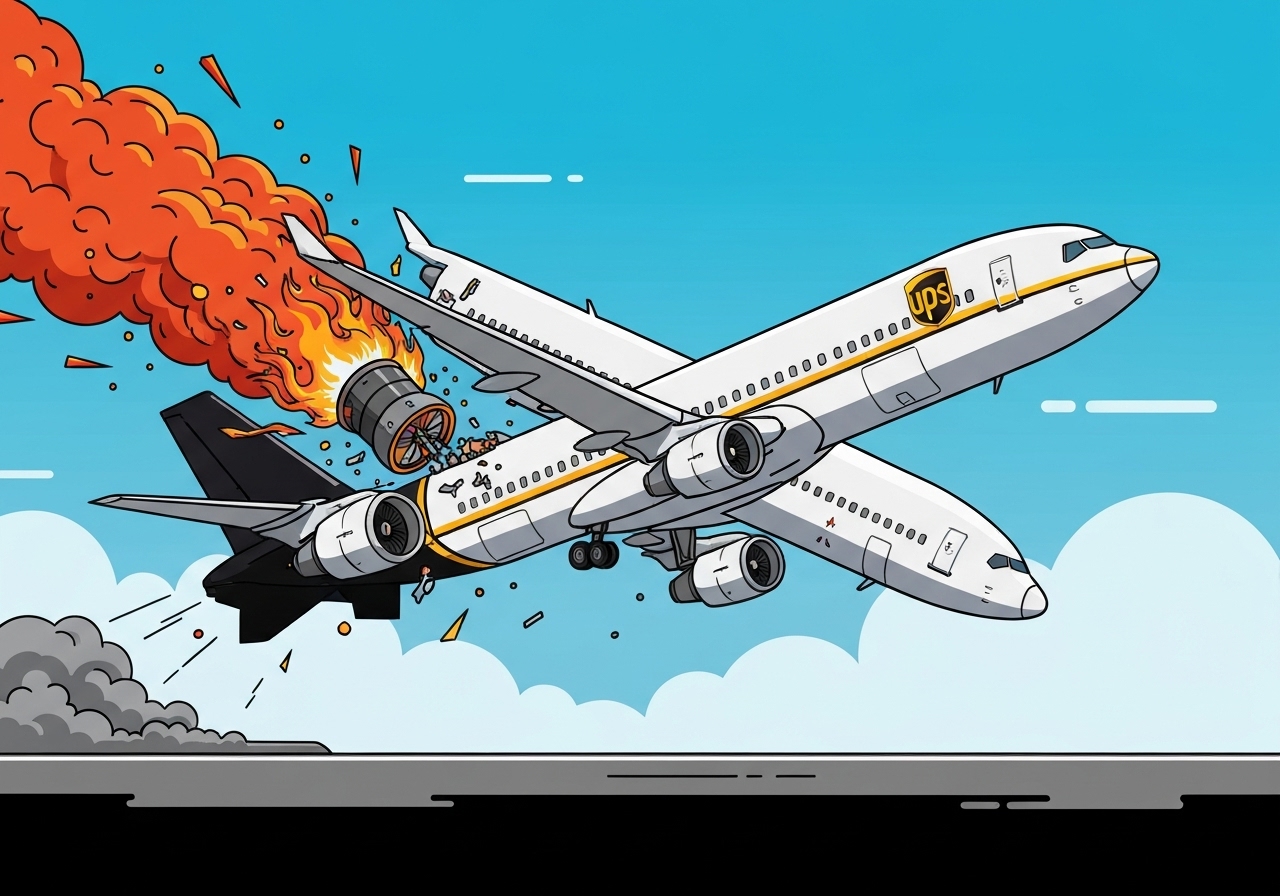
Lead: Federal investigators on Thursday released a sequence of airport surveillance images showing a UPS cargo jet shedding an engine and erupting into flames during takeoff at Louisville. The preliminary National Transportation Safety Board (NTSB) report and photos document the engine separating, fire spreading, and the aircraft becoming airborne before it later crashed in a massive explosion. The Nov. 4 accident killed 14 people, including the three crew members, and caused widespread damage near Louisville’s airport. Authorities are focusing on evidence of cracks in the left wing’s engine mount as they continue the probe.
Key Takeaways
- Six surveillance photos released by investigators show an engine detaching from the aircraft during takeoff, followed by fire on the wing and a blazing engine falling away.
- The incident occurred on Nov. 4 at Louisville, Ky.; the crash subsequently killed 14 people, including three crew members, and damaged nearby buildings.
- The NTSB preliminary report cites signs of cracks in the left-wing engine mount as a point of investigation.
- Video and images show the burning aircraft briefly airborne, leaving trails of smoke before impacting a populated area near the airport.
- Investigators recovered multiple component fragments and are analyzing debris to determine the sequence of structural failures.
- Comparisons in the report noted a visual resemblance to imagery from the 2000 Air France Concorde accident outside Paris; investigators stress each accident has distinct causes.
Background
The UPS freighter involved in the Nov. 4 accident was operating a cargo service out of Louisville, a major logistics hub with dense ground infrastructure near its runways. The aircraft type, its maintenance records and the specifics of the cargo manifest are central to the inquiry because engine and mounting structures are subject to regular inspection cycles in commercial freighter operations. Historically, catastrophic failures during takeoff—though rare—have outsized consequences because aircraft are low and slow and over or near populated zones. Regulators and carriers maintain strict inspection and reporting rules for engine mounts and related structures precisely to mitigate those risks.
The NTSB typically issues a preliminary report that presents raw evidence and initial observations, with a full probable-cause determination arriving months later after metallurgical tests and flight-data analysis. In this case, the agency released photo frames from airport surveillance video alongside the early findings to document the visible sequence of events. Multiple stakeholders are involved in the follow-up work: the NTSB as lead investigator, the Federal Aviation Administration for regulatory context, the aircraft and engine manufacturers for technical analysis, and the carrier for maintenance records and operational data.
Main Event
According to the images and the preliminary NTSB release, the sequence begins with the engine on the left wing showing a sudden separation as the plane accelerated for takeoff. The first frame in the released set captures a component failing to remain attached; the next frames show flames erupting near the separation point. One frame depicts the detached engine enveloped in fire and moving away from the wing while the airframe is still in the takeoff roll or just lifting off.
Subsequent frames show the aircraft briefly airborne with visible fire and smoke streaming from the left wing area; trails of dark smoke are evident as the airplane climbs away from the runway. Witness videos and further surveillance clips included in the investigative package depict the burning airplane continuing beyond the airport perimeter and then crashing into structures, producing a large explosion and plume of smoke that could be seen for miles.
Investigators recovered fragments from the scene and included photos of component pieces in the preliminary report. Early forensic attention has centered on the left-wing engine mount, where the report notes evidence consistent with cracking. That structural joint carries enormous loads during engine operation and takeoff; any preexisting defect or undetected fatigue could permit separation under stress. Authorities have said the probe remains active and that more detailed metallurgical and data-driven work is required to determine the exact failure chain.
Analysis & Implications
The visible detachment of an engine in flight is an acute failure mode that immediately alters an airplane’s aerodynamics and structural load paths. Even on large multi-engine freighters designed to fly safely with one engine out, an unplanned separation—especially if accompanied by fire and damage to control surfaces or fuel systems—can overwhelm crew response options. The images suggest a cascade: structural failure, ignition, and loss of controllability before impact.
From a regulatory and industry perspective, the finding of cracks in an engine mount raises questions about inspection intervals, detection capabilities for fatigue cracks, and whether current non-destructive testing methods are sufficiently sensitive. If testing reveals a systemic maintenance or design vulnerability, regulators could mandate more frequent inspections, design reinforcements, or service bulletins from manufacturers. Such actions have operational and economic implications for carriers that rely on timely aircraft availability.
There are broader safety-system ramifications as well. Airports adjacent to industrial and residential areas face higher risks when heavy aircraft suffer catastrophic failures on departure. The accident underscores the continuing tension between locating large logistics operations near population centers for efficiency, and managing the residual risk of low-altitude aircraft accidents during critical flight phases. Emergency response and urban planning around airports may receive renewed scrutiny as communities and regulators review resilience and zoning policies.
Comparison & Data
| Event | Date | Key similarity |
|---|---|---|
| UPS cargo jet (described images) | Nov. 4 | Engine separation and subsequent fire during takeoff; images show rapid escalation |
| Air France Concorde (referenced) | 2000 | Stricken aircraft images captured shortly after takeoff; widely referenced for visual similarity |
The table highlights visual parallels investigators and press observers noted between the Louisville frames and historical accident imagery. It does not imply identical causes; accident investigations routinely find different root causes even when initial visuals appear similar. Analysts caution against drawing technical conclusions from photographs alone without accompanying flight-data, maintenance, and metallurgical analyses.
Reactions & Quotes
The NTSB released the images as part of its preliminary package to document observable events; the agency emphasized the work is ongoing and preliminary observations should not be construed as final findings.
“Preliminary images show an engine separating and fire on the left wing during takeoff.”
National Transportation Safety Board (preliminary report)
That excerpt summarizes the material the NTSB made public; the agency continues to process flight-data recorder information and conduct metallurgical examinations. The release of visual evidence aims to be transparent while the technical analysis continues.
UPS and local officials responded to the loss by coordinating recovery and family assistance; company spokespeople have typically expressed condolences and stated cooperation with investigators in similar cases.
“We are deeply saddened by the loss of life and are cooperating fully with investigators.”
UPS (company statement)
The carrier’s statement frames its immediate priorities: support for victims’ families and cooperation on technical fact-finding. Corporate cooperation is standard practice in investigations involving commercial operators.
Aviation-safety specialists note that an engine mount failure can lead to abrupt and catastrophic consequences if accompanied by fire or secondary structural damage.
“A failed engine mount can trigger rapid structural and control-system complications that challenge any crew’s options during takeoff.”
Aviation safety consultant (expert commentary)
Experts urge caution about drawing conclusions until the full NTSB probable-cause report is issued, but they underscore the importance of thorough metallurgical testing and record review in such accidents.
Unconfirmed
- No final probable-cause determination has been issued; the role of the cracked engine mount remains under technical review and is not yet legally established.
- Public reports have not confirmed whether maintenance records showed prior indications or if any service bulletins were outstanding for the specific aircraft or engine model.
- Details about whether fuel or other systems were compromised prior to impact have not been confirmed pending laboratory analysis of recovered components.
Bottom Line
The released photos provide a stark visual record: an engine detaching, fire erupting, and the aircraft continuing briefly before a fatal crash. Those frames are an important piece of evidence but are only one element of a full investigative mosaic that includes flight-data, maintenance history, metallurgical tests, and witness statements. The NTSB’s identification of cracks in the left-wing engine mount in its preliminary notes highlights a plausible mechanical pathway, but investigators need lab results to confirm causation.
For regulators and operators, the incident will likely prompt detailed reviews of inspection practices for engine mounts and related structural components. Communities near airports may also press for renewed assessments of risk mitigation and emergency preparedness. Ultimately, the full technical report expected later will determine whether procedural, design, or maintenance changes are required to reduce the odds of a similar tragedy.