
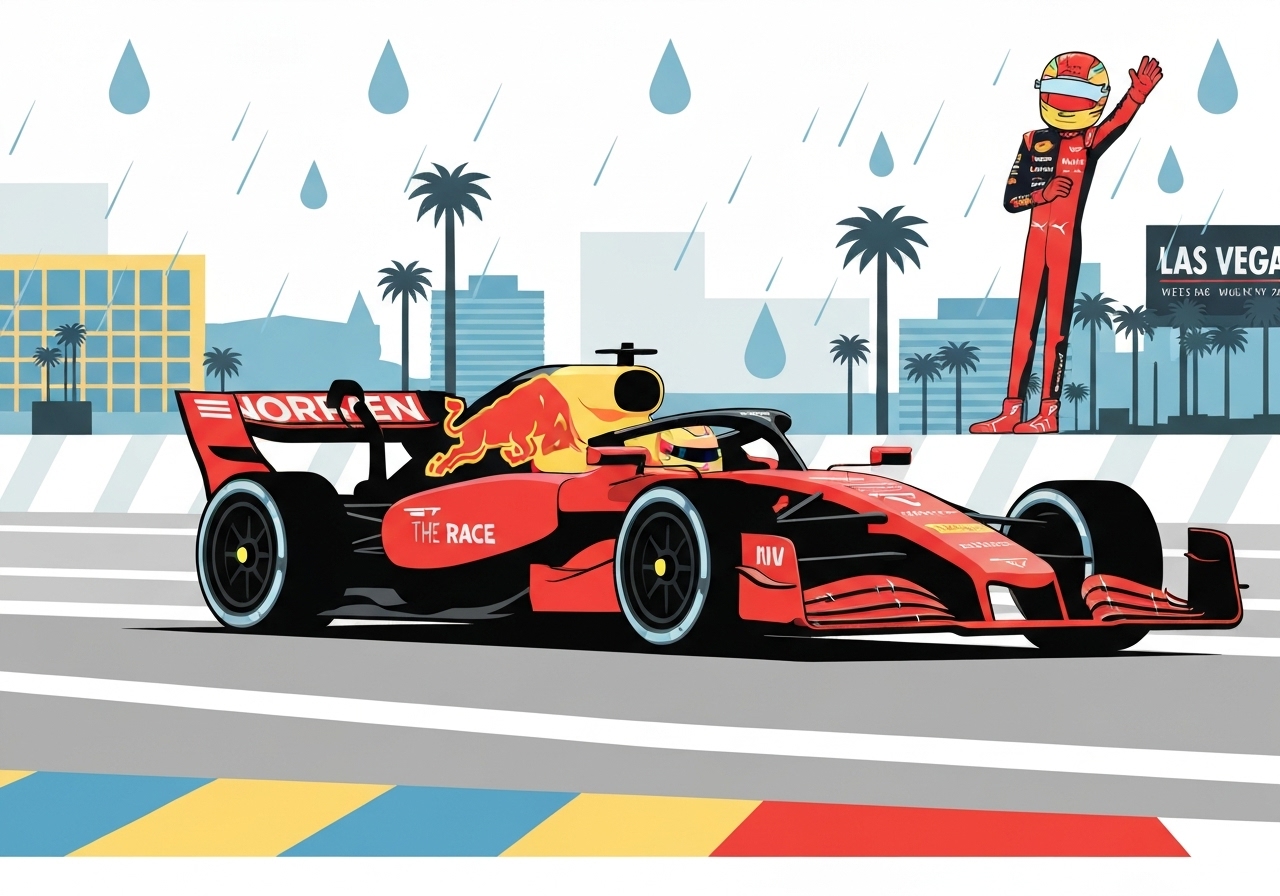
Lando Norris took pole position for the 2025 Las Vegas Grand Prix after a rain-affected qualifying session that reshaped expectations on a drying track. The McLaren driver delivered a decisive final lap to beat Max Verstappen by 0.323 seconds, claiming his third consecutive pole. The session featured mixed tyre calls, on-track incidents and stewards’ checks that left the grid and strategy questions unsettled heading into the race. Several teams — notably Mercedes and Aston Martin — faced technical or tactical setbacks that influenced their starting positions.
Key Takeaways
- Lando Norris (McLaren) claimed pole in Las Vegas, 0.323s clear of Max Verstappen (Red Bull), marking Norris’s third straight pole.
- McLaren had shown a misleading pace in FP3 (19th and 20th) before rain and an intermediate-tyre switch improved their qualifying prospects.
- Max Verstappen recorded second and said the RB21 felt stronger on the extreme wet tyre used extensively in Q1 and Q2.
- Carlos Sainz finished third for Williams but is under investigation for an unsafe rejoin in Q1 that affected Lance Stroll.
- George Russell was fastest in Q1 and Q2 but was nearly 0.9s adrift of pole in P4 after reporting a power-steering issue in Q3.
- Aston Martin’s tyre switch to intermediates late in Q2 cost them track time; Lance Stroll qualified 12th while Fernando Alonso took seventh.
- Lewis Hamilton, Alex Albon and Kimi Antonelli were eliminated in Q1; Hamilton’s exit was described as particularly calamitous.
Background
The Las Vegas Grand Prix arrived late in the 2025 season with title momentum favouring drivers who can manage changing conditions. Wet sessions earlier in the weekend and periodic rain between final practice and qualifying made tyre choice and timing decisive factors for teams. Historically, Las Vegas’s street circuit amplifies the consequences of small setup or timing errors because runoff is limited and walls are close. The weekend was already notable for strategic gambles on wet versus intermediate tyres, a theme that would decide who advanced through the knockout qualifying rounds.
McLaren’s low FP3 placings (19th and 20th) initially suggested a struggle, but the return of rain and the team’s move to intermediates in the closing phase of qualifying proved transformative. Several front-running teams experimented with the full wet tyre in Q1 and Q2 before some switched to intermediates as the track evolved. That mix of choices created a chaotic session where timing of banker laps and getting tyres up to temperature were as important as outright car balance. Off-track administrative issues also emerged: Mercedes was summoned over missing set-up sheets, a matter later attributed to an IT transmission problem from the team to the FIA.
Main Event
Q1 and Q2 were dominated initially by teams on the full wet tyre; Aston Martin was first to send both cars out on that rubber and reaped early gains. George Russell posted the fastest times in Q1 and Q2 for Mercedes, but the advantage did not translate into Q3 pace after he reported a power-steering fault. As the session progressed and the line dried, teams that switched to intermediates at the right moment gained an edge, with McLaren’s Norris and teammate Oscar Piastri fighting for top times in the mid part of Q3.
Norris and Piastri exchanged fastest laps through the middle of Q3, but Norris managed the evolving conditions better and produced a strong final effort. Max Verstappen had been quickest at one point on the same lap sequence, yet Norris was almost a second faster through the first two sectors and, despite a moment in the final sector on his last tour, still posted a 0.323s advantage. Piastri, attempting to respect a yellow flag at Turn 12, backed off on his last run and ultimately could not complete a final timed lap, slotting into P5.
Carlos Sainz put Williams into an impressive third on the grid, but race control opened an inquiry after replays showed him rejoining the track in front of Lance Stroll during Q1, forcing Stroll onto a compromised line through Turn 5. Alex Albon struck the wall on his last Q1 lap, breaking his front-right suspension and ensuring he could not progress, while Lewis Hamilton’s Q1 exit was chaotic: he clipped a bollard that lodged beneath his front wing and crossed the line near the chequered flag but then slowed after seeing the session-end light. That sequence saw Hamilton eliminated in 20th.
Stewards called Mercedes to explain missing set-up paperwork for Russell and Kimi Antonelli; the team later said the sheets had been sent but an IT fault prevented the FIA from receiving them. The stewards’ involvement, Sainz’s pending investigation and several on-track incidents left the paddock with procedural questions as well as sporting ones ahead of the race.
Analysis & Implications
Norris’s pole in mixed conditions underscores McLaren’s growing competence in low-grip scenarios and their operational execution when track conditions change quickly. The team’s poor FP3 showing may have masked a deliberate long-run focus or simply reflected a setup that was unsuited to drying conditions; either way, the qualifying outcome shows McLaren and Norris adapted fastest. For the title picture, starting ahead of Verstappen gives Norris a strategic advantage into the first corners and potential control over early tyre choices if rain returns for the race.
Red Bull’s Verstappen showed the RB21 remains competitive in wet-running trim, particularly on the extreme wet tyre used early in qualifying. That suggests Red Bull can match McLaren in outright grip when conditions are fully damp, but the team’s performance dropped relative to McLaren as the track evolved toward intermediate conditions. If race-day weather remains changeable, Red Bull’s ability to extract performance on both wet and intermediate compounds will be central to their tactical approach.
Mercedes’s situation is more concerning: Russell topped Q1 and Q2 but then lost nearly nine tenths to pole in Q3 while citing a power-steering issue. Reliability or electronic gremlins at crucial times can negate outright pace, and the stewards’ summons over the paperwork added a distraction. Aston Martin’s mixed tyre calls — early commitment to wets then a late switch to intermediates — illustrate how marginal timing decisions can cost track temperature and lap time, leaving them further down the grid than expected.
Comparison & Data
| Pos | Driver | Team |
|---|---|---|
| 1 | Lando Norris | McLaren |
| 2 | Max Verstappen | Red Bull |
| 3 | Carlos Sainz | Williams |
| 4 | George Russell | Mercedes |
| 5 | Oscar Piastri | McLaren |
| 6 | Liam Lawson | Racing Bulls |
| 7 | Fernando Alonso | Aston Martin |
| 8 | Isack Hadjar | Racing Bulls |
| 9 | Charles Leclerc | Ferrari |
| 10 | Pierre Gasly | Alpine |
The table highlights how mixed conditions shuffled the grid versus practice running; McLaren’s Norris and Piastri showed low practice pace but high qualifying performance. The 0.323s gap to Verstappen and Russell’s near-0.9s deficit to pole underline how quickly session dynamics shifted. Teams that managed tyre warm-up and timing of tyre changes scored the biggest gains in position. Several mid-field names capitalised on the variable conditions to secure strong starting slots, complicating strategy lines for race day.
Reactions & Quotes
Max Verstappen reflected on tyre behaviour after qualifying and noted the RB21’s comparative strengths on wetter rubber, while acknowledging Norris’s superior final lap in changing conditions. His comment framed Red Bull’s hope that race conditions could still play to their strengths if rain returned. The exchange highlighted contrasting tyre windows between the front-running teams.
The RB21 felt more competitive on the extreme wet tyre today — we were closer early but the track then shifted.
Max Verstappen / Red Bull
George Russell and Mercedes described a hardware issue that compromised their Q3 push, explaining why the car could not convert Q1/Q2 speed into a top qualifying slot. Team engineers will review telemetry to identify whether the fault was electronic or mechanical and whether changes are needed for the race. The incident emphasises how transient problems can have outsized sporting consequences.
I experienced a power-steering issue during Q3 which cost me time on the final lap.
George Russell / Mercedes
The FIA opened an investigation into Carlos Sainz’s Q1 rejoin that impeded Lance Stroll, a procedural review that could lead to a post-session penalty. The inquiry is focused on safety and whether Stroll was forced onto a compromised line while on a fast lap. The outcome could alter the final grid or draw reprimands that influence race-day strategy.
Stewards are examining an unsafe rejoin during Q1 involving Carlos Sainz and Lance Stroll.
FIA Stewards (investigation)
Unconfirmed
- The precise technical root cause of Mercedes’s Q3 power-steering problem has not been publicly confirmed by the team.
- The stewards’ final decision on Carlos Sainz’s alleged unsafe rejoin in Q1 is pending and could alter grid positions or carry penalties.
- Whether McLaren’s FP3 low running (19th/20th) was a deliberate setup/long-run programme or an indicator of earlier problems has not been clarified by the team.
Bottom Line
Lando Norris’s pole in Las Vegas is a significant statement of McLaren’s capacity to perform under shifting conditions and gives the championship leader an ideal starting platform for the race. The session exposed how quickly fortunes can change when rain returns, with tyre selection, timing and small technical faults deciding who advances and who is left to recover from the back. Teams that misjudged the switch from extreme wet to intermediate tyres — or suffered late technical issues — face a strategic uphill task on race day.
Several procedural and investigatory threads remain open: Mercedes’s paperwork/IT matter, Sainz’s Q1 rejoin inquiry and the exact causes of Hamilton’s and Albon’s Q1 exits. Those outcomes, plus the race-day weather and first-lap traffic on a tight street circuit, will shape whether Norris can convert pole into maximum points or whether the mix of teams behind him can exploit variable conditions to turn the order on its head.
Sources
- The Race — motorsport news report