
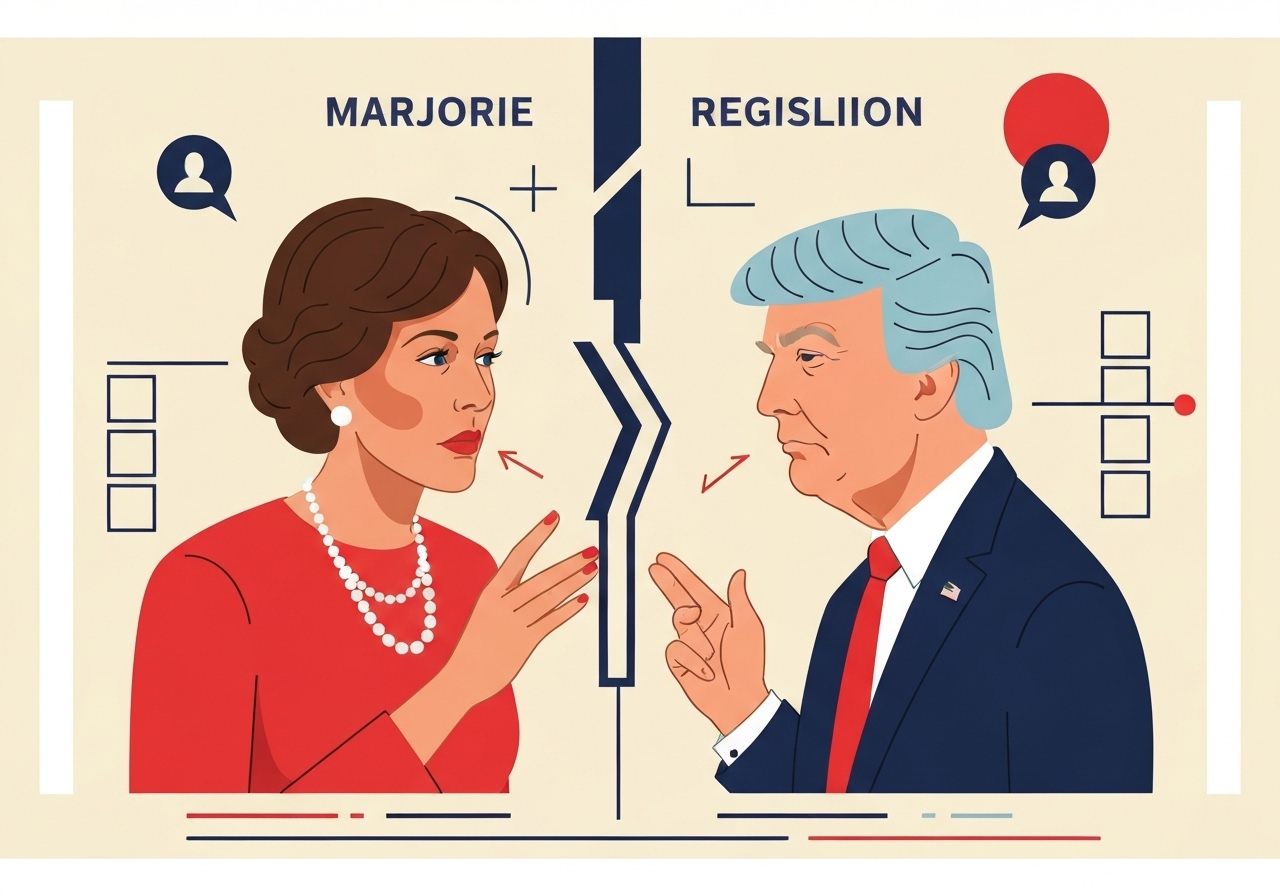
Rep. Marjorie Taylor Greene, a Republican from Georgia, announced in November 2025 that she will leave Congress in January 2026, stepping down before her current term ends. The move followed a widening public split with former President Donald Trump after Greene pressed for release of federal files tied to Jeffrey Epstein and pursued policy positions at odds with Trump’s recent stances. Greene framed her exit as a way to spare northwest Georgia’s 14th Congressional District a painful primary fight and to avoid dividing voters who backed both her and Trump. Her resignation crystallizes a rare public rupture between a prominent Trump ally and the former president at a volatile moment for the GOP.
Key Takeaways
- Marjorie Taylor Greene announced she will leave Congress in January 2026, before her term expires, citing the need to avoid a divisive primary in Georgia’s 14th District.
- Greene publicly pressed for full release of two federal investigatory file sets on Jeffrey Epstein, helping force a House vote that earned near-unanimous support and prompted Trump to reverse his prior stance.
- Donald Trump publicly rebuked Greene before the reversal, calling her “Marjorie Traitor Greene,” and said she had “changed politically” in recent weeks.
- Greene has recently criticized several of Trump’s policies — calling the war in Gaza a genocide, opposing strikes on Iranian nuclear facilities, and urging extension of expiring health subsidies — even as she maintains core America First and anti-elite principles.
- The 14th District of northwest Georgia remains heavily conservative; local party leaders say many constituents prioritize taxes, health-care costs and economic issues over national feuds.
- Political strategists weigh whether Greene’s shift is a genuine change in approach, a bid to broaden appeal to women, or a recalibration ahead of possible future statewide runs.
Background
Greene rose to national prominence during the 2020 campaign by using combative rhetoric, high-visibility stunts and staunch support for then-presidential candidate Donald Trump. Her early tenure was marked by inflammatory online posts and associations with conspiracy movements, which made her a polarizing figure both inside Congress and in public debate. Those outsider credentials and “America First” positioning helped her win a strongly conservative northwest Georgia seat—District 14—which remains one of the most Republican districts in the country.
Over time Greene’s public persona evolved from shock-politics provocateur to a lawmaker more focused on certain policy fights, notably oversight of alleged misconduct by powerful individuals. That evolution has included appearances on mainstream outlets such as ABC’s The View and more prominent engagement with advocacy by abuse survivors. Still, she has not fully renounced several of her prior controversial positions, including unproven claims about widespread 2020 election fraud, leaving her record mixed in the eyes of both supporters and critics.
Main Event
In the weeks before her resignation announcement, Greene became one of a small group of House Republicans who pressed for release of two federal case files related to Jeffrey Epstein. Her persistent public demands forced a floor vote to make the documents available, a process that ultimately produced near-unanimous congressional support and a reversal by Trump on his earlier reluctance to disclose the materials. Greene framed that push as defending victims who were minors when abused and trafficked.
Trump’s response was sharply critical at first: he publicly labeled her “Marjorie Traitor Greene” and said she had “changed politically” over the preceding month or two. Greene rebutted that criticism directly, saying she had fought for Trump in the past but would not be branded a traitor for siding with survivors. She also stood publicly alongside women who say they were abused by Epstein, using the visibility to press the transparency case.
The rift widened because Greene has also moved into public criticism of several of Trump’s policy choices. She characterized the war in Gaza as a genocide, criticized U.S. strikes on Iranian nuclear facilities, and urged extension of expiring health-insurance subsidies to prevent premium spikes that would affect families in her district. Those stances placed her at odds with parts of Trump’s foreign- and domestic-policy messaging and sharpened the sense of estrangement.
Locally, party activists and voters reacted with a mix of confusion and cautious pragmatism. Some Georgia Republican operatives said Greene remains closely aligned with district priorities on taxes and health care, while others said the split with Trump creates a new opening for challengers if she had not chosen to resign. Political commentators noted the resignation itself was unexpected and leaves open questions about both Greene’s political future and the GOP’s post-Trump identity.
Analysis & Implications
Greene’s resignation matters for three interlocking reasons: it underscores internal strains in the Republican coalition built around Trump; it highlights the political salience of Epstein-related transparency; and it illustrates the dilemma faced by populist outsiders who become institutional actors. Her willingness to break publicly with the former president on specific issues signals that allegiance to Trump is not monolithic among his early or loudest supporters.
For Trump, the episode is a reminder that loyalty can be transactional. His initial denunciation and later reversal over the Epstein files show both the influence of high-profile oversight fights and the limits of personal authority when congressional votes move decisively. Strategically, the incident could make other close allies more cautious about straying from Trump’s positions—or embolden some who see political space outside his orbit.
For the GOP broader picture, Greene’s trajectory raises questions about the party’s coalitional future. In heavily Republican districts like Georgia’s 14th, voters still prioritize pocketbook issues such as property taxes and health-care affordability; yet national culture-war stances and personality politics remain influential. Republicans must decide whether to unify under Trumplike leadership, broaden to appeal to suburban and female voters, or tolerate a plurality of stances within the party.
Finally, Greene’s stated rationale—that she would not subject her district to a “hurtful and hateful primary” and that “Republicans will likely lose the midterms”—is itself politically consequential. It signals an awareness of electoral risk and suggests local party stakeholders will now shape the next primary. Observers will watch whether her resignation stabilizes local GOP dynamics or accelerates factional contests for the seat and for the party’s identity in Georgia.
Comparison & Data
| Issue | Early Tenure (2020–2022) | Recent Stance (2024–2025) |
|---|---|---|
| Relationship with Trump | Firm ally, vocal supporter | Public rift, criticized specific policies |
| Epstein files | Not a public focus | Led push for release; helped force near-unanimous House vote |
| Controversial rhetoric | Embraced conspiracy ties and incendiary posts | Disavowed some earlier statements but retains several disputed views |
The table summarizes contrasts in tone and focus across Greene’s congressional career. It highlights a shift from incendiary outsider tactics toward selective institutional engagement—oversight votes and media appearances—while preserving key ideological through-lines such as anti-elite, America First rhetoric. That blend helps explain why reaction to her resignation is mixed rather than uniformly celebratory or condemnatory.
Reactions & Quotes
Trump’s public condemnation and subsequent policy reversal have dominated headlines and framed much of the debate around Greene’s choices. His initial, terse dismissal underscored the personal dimension of their rupture.
“Marjorie Traitor Greene,”
Donald J. Trump (former president)
Greene defended her push to make Epstein-related files public and framed it as standing with survivors of sexual abuse. She positioned the move as consistent with protecting women and children, not as a betrayal of past political alliances.
“Standing up for American women who were raped at 14, trafficked and used by rich powerful men should not result in me being called a traitor,”
Rep. Marjorie Taylor Greene
Local and state figures offered cautious assessments that mixed praise for Greene’s attention to district concerns with surprise at her decision to resign. Political strategists suggested several interpretations of her motives, from genuine moderation to tactical repositioning for future statewide runs.
“We elect outsiders who learn how Congress works; some evolve and want to do substantive things,”
Brian Robinson (Georgia GOP strategist)
Unconfirmed
- Whether Greene plans an immediate statewide run (governor or Senate) in Georgia has not been confirmed; media speculation exists but no formal filing or campaign launch is public.
- Internal motives—whether the resignation was driven primarily by personal conviction, political calculation, or pressure from local party actors—remain a matter of interpretation.
- Specific polling data Trump reportedly showed Greene about potential statewide races have not been publicly released or independently verified.
Bottom Line
Greene’s resignation closes one chapter in a political arc that began with combative outsider politics and moved toward selective institutional engagement on issues such as the Epstein files. The departure underscores fissures in the Trump-era Republican coalition and illustrates how accountability fights can reshape alliances. While some of Greene’s core policy instincts remain intact, her decision to step down reduces an unpredictable national voice and hands the 14th District’s immediate fate to local Republican processes.
What to watch next: who files for the open seat in northwest Georgia, whether Greene’s departure accelerates intraparty debates about the GOP’s direction after Trump, and how the Epstein-files disclosure shapes future oversight and public scrutiny of powerful figures. Those developments will determine whether this episode represents a one-off rupture or an early sign of broader realignment within conservative politics.
Sources
- NPR — (News report, November 22, 2025) primary reporting on Greene’s resignation and related events.
- AFP (photo service) — (Press agency) credited for Capitol photograph published with coverage of Greene on November 18, 2025.