
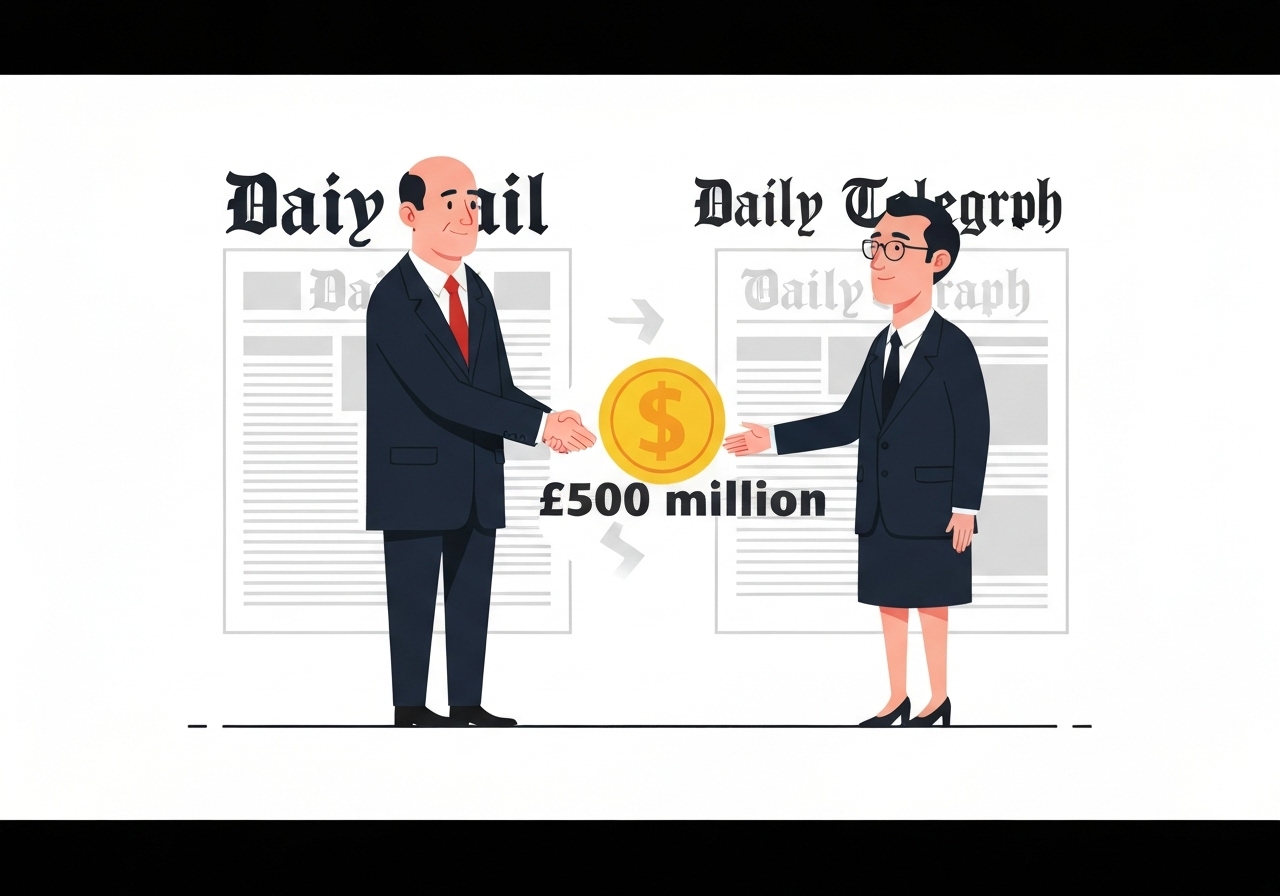
The Daily Mail and General Trust (DMGT) has reached agreement to buy the Daily and Sunday Telegraph titles for £500m in a transaction announced today, with the parties saying they expect a swift completion. The deal, struck with RedBird IMI — a joint venture linked to the UAE and US private equity RedBird Capital Partners — remains subject to regulatory review by Culture Secretary Lisa Nandy under the public interest and foreign influence rules. DMGT says the Telegraph will remain editorially independent and that funding does not include foreign state capital; regulators and political figures have already flagged scrutiny. If approved, the acquisition would fold the Telegraph into DMGT’s stable alongside titles such as the i, Metro and New Scientist while promising newsroom investment.
Key takeaways
- DMGT has agreed terms to acquire the Daily and Sunday Telegraph for £500m; the companies say they expect the transaction to be finalised quickly.
- The agreement involves RedBird IMI, a JV tied to RedBird Capital and UAE interests; RedBird’s earlier, separate bid collapsed last week.
- Culture Secretary Lisa Nandy will review the sale under the UK public interest and foreign state influence media merger regimes.
- DMGT states the financing structure contains no foreign state capital and insists the Telegraph will remain editorially independent from other DMGT titles.
- DMGT chairman Lord Rothermere signalled plans to invest in the newsroom and expand the Telegraph’s global reach, notably in the US market.
- Opposition voices, including Lib Dem peers, called for close competition and plurality checks to avoid excessive concentration of media influence.
- The Telegraph has been in a period of uncertainty for more than two years since RedBird IMI paid off debts owed by the Barclay family.
Background
The Telegraph group entered a prolonged ownership limbo more than two years ago when a consortium led by RedBird IMI cleared debts held by the Barclay family with an eye to eventual control. Political and regulatory concern followed previous takeover attempts because of the involvement of Abu Dhabi-related finance; a law change now limits foreign sovereign stakes in newspapers to a maximum of 15%.
RedBird’s initial approach was rebuffed amid questions over sovereign influence, and the consortium later paused its pursuit after facing both political scrutiny and internal newsroom resistance, according to company statements and industry reporting. DMGT, owner of the Daily Mail and a portfolio of other magazines and papers, had not previously held the Telegraph, making this a significant consolidation within the UK national press landscape.
Main event
DMGT and RedBird IMI announced they had entered focused discussions and reached a deal for the Telegraph titles valued at £500m. Both parties said they will submit documentation to the Culture Secretary and relevant competition authorities for review under existing media merger and national security frameworks.
DMGT chairman Lord Rothermere framed the move as offering certainty to staff and as a chance to strengthen the Telegraph’s resources; he emphasised an intention to back editor Chris Evans with additional investment for the newsroom and digital expansion. Company statements stressed the absence of foreign state capital in the deal’s funding structure as central to their case for regulatory approval.
Political reaction was immediate. The Liberal Democrats’ business spokesperson in the Lords urged rigorous examination by competition regulators to guard against excessive agenda-setting power in too few hands, while government sources confirmed the sale will be assessed for public-interest implications.
Analysis & implications
Consolidation of the Telegraph under DMGT would reshape the UK media ownership map by bringing two of Britain’s most influential national newsbrands closer together under a single corporate umbrella. Economies of scale may aid digital subscription growth and newsroom investment, but the balance between commercial efficiencies and editorial plurality will be central to regulator scrutiny.
DMGT’s promise of editorial independence will be tested in practice. Regulators typically weigh structural safeguards, editorial firewalls and governance arrangements when assessing whether ownership changes threaten editorial autonomy or market competition; the company’s published commitments will be examined alongside enforceable remedies if approved.
For readers and advertisers, the immediate commercial impact could include cross-platform subscription offers, shared technology and broader international distribution, particularly if DMGT pursues RedBird’s stated plan to expand Telegraph reach in the US. However, combining resources may also reduce diversity of investment models across the industry, raising longer-term plurality questions.
Politically, the case will be a bellwether for how the UK applies its tighter foreign investment rules to high-profile media assets. A quick clearance would signal regulatory confidence in deal structures that exclude sovereign capital, while a protracted review or conditions could set precedents for future transactions involving overseas-linked investors.
| Event | When | Note |
|---|---|---|
| RedBird IMI cleared Telegraph debts | Over two years ago | Put consortium in a position to pursue ownership |
| RedBird’s own takeover bid collapsed | Last week | Reportedly influenced by political and newsroom factors |
| DMGT/RedBird IMI reach agreement | Today | £500m acquisition announced, subject to ministerial and competition review |
The short table above highlights the recent sequence: debt clearance, a failed bid, and now a DMGT agreement. Contextualising these steps helps explain why regulators and political actors are focused on timing, financing and editorial safeguards rather than price alone.
Reactions & quotes
We have moved quickly to provide certainty for Telegraph staff and to back editorial investment while respecting its editorial remit.
Lord Rothermere / DMGT (company statement)
DMGT framed the purchase as stabilising and resource-enhancing. The company highlighted plans to strengthen the newsroom and develop the Telegraph brand globally, particularly in digital subscriptions.
The agreement will be submitted to the secretary of state and follows swift engagement between the parties.
Spokesperson, RedBird IMI (company statement)
RedBird’s spokesman emphasised the speed of the negotiations and signalled cooperation with the ministerial review process while avoiding commentary on its prior withdrawal.
Ending uncertainty around the Telegraph’s ownership is welcome, but concentration of agenda-setting power must be examined closely.
Chris Fox, Liberal Democrat Lords spokesperson
Opposition voices urged competition authorities to scrutinise market effects and ensure consumers and rival publishers are protected from undue concentration.
Unconfirmed
- Exact timetable for regulatory sign-off: parties say they expect a quick conclusion, but no formal clearance date has been published.
- The precise contractual mechanisms that DMGT will use to guarantee editorial independence have not been made public in full.
- The role that negative coverage from the current Telegraph newsroom played in RedBird’s earlier withdrawal is reported but not officially corroborated by independent documentation.
- Any remedies or conditions the Culture Secretary or competition authorities might impose remain speculative until formal filings are published.
Bottom line
The proposed £500m acquisition would bring the Telegraph titles into DMGT’s wider media portfolio and promises newsroom investment and global expansion ambitions. Its success depends on convincing regulators that the funding is free of foreign state capital and that robust safeguards will preserve editorial independence and market plurality.
How ministers and competition authorities balance those arguments will shape both the outcome of this deal and broader precedent for future media takeovers involving overseas-linked investors. Readers, advertisers and rivals should watch forthcoming filings and any conditional remedies closely — they will determine the transaction’s practical impact on editorial autonomy and the competitive landscape.
Sources
- BBC News (UK public broadcaster; news report summarising company statements and political reactions)